Traits age asynchronously in wild Seychelles warblers
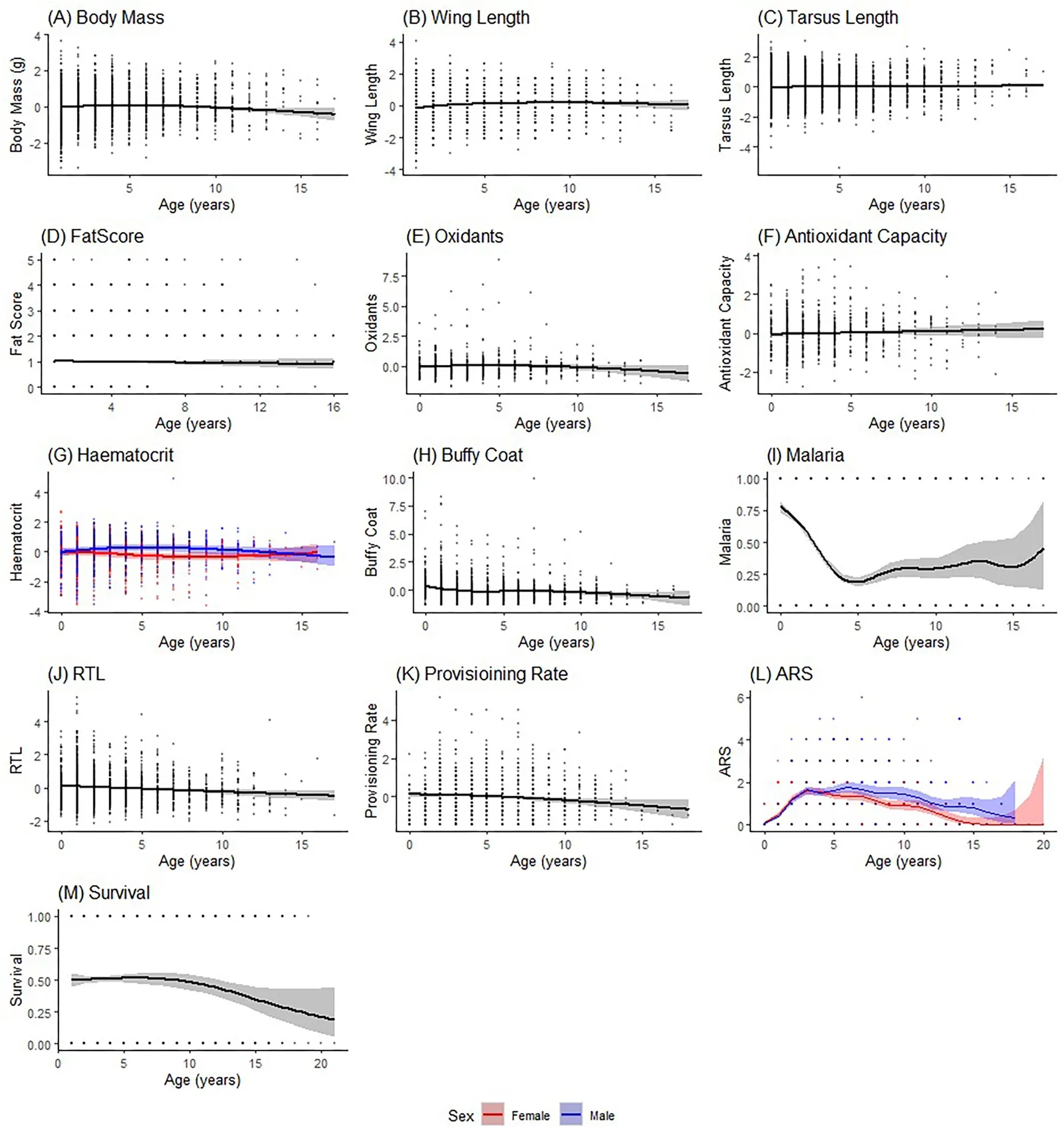
Across 13 traits tracked over four decades in wild Seychelles warblers, only five showed age-related declines, with no evidence of synchronized aging among them.
Evolution Letters
In a wild population of Seychelles warblers (Acrocephalus sechellensis), researchers tracked 13 reproductive, behavioral, physiological, and morphological traits using data collected between 1981 and 2022. They modeled individual aging trajectories to determine whether distinct traits senesce synchronously. Only five traits showed significant age-related declines: body mass, telomere length, offspring provisioning rate, annual survival probability, and female annual reproductive success. Eight traits, including wing length, tarsus length, and immune markers, did not deteriorate with age. When the authors tested whether traits with similar trajectory shapes covaried within individuals, the correlation between body mass and provisioning rate was low (−0.03178), providing no evidence that traits decline together.
Why it matters
Classical evolutionary theories predicted that natural selection should synchronize senescence across an organism's traits. These findings instead support newer asynchronous aging models, demonstrating that distinct behavioral, physiological, and fitness-related functions decline on separate timelines.
Caveats
The study was conducted in a single, closed island bird population and may not directly generalize to other species. Additionally, direct statistical tests of within-individual synchrony were restricted to the few traits that exhibited both age-related declines and matching trajectory shapes.
The paper
Asynchrony of ageing among traits in a wild bird population
University of East Anglia · University of Groningen
Evolution Letters · 21 Jul 2026

