Benzene exposure links to higher thyroid dysfunction risk
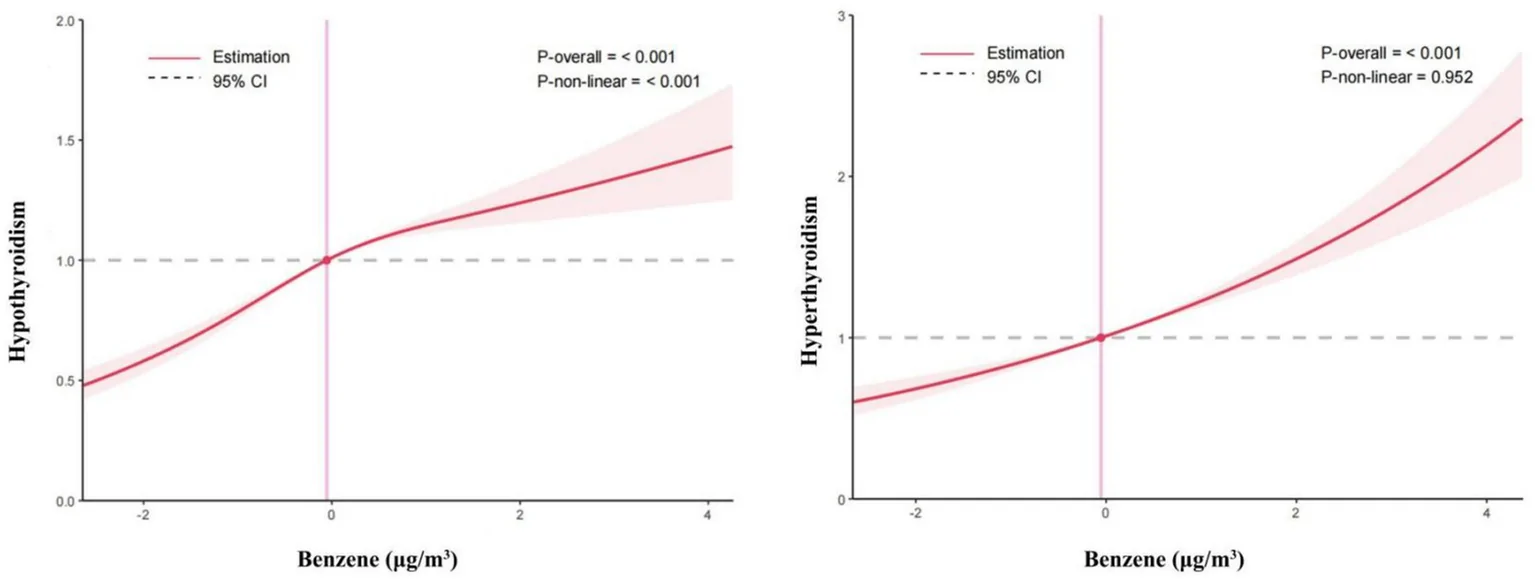
Each 1 μg/m³ increase in ambient benzene was linked to hazard ratios of 1.19 for hypothyroidism and 1.21 for hyperthyroidism.
Frontiers in Public Health
In a study of 385,130 UK Biobank participants aged 40 to 69 years, researchers investigated whether long-term exposure to ambient benzene affects thyroid health and biological aging. Over a median follow-up of 13.68 years, investigators tracked incident thyroid dysfunction against residential benzene concentrations. Each 1 μg/m³ rise in benzene was linked to hazard ratios of 1.19 for hypothyroidism and 1.21 for hyperthyroidism. Comparing the highest to lowest benzene quartiles, hazard ratios reached 1.58 for hypothyroidism and 1.60 for hyperthyroidism. In 314,204 participants with PhenoAge measurements, accelerated biological aging showed an additive interaction with benzene exposure on hypothyroidism risk and mediated 3.07% of the hyperthyroidism risk.
Why it matters
The findings indicate that environmental pollutants may disrupt endocrine function partly by speeding up multisystem biological decline. They also show that an older biological age can compound vulnerability to low-level chemical exposures.
Caveats
The observational design cannot establish direct causation, and exposure was modeled from residential addresses rather than direct personal monitoring. Relying on hospital inpatient records for diagnoses may also have overlooked milder outpatient cases.
The paper
Wuhan University of Science and Technology
Frontiers in Public Health · 17 Sep 2026