Hobby engagement links to lower functional disability risk
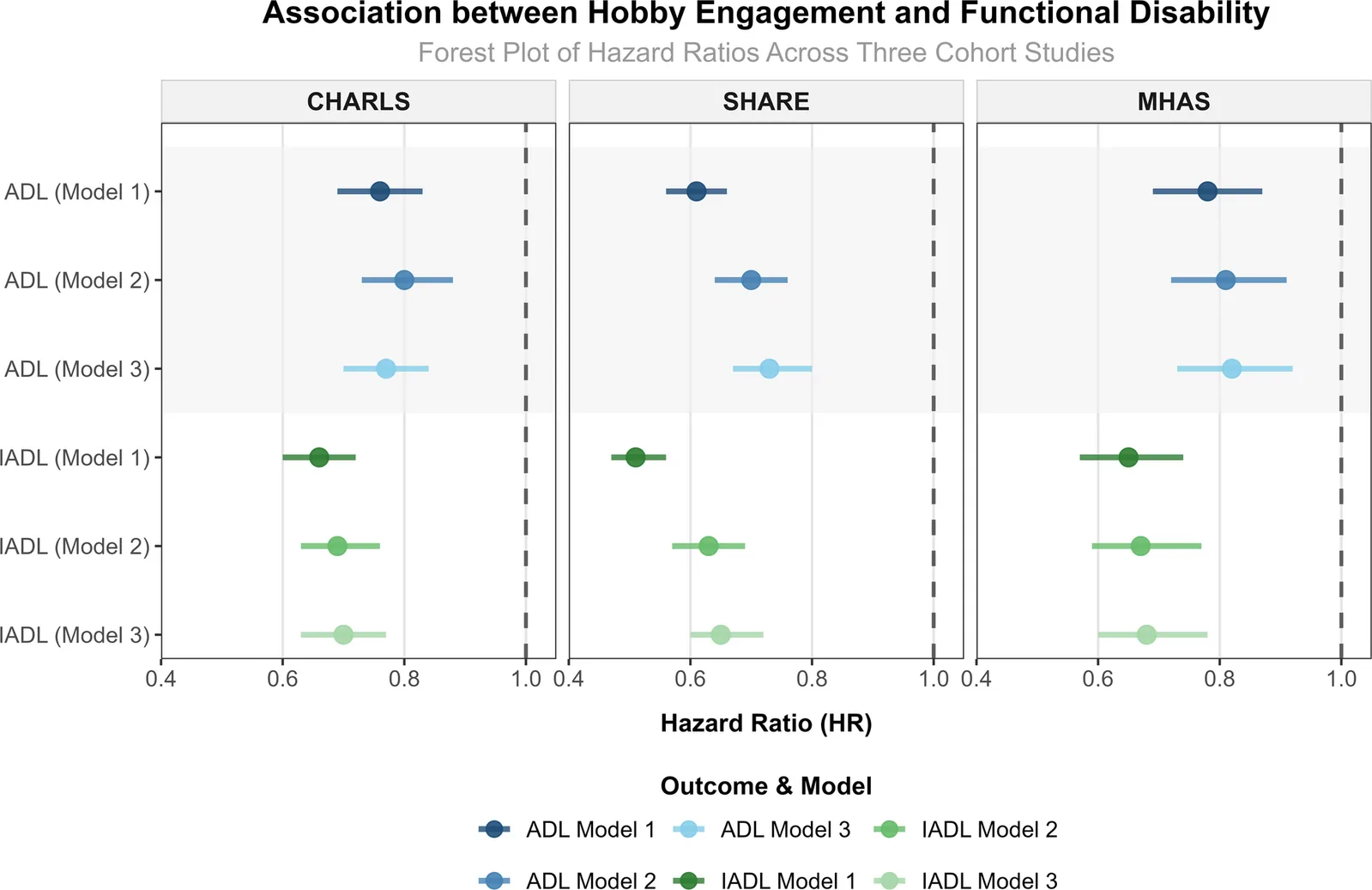
Across cohorts in China, Europe, and Mexico, hobby engagement lowered ADL disability hazard ratios to between 0.73 and 0.82, partly mediated by reduced depressive symptoms.
BMC Public Health
Researchers analyzed human participants across three longitudinal aging cohorts: the China Health and Retirement Longitudinal Study, the Survey of Health, Ageing and Retirement in Europe, and the Mexican Health and Aging Study. Participants self-reported hobby engagement and depressive symptoms, while researchers tracked functional disability through activities of daily living (ADL) and instrumental activities of daily living (IADL). Hobby engagement was associated with a reduced risk of ADL disability (hazard ratios of 0.77 in China, 0.73 in Europe, and 0.82 in Mexico) and IADL disability (hazard ratios of 0.70, 0.65, and 0.68, respectively). It also tracked with slower annual rates of functional decline across all cohorts. Depressive symptoms partially mediated this relationship, explaining 21.05% to 32.25% of the association for ADL disability and 12.53% to 14.52% for IADL disability.
Why it matters
Maintaining functional independence is a central objective in healthy aging and longevity research. These findings demonstrate that behavioral interventions and lifestyle habits may protect physical function partly by supporting mental health.
Caveats
The findings come from observational cohort studies and cannot prove cause and effect. Both hobby engagement and depressive symptoms were self-reported by participants.
The paper
Wuhan Children's Hospital · Wuhan University
BMC Public Health · 8 Sep 2026