Advanced CKM syndrome is linked to higher suicide risk
In over 4.6 million Korean adults followed for 10.11 years, stage 3 and 4 CKM syndrome carried hazard ratios of 1.328 and 1.319 for suicidal death.
Journal of Affective Disorders
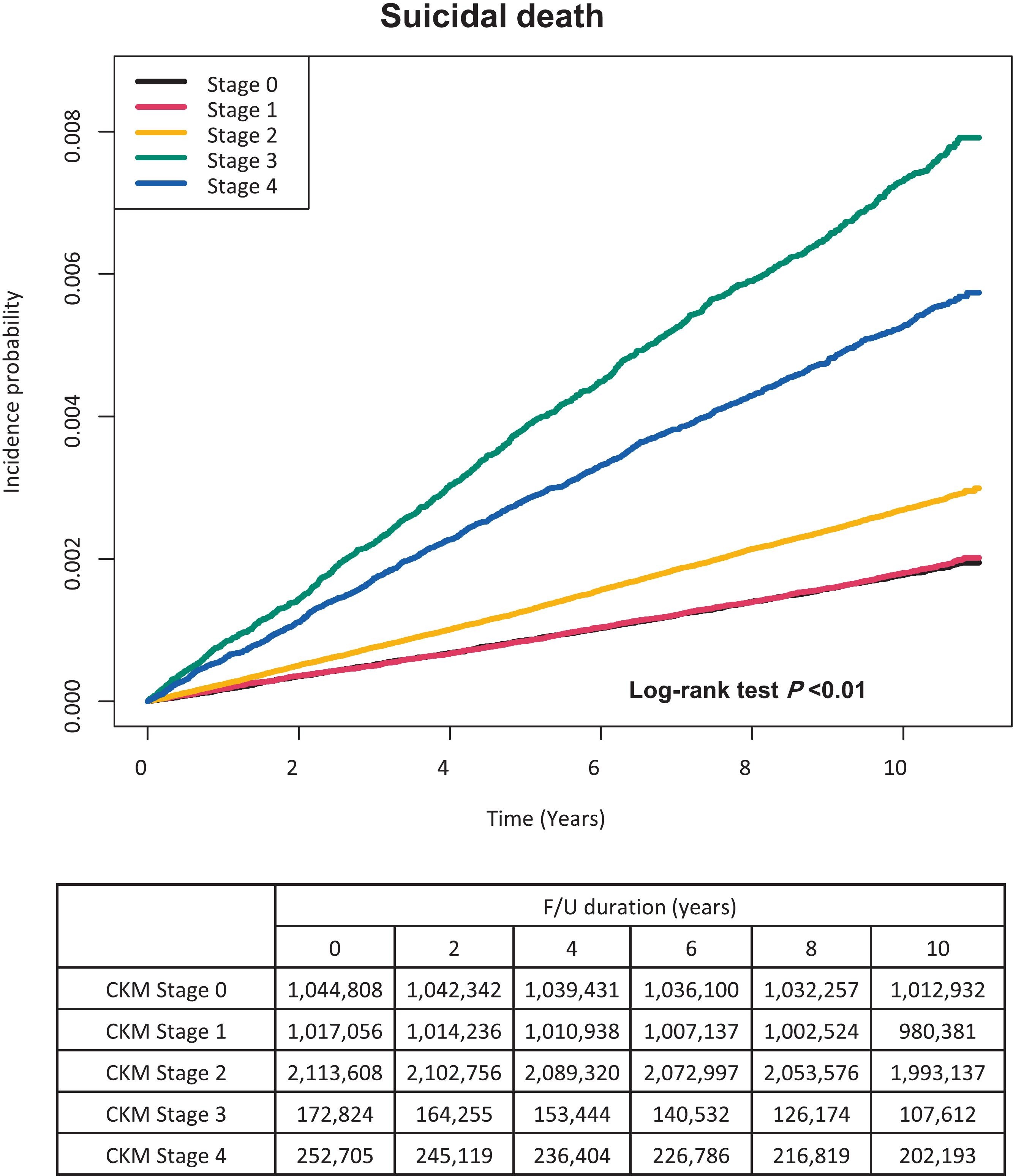
In a nationwide cohort of 4,601,001 Korean adults from the Korean National Health Insurance Service database, researchers examined whether the Cardiovascular-Kidney-Metabolic (CKM) syndrome framework associates with suicide-related mortality. Participants were categorized into CKM stages 0 through 4 and followed for a median of 10.11 years, during which 12,034 suicidal deaths occurred.
After adjusting for clinicodemographic variables, comorbidities, and claims-based psychiatric diagnoses, advanced CKM stages correlated with increased risk of suicidal death, yielding adjusted hazard ratios of 1.328 for stage 3 and 1.319 for stage 4. In Fine-Gray models accounting for non-suicide death as a competing event, associations remained significant, with subdistribution hazard ratios of 1.199 for stage 3 and 1.246 for stage 4. Exploratory subgroup analyses showed the association was most pronounced in adults aged 20 to 39 and in individuals without a claims-based diagnosis of depression.
Why it matters
Cardiometabolic and renal dysfunctions frequently co-occur as multi-organ conditions driven by systemic physiological decline. Connecting this integrated CKM framework to psychiatric outcomes demonstrates how multi-system metabolic and vascular pathology relates to behavioral health.
Caveats
The observational design relies on routine national health insurance claims data from a single country and cannot prove a causal relationship between CKM syndrome progression and suicide.
The paper
Cardiovascular-Kidney-Metabolic syndrome and suicidal death in a nationwide cohort study
Show 14 more authors
Jaeik Oh, Minsang Kim, Jung Hun Koh, Jin Kyung Kwon, Jeong Min Cho, Seong Geun Kim, Sehyun Jung, Semin Cho, Soojin Lee, Eunjeong Kang, Yaerim Kim, Kwon Wook Joo, Kyungdo Han, Sehoon Park,Inje University Busan Paik Hospital · Seoul National University
Journal of Affective Disorders · 1 Oct 2026