Deep learning matches experts in scoring aortic valve calcium
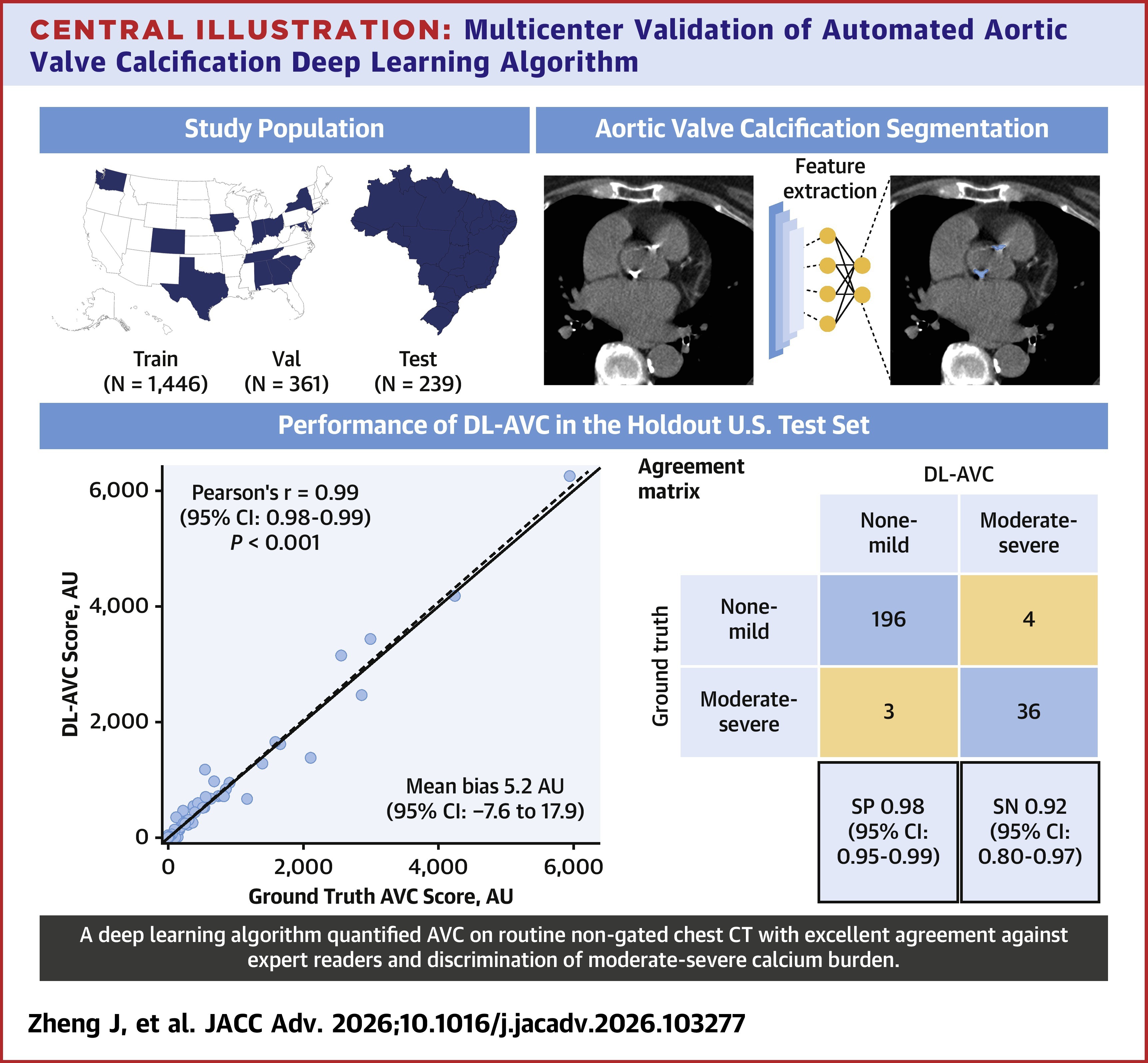
Algorithm scores correlated strongly with expert assessments at r = 0.99, identifying moderate-to-severe aortic stenosis with 0.92 sensitivity and 0.98 specificity.
JACC Advances
In nongated chest CT scans from patients across 33 sites in the United States and Brazil, an automated deep learning algorithm accurately quantified aortic valve calcification. Researchers trained a convolutional neural network on 1,446 scans, validated it on 361, and evaluated performance on a separate holdout set of 239 scans collected between 2021 and 2024. Manual segmentations independently verified by at least two board-certified radiologists served as reference standards. The algorithm-estimated Agatston scores correlated closely with expert assessments (r = 0.99; 95% CI: 0.98-0.99; P < 0.001) with minimal bias on Bland-Altman analysis (mean difference: 5.2 AU). When detecting high calcium burden linked to moderate-to-severe aortic stenosis, the algorithm showed 0.92 sensitivity and 0.98 specificity, with consistent performance across demographic subgroups and technical CT parameters.
Why it matters
Aortic valve calcification is a primary driver of age-related aortic stenosis that often goes unquantified on routine imaging. Automated scoring could allow opportunistic detection of progressive cardiovascular degeneration during standard clinical scans without extra radiation or costs.
Caveats
The final evaluation was conducted on a retrospective holdout set of 239 scans. Prospective studies remain necessary to evaluate whether implementing the automated algorithm improves patient clinical outcomes.
The paper
Show 8 more authors
Jo Ann Efobi, William Fuller Fearon, Paul A. Heidenreich, Nishith Khandwala, David Joel Maron, Felipe Morais, Fátima Rodríguez, David Eng,Cardiovascular Institute of the South · VA Palo Alto Health Care System
JACC Advances · 23 Sep 2026