Language model multimorbidity score predicts mortality in adults
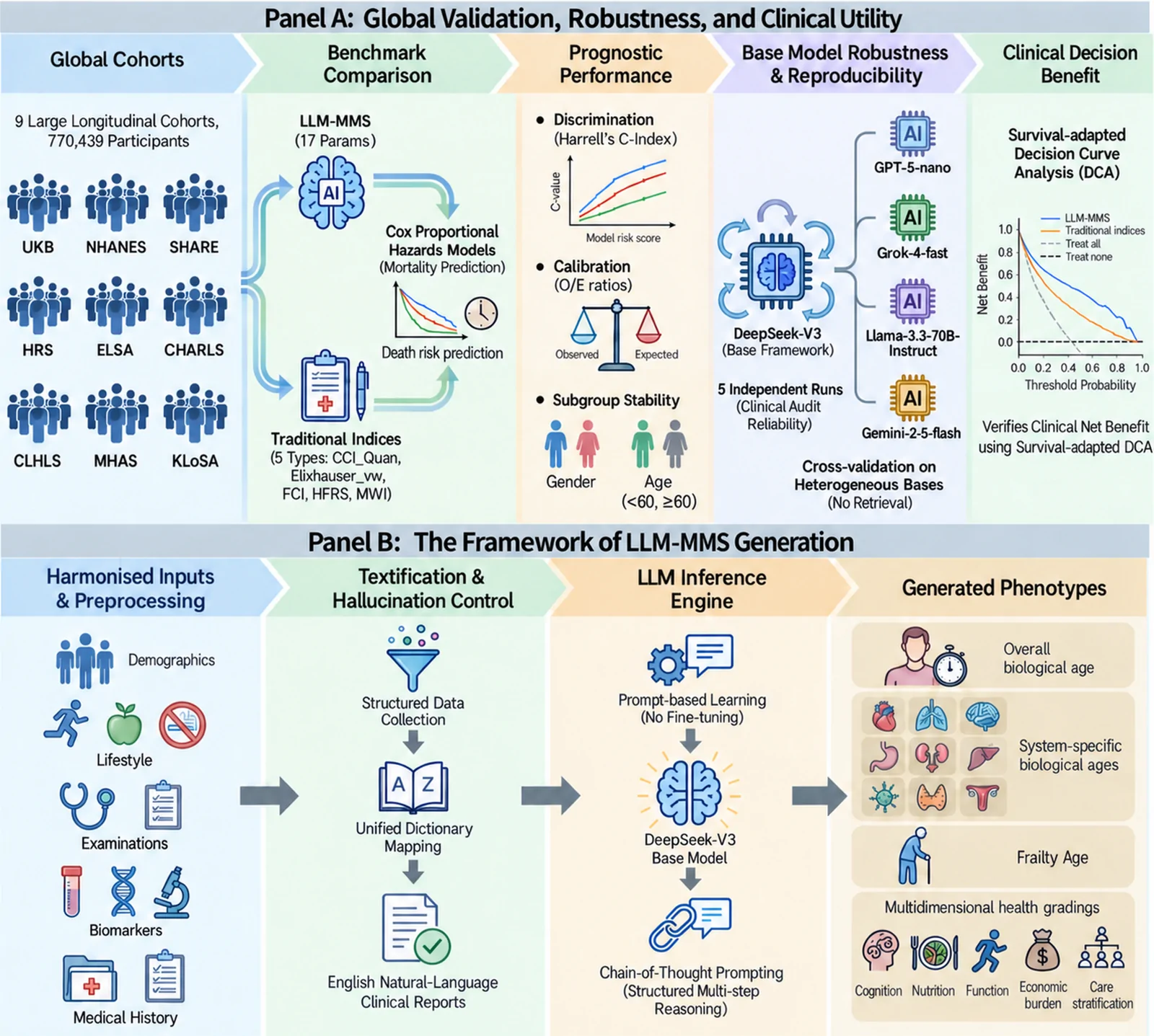
Across eight external cohorts, the score yielded C-indices of 0.67 to 0.86, outperforming recalibrated conventional comorbidity indices by absolute gains of 0.12 to 0.21.
Cyborg and Bionic Systems
In 770,439 adults from nine international longitudinal cohorts, researchers evaluated a large-language-model-based multimorbidity score (LLM-MMS) to predict all-cause mortality. The team converted harmonized health data into standardized natural-language narratives without model fine-tuning, using DeepSeek-V3 to estimate organ-specific biological ages, frailty age, and multidimensional health gradings. In the UK Biobank derivation cohort, the score achieved a C-index of 0.81, outperforming traditional comorbidity measures and raw-variable survival algorithms. Across eight external cohorts, LLM-MMS maintained discrimination with C-indices from 0.67 to 0.86 and observed-to-expected ratios between 0.94 and 1.04. Discrimination held across sexes and age groups, including adults under 60. Proteomic analyses linked higher score risk to elevated inflammatory and cellular-stress markers, such as GDF15, FGF21, and IL6.
Why it matters
The findings show that large language models can synthesize diverse routine clinical data into organ-specific biological ages and multimorbidity phenotypes without cohort-specific retraining. This approach captures systemic physiological decline and inflammatory pathways more effectively than static comorbidity indices across diverse populations.
Caveats
The analysis relied on observational cohorts with variable baseline disease definitions, missing data rates, and follow-up intervals ranging from 2.1 to 15.7 years. Furthermore, decision-curve analyses revealed attenuated or negative clinical net benefit at low threshold probabilities in two cohorts.
The paper
Show 28 more authors
Zixian Xie, Yijian Lin, Jihao Qi, Yiwen Cai, 何永轩, Yaowen Liang, Yiling Chen, Suzheng Zhao, Ziqiu Cheng, Fayuan Wu, Haonan Zhao, Xinhao Liang, Kaiqi Zhang, Yuanlin Yuan, Jingchun Ni, Xiaoyao Lei, Liangyi Yao, Yuanqin Liu, Zishan Huang, Dianhan Lin, Weiqiang Yin, Hengrui Liang, Zhihua Guo, Qiu Wei, Feiying He, Mingyang Jiang, Nanshan Zhong, Qiong Liang,First Affiliated Hospital of Guangzhou Medical University
Cyborg and Bionic Systems · 30 Sep 2026