Physical performance predicts fracture risk in older adults
In older men, a five-variable physical model beat FRAX without bone scans, raising 10-year fracture discrimination by an area under the curve of 0.052.
Calcified Tissue International
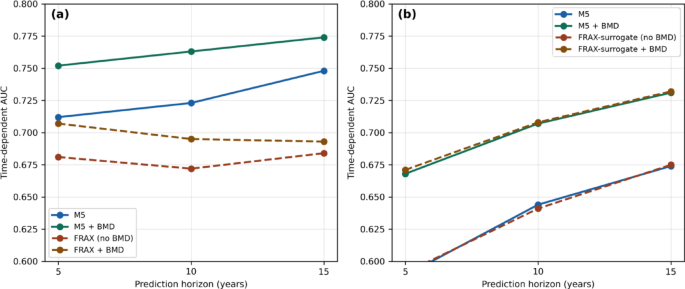
In community-dwelling older men and women, researchers evaluated whether an imaging-free model based on physical performance could predict 10-year fracture risk. The M5 model uses age, body-mass index, grip strength, gait speed, and chair-stand rate. The team analyzed data from 5,994 men in the Osteoporotic Fractures in Men Study and 9,704 women in the Study of Osteoporotic Fractures with adjudicated incident major osteoporotic fractures. In men, M5 discriminated 10-year fracture risk better than FRAX without bone mineral density, yielding an AUC increase of 0.052, and performed similarly to FRAX with bone mineral density. In women, M5 did not differ significantly from a FRAX-surrogate comparator. Across both cohorts, adding bone mineral density measurements to the models yielded the highest discrimination.
Why it matters
Measures of physical performance track functional musculoskeletal decline and can gauge fracture vulnerability in older adults when bone densitometry is inaccessible.
Caveats
The findings require external validation because M5 was developed within these study cohorts, does not replace measured bone mineral density, and relied on a surrogate comparator rather than licensed FRAX scores in women.
The paper
University of Algarve · Centro de Ciências do Mar do Algarve
Calcified Tissue International · 1 Oct 2026