Functional mobility and cardiometabolic multimorbidity: Evidence from the China health and retirement longitudinal study
Declared no competing interests
Abstract
BACKGROUND: Population ageing has increased the burden of cardiometabolic multimorbidity (CMM), defined as the presence of two or more cardiometabolic diseases. Functional mobility is a marker of systemic ageing and adverse health outcomes, but its association with CMM remains unclear among Chinese adults. METHODS: Data were from 16,032 adults aged ≥45 years in the China Health and Retirement Longitudinal Study (2011-2018). Functional limitation was assessed using Activities of Daily Living and a seven-item mobility scale. The primary exposure was a standardised composite score based on the equal-weighted average of the two standardised indicators. PCA-derived, ADL-only, mobility-only, and Winsorised composite scores were examined in sensitivity analyses. Cross-sectional associations were estimated using multivariable logistic regression, and longitudinal associations using generalised estimating equations with time-varying covariates. RESULTS: Higher functional limitation was consistently associated with increased odds of CMM. In cross-sectional analyses, each standard-deviation increment in the functional limitation composite score was associated with 46% higher odds of CMM (odds ratio = 1.46; 95% confidence interval: 1.35-1.58; p < 0.001). In longitudinal analyses with time-varying covariates, the corresponding increase was 37% (odds ratio = 1.37; 95% confidence interval: 1.28-1.46; p < 0.001). A graded pattern was also observed across functional limitation tertiles. CONCLUSIONS: Poorer functional mobility was associated with CMM among middle-aged and older adults in China in both cross-sectional and longitudinal analyses. Simple functional assessments may help characterize groups with greater cardiometabolic burden and may be useful in clinical assessment and monitoring in ageing populations.
From the paper
- Participants
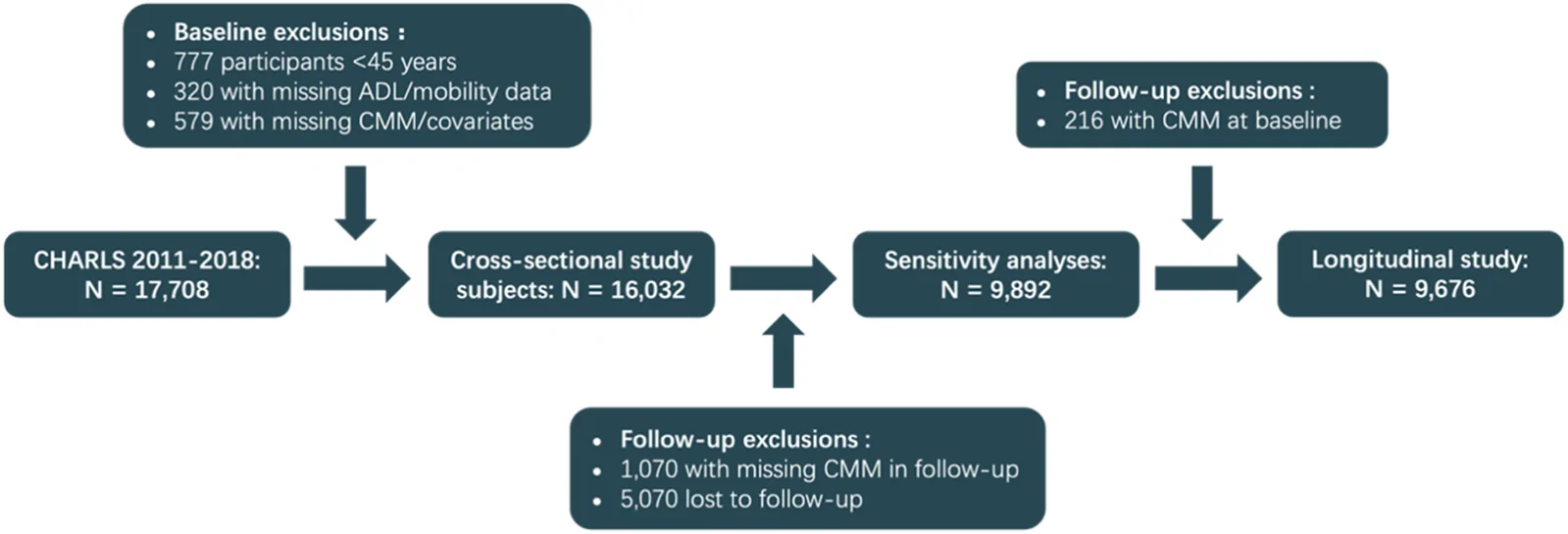
At baseline, a total of 16,032 participants were included in the analytic sample, comprising 15,620 individuals without cardiometabolic multimorbidity (CMM) and 412 individuals with CMM.
Results, Descriptive characteristics of the study population
- Result
Each one-standard-deviation increase in the composite score was associated with higher odds of CMM (OR = 1.46, 95% CI: 1.35–1.58, p < 0.001).
- Limitation
Because health conditions were identified from self-reported information, recall error and disease misclassification may have occurred.
Quoted word for word from the full text on PubMed Central.
- Cardiometabolic multimorbidity
- Activities of Daily Living
- Functional limitation composite score
- Mobility scale
- Humans
The paper
University of Nottingham Ningbo China
Journal of Multimorbidity and Comorbidity, 16 Sep 2026