An enzyme prolonged DNA damage signals in mouse cells
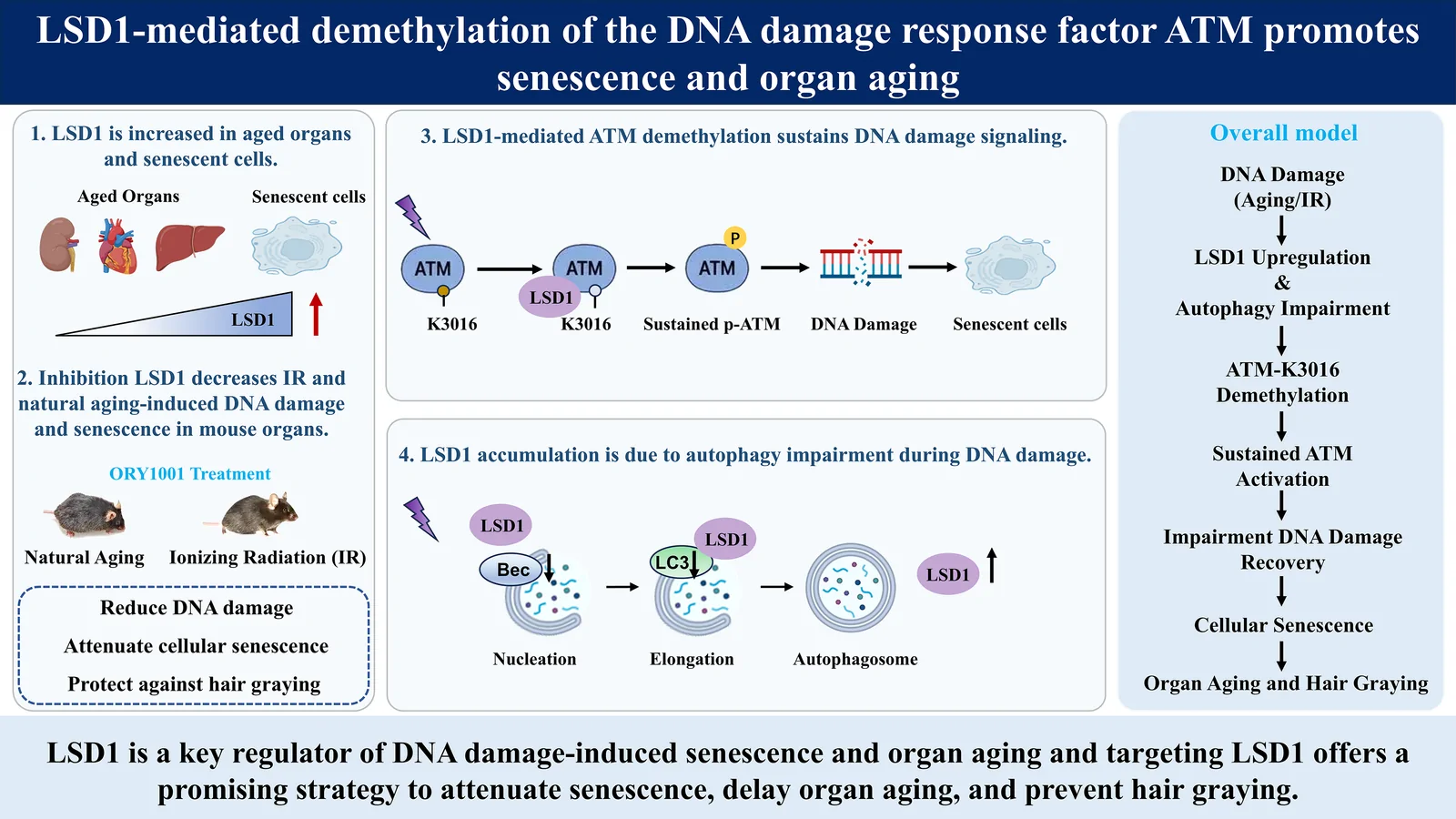
In experiments with mouse cells grown in the lab, the enzyme removed a chemical tag from a protein that coordinates the response to DNA damage.
Limit: Selective mutants separating LSD1's histone and nonhistone effects were missing
Edited by Boris Djordjevic · AgingResearch.News
In experiments in mice of both sexes and mouse cells grown in the lab, researchers studied LSD1, an enzyme that removes chemical tags from proteins. LSD1 protein levels were higher in organs from 20–22-month-old mice than in those from 2-month-old mice. In mouse cells, LSD1 removed a chemical tag from ATM, a protein that coordinates the response to DNA damage. This sustained damage signaling and promoted senescence, a state in which cells stop dividing.
The researchers also exposed 10-week-old C57BL/6J mice to a single radiation dose of 7 grays. They injected the LSD1-blocking drug ORY-1001 at 0.04 milligrams per kilogram every other day for eight weeks, comparing it with a control solution. The drug reduced DNA damage and senescence markers in the kidneys, hearts and livers.
Why it matters
DNA damage can trigger senescence as organs age. The authors suggested that targeting LSD1 may delay organ aging.
Caveats
The radiation experiment modeled damage-induced senescence in young mice, not normal aging. Animal and cell results do not establish benefits for people or effects on lifespan.
The paper
Tongji University; Mayo Clinic
The Journal of Clinical Investigation, Sep 15, 2026, Open access

