Sustained enzyme activity weakened skeletal muscle in mice
In experiments, keeping a signaling enzyme active in young mice reduced muscle force after six weeks, before substantial muscle loss developed.
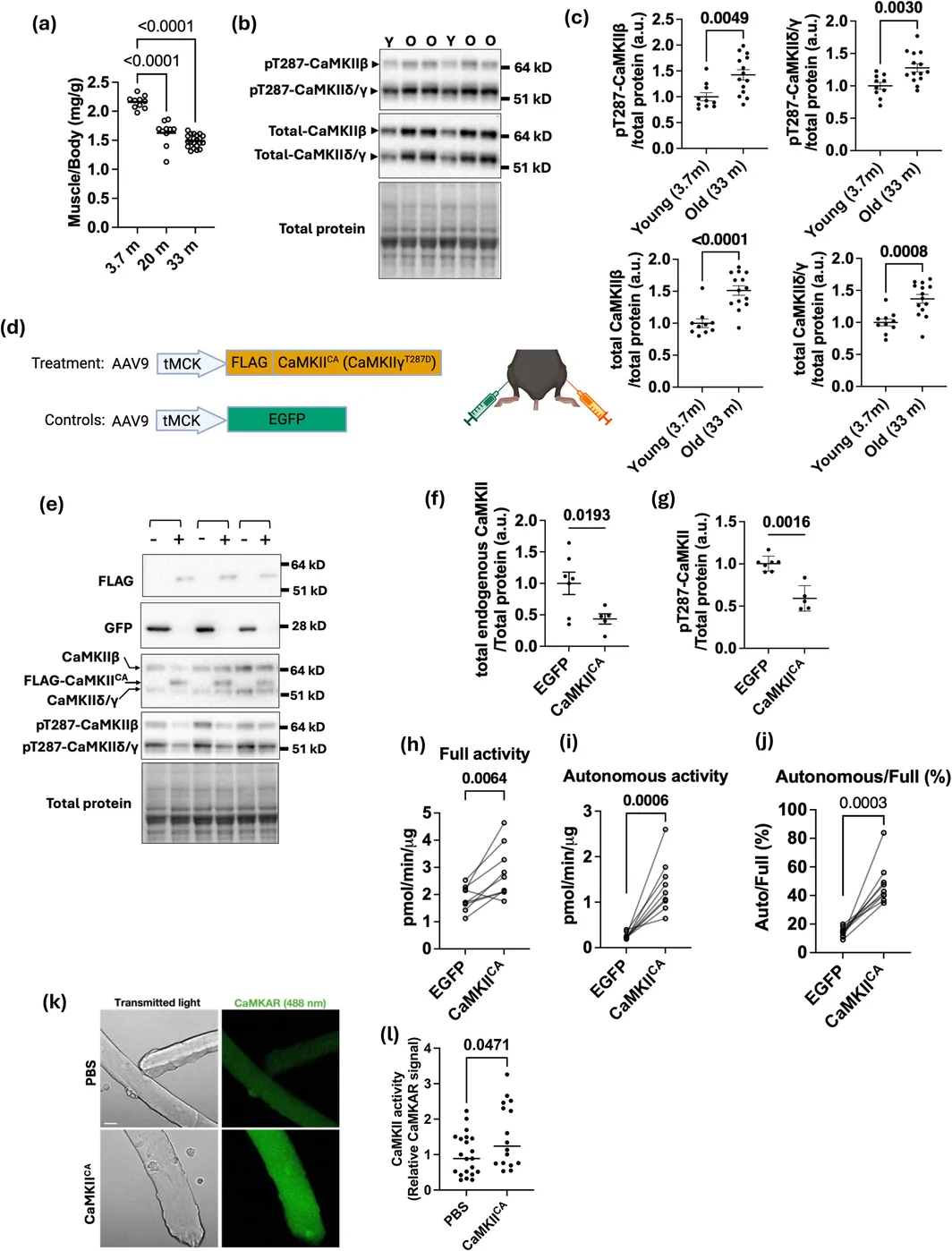
Limit: Engineered CaMKII activation differs from aging muscle in magnitude, duration, isoforms, and cellular distribution
Edited by Boris Djordjevic · AgingResearch.News
In experiments in mice, researchers kept CaMKII, a cell-signaling enzyme, continuously active in one lower-leg muscle of 3.5-month-old animals. They used a virus to deliver the instructions and injected a control virus into the matching muscle in the other leg.
After six weeks, the altered muscles generated less force. At seven weeks, they weighed about 7.0% less than controls, but reduced mass did not account for the weakness. Prolonged activation promoted progressive muscle loss. Sustained activation also disrupted the organization of mitochondria, the cells’ energy-producing structures, and shifted gene activity toward an aged profile. Older mouse muscles contained more CaMKII protein. Conversely, delivering a CaMKII inhibitor to muscles in 21-month-old mice increased force after five weeks without increasing muscle mass.
Why it matters
The work addresses whether muscle signaling that supports adaptation can also contribute to sarcopenia, the age-related loss of muscle strength and mass.
Caveats
The activation experiment used an engineered, continuously active enzyme rather than natural aging. These mouse findings do not establish benefits in people.
From the paper
- Result
Contractile force of CaMKIICA‐expressing muscles remained significantly smaller after normalization to muscle mass (estimate = −0.99, 95% CI [−1.39, −0.59], p = 4.21 × 10⁻⁶, Figure ).
- Limitation
First, constitutively active CaMKIIγ models sustained CaMKII activation but do not reproduce the endogenous magnitude, duration, isoform composition, or subcellular distribution of CaMKII dysregulation in aging muscle.
Quoted word for word from the full text on PubMed Central.


