Cellular senescence as endocrine information failure in aging
Abstract
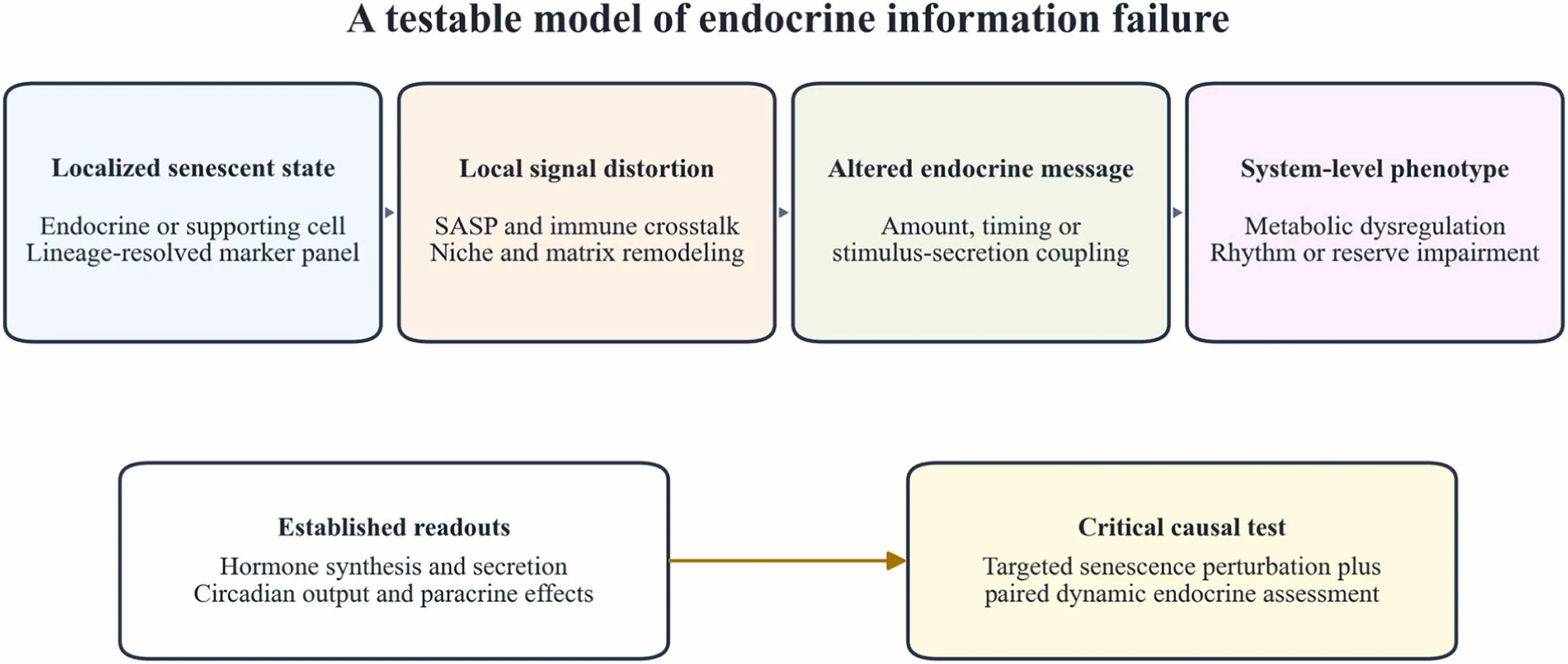
Endocrine organs translate nutrient, stress and circadian cues into hormone outputs that coordinate whole-body physiology. Cellular senescence can distort this communication by changing endocrine-cell identity, stimulus-secretion coupling, secretory timing and local immune or paracrine signaling. Evidence is strongest in pancreatic β-cells and the adrenal zona fasciculata, where composite senescence phenotypes have been linked to endocrine dysfunction and modified by targeted perturbations. β-cell senescence is not uniformly deleterious. Some states retain insulin production, support functional maturation or restrain immune injury, whereas others propagate inflammatory and paracrine dysfunction. Pituitary and thyroid findings support direct but narrower mechanisms, while parathyroid and pineal evidence remains largely downstream or axis level. No single marker identifies endocrine senescence across tissues, and therapeutic evidence remains predominantly preclinical. A state-resolved approach combining lineage localization, multiple senescence domains and dynamic endocrine readouts is needed to identify pathogenic states and evaluate intervention.
The paper
Anhui University of Traditional Chinese Medicine
Ageing Research Reviews, 8 Sep 2026