Hepatic Steatosis and Cardiovascular Risk in Obesity: A 10-Year Follow-Up Study From Childhood Into Young Adulthood
10 years
Abstract
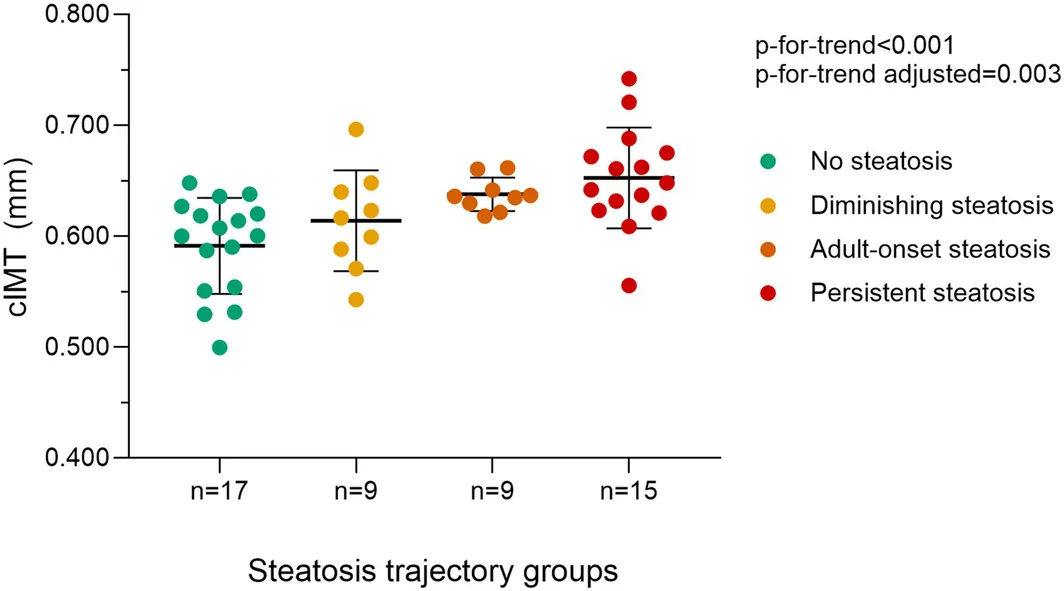
BACKGROUND: The early vascular impact of metabolic dysfunction-associated steatotic liver disease (MASLD) remains unclear. This study examined associations of steatosis in childhood and young adulthood with cardiovascular risk in adulthood. METHODS: Children with severe obesity were investigated for MASLD and cardiovascular risk, with 10-year follow-up. Hepatic steatosis was measured using proton magnetic resonance spectroscopy and cardiovascular risk by ultrasound carotid intima-media thickness (cIMT). Participants were categorised into four trajectory groups based on presence of steatosis in childhood and/or adulthood: 'absent', 'diminishing', 'adult-onset' and 'persistent'. Associations between steatosis (presence and change over time) and cIMT, and between childhood metabolic factors and cIMT progression, were evaluated. RESULTS: Of 52 participants, 46% had steatosis in childhood ('diminishing' or 'persistent'), and 46% in adulthood ('adult-onset' or 'persistent'). Childhood steatosis was not associated with cIMT in adulthood, whereas adulthood steatosis was independently associated with increased cIMT (mean difference 0.035 mm, 95% CI: 0.010-0.060 mm; p-adjusted = 0.008). Mean cIMT at follow-up increased progressively across steatosis trajectory groups; (adjusted p-for-trend = 0.003). Childhood steatosis was the only metabolic factor associated with cIMT progression (β = 0.006, p = 0.030). CONCLUSIONS: Hepatic steatosis in young adulthood is independently associated with increased cardiovascular risk, and childhood steatosis relates to cIMT progression, supporting early MASLD detection and prevention.
From the paper
- Follow-up
The study population comprised 52 of the 119 participants (44%) from the original cohort, with a mean duration of follow‐up of 10.3 years (standard deviation [SD] 1.3).
- Result
Mean cIMT at follow‐up was 0.638 mm (SD 0.048) for participants with childhood steatosis and 0.604 mm (SD 0.045) for those without childhood steatosis (mean difference: 0.034 mm, 95% CI 0.008–0.060 mm; p = 0.012; Table ).
Results, Association Between Childhood Steatosis and cIMT in Young Adulthood
Quoted word for word from the full text on PubMed Central.
- Lipid and ceramide metabolism
- Cardiovascular disease
- Obesity
- Metabolic dysfunction-associated steatotic liver disease
- Carotid intima-media thickness
- Humans
The paper
Emma Kinderziekenhuis; Amsterdam University Medical Centers
Pediatric Obesity, 1 Sep 2026, Open access


