Cardiovascular risk from metabolic burden weakens with age
The hazard ratio for hypertension dropped from 3.60 in adults under 40 to 1.21 in those aged 80 and older over a 4.5-year follow-up.
Our read
Populations- Studied:
- Cohort study in people
- In the record:
- The 2,510th paper on hypertension with results in people; 12,258 on record in all. Its result on cardiovascular disease agrees with 47 of 48 other findings on record; 1 points the other way.
Editor of record: Boris Djordjevic · AgingResearch.News
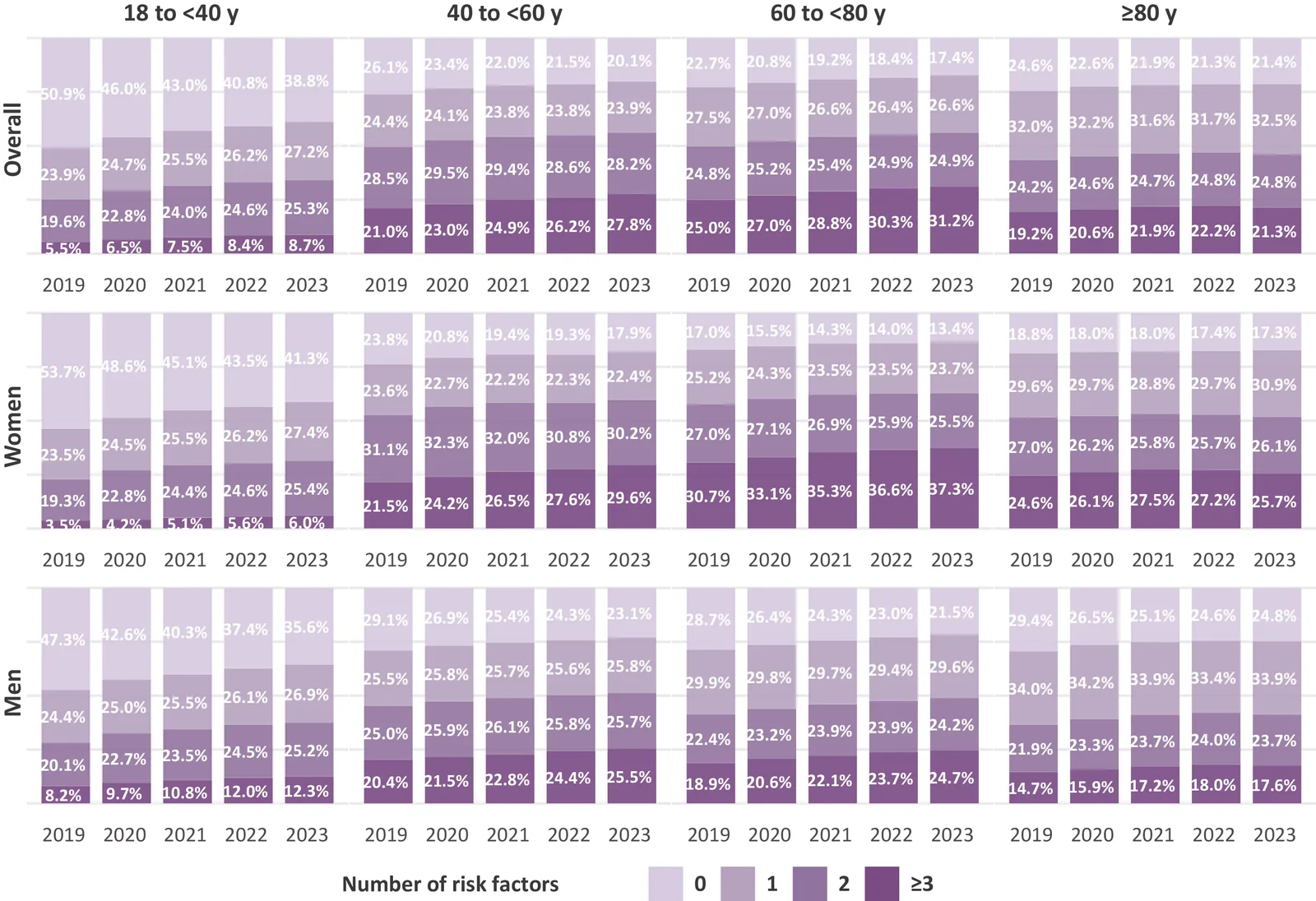
In a prospective cohort of 7,513,828 adults in northwestern China without baseline cardiovascular disease, researchers tracked six metabolic risk factors over a median of 4.5 years. These factors included obesity, hepatic steatosis, hypertension, hyperlipidemia, diabetes, and renal dysfunction across four adult age brackets. Associations between metabolic abnormalities and incident cardiovascular disease were strongest in younger adults and attenuated with advancing age. For hypertension, the hazard ratio declined from 3.60 in people aged 18 to under 40, to 2.12 at ages 40 to under 60, 1.41 at 60 to under 80, and 1.21 in those 80 and older. Obesity accounted for the highest population attributable fraction for cardiovascular disease regardless of age or sex. Moving to a healthier metabolic state within an average of one year was associated with a substantially reduced risk of cardiovascular disease, especially in younger participants.
Why it matters
The findings show that cardiovascular susceptibility to metabolic dysfunction shifts across the adult lifespan, with metabolic insults having a greater relative cardiovascular impact earlier in adulthood.
Caveats
The observational design cannot establish causality, and the cohort was restricted to a single regional population followed for a median duration of 4.5 years.
From the paper
- Participants
… and had missing data on the metabolic risk factors or covariates at the second examination, 3,712,053 participants were included in the analysis on transition in metabolic status and incident CVD (Sample 2).
- Follow-up
During a median follow-up of 4.5 years, 669,995 incident cases of CVD were identified (352,138 in women and 317,857 in men), including 442,120 cases of CHD and 398,300 cases of stroke.
- Result
In the youngest group, hypertension demonstrated the strongest association with risk of CVD (HR = 3.60; 95% CI: 3.47, 3.73), whereas in older groups diabetes showed more evident associations than other metabolic risk factors ( A and ).
Results, Metabolic abnormalities and incidence of cardiovascular disease
- Events by group
For example, achieving control of ≥3 risk factors was associated with a 55% lower risk of CVD in the youngest group, compared to only a 17% risk reduction in the very old group.
Results, Transition of metabolic states and incidence of cardiovascular disease
Quoted word for word from the full text on PubMed Central.
The paper
Soochow University
The Lancet Regional Health Western Pacific, Sep 19, 2026, Open access


Comments
Be the first to comment.