Can physical activity modification mitigate the relationship between adverse childhood experiences and cognitive frailty in middle-aged and older adults? A prospective cohort study
Declared no competing interests
Abstract
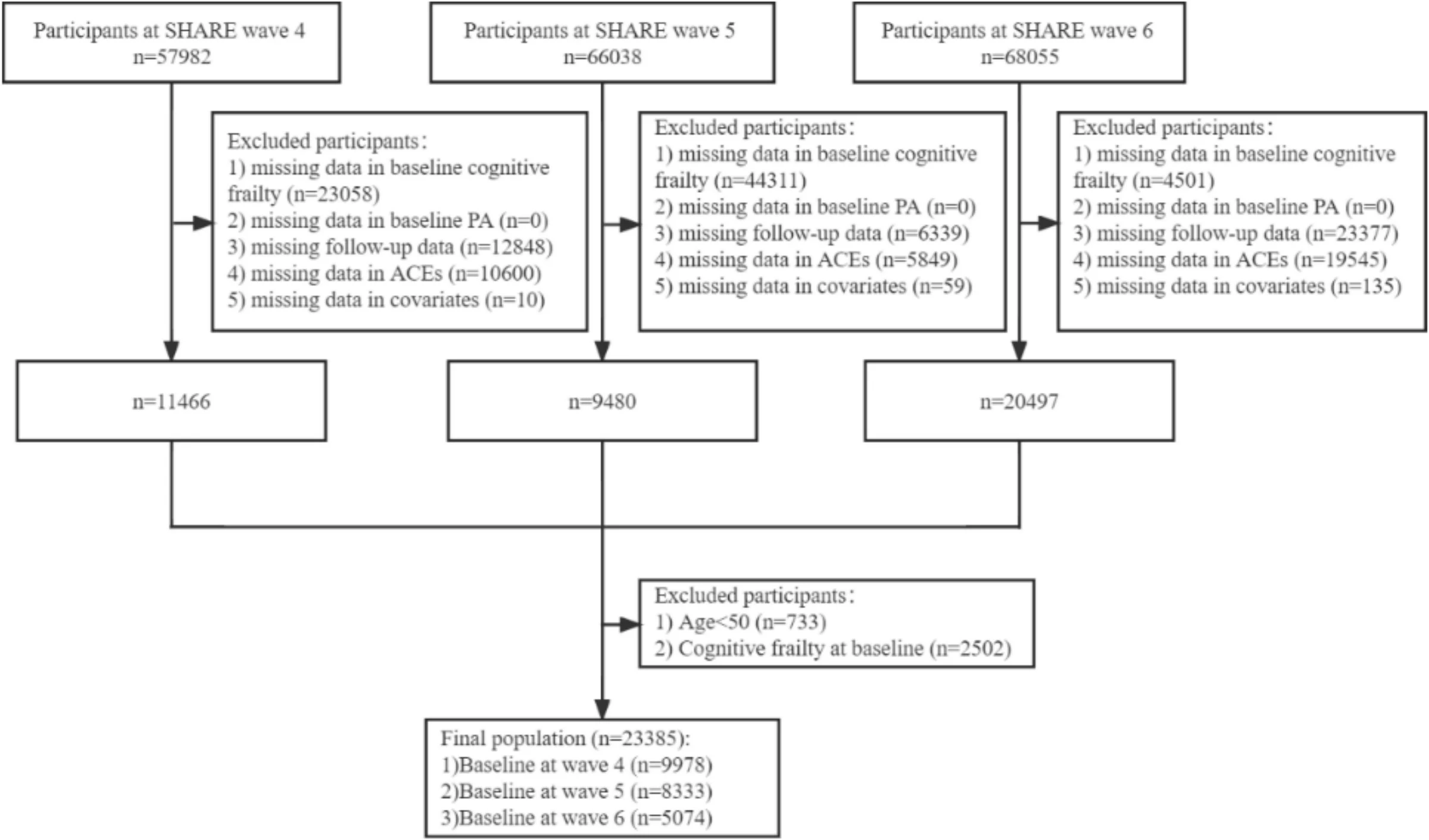
PURPOSE: This study aims to examine the relationship between adverse childhood experiences (ACEs), physical activity (PA), and cognitive frailty (CF). METHODS: Data were obtained from the Survey of Health, Aging, and Retirement in Europe (SHARE). ACEs, PA, and CF were collected through questionnaires and physical measurements. Statistical analyses were conducted using Cox regression models and causal mediation analysis. RESULTS: A total of 23,385 participants were included. After adjusting for all covariates, each additional ACE was associated with a 9% increased risk of CF (HR = 1.09). Conversely, each additional year of sufficient PA was associated with a 25% reduced risk of CF (HR = 0.75). Compared with the I-PA _ I-PA group, the S-PA _ I-PA group (HR = 0.61), the I-PA _ S-PA group (HR = 0.87), and the S-PA _ S-PA group (HR = 0.46) reduced the risk of CF occurrence by 39%, 13%, and 54% respectively. Maintaining sufficient PA for over 6 years significantly mitigated the negative effects of ACEs on CF, particularly in individuals with poor childhood socioeconomic status (HR = 0.59) and poor neighbor quality (HR = 0.45). Mediation analysis indicated that changes in PA and the maintenance of sufficient PA mediated the association between ACEs and CF, with mediation proportions of 11.26% and 23.00%, respectively. CONCLUSION: A higher number of ACEs is associated with an increased risk of CF. However, increasing and maintaining sufficient PA for at least four years reduces this risk. Furthermore, PA can counteract the adverse effects of ACEs on CF.
The paper
Shandong University
General Hospital Psychiatry, 15 Aug 2026