Cell powerhouses differed by eye deposit type in aged macaques
An observational study of retinal tissue from 12 aged rhesus macaques linked two deposit types to different structural changes in cells’ energy-producing machinery.
Edited by Boris Djordjevic · AgingResearch.News
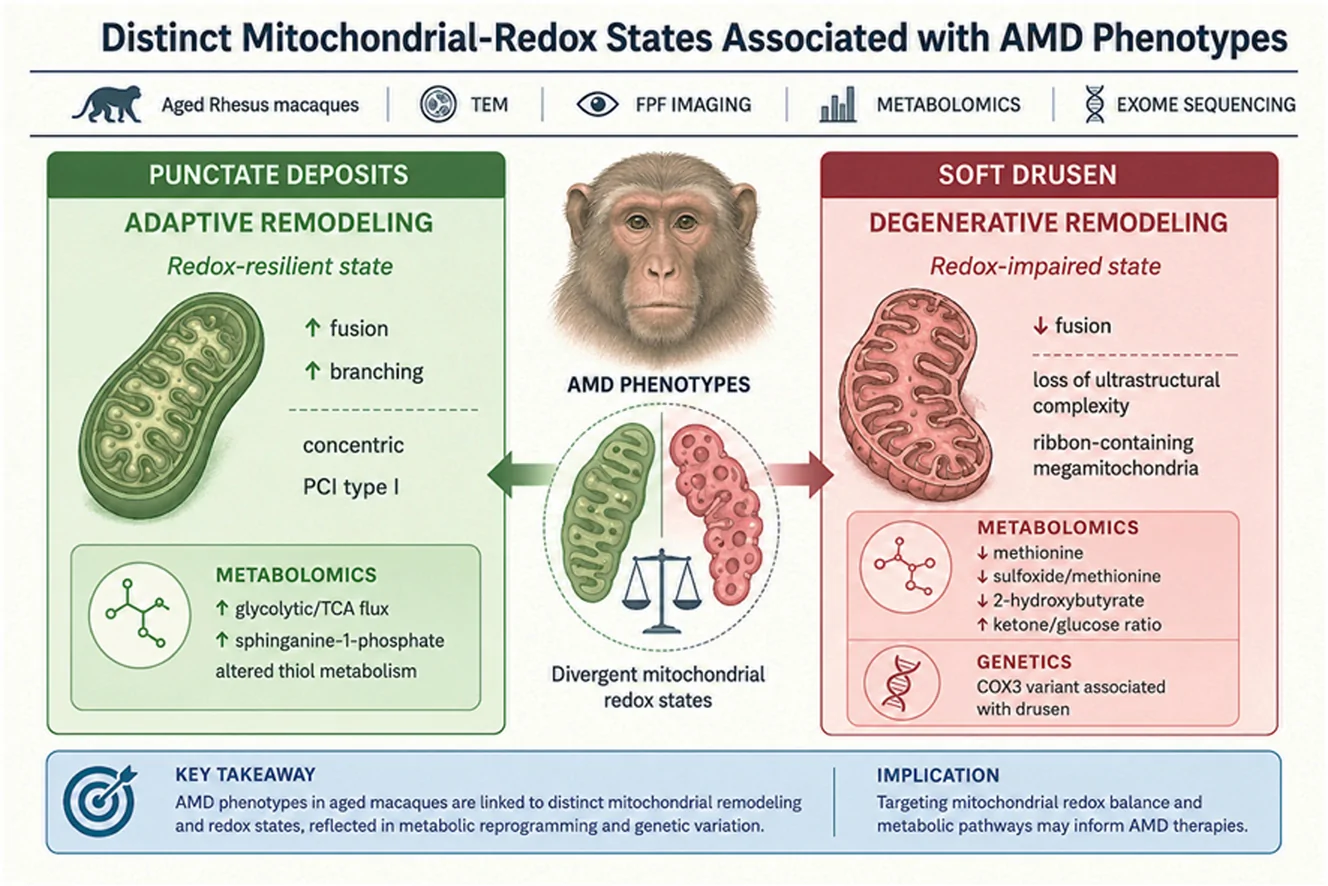
An observational study in aged rhesus macaques linked two types of eye deposits to distinct changes in mitochondria, the energy-producing structures inside cells. Researchers examined retinal support cells from 12 monkeys after death: four with dot-like deposits, three with soft drusen—another deposit type—and five with normal eyes.
Mitochondria near dot-like deposits had more branching and more shapes associated with fusion, or joining together, than in normal eyes. Those near soft drusen had less complex shapes and features consistent with deterioration. The authors suggested these patterns reflected different responses to chronic stress in the retina, the eye’s light-sensing tissue. Imaging in 37 macaques, averaging 23 years old, found more variation in a metabolism-related fluorescence signal in eyes with soft drusen than in controls. Blood analyses also linked the deposit types to different metabolic patterns.
Why it matters
Age-related macular degeneration is associated with disrupted mitochondrial function and oxidative stress, an imbalance between reactive molecules and cellular defenses. The authors offered a framework for investigating these processes in this age-related eye disease.
Caveats
The observational comparisons did not establish causation or test whether the structural changes helped cells adapt. Fluorescence was an indirect measure, not proof of mitochondrial dysfunction or oxidative damage, and the findings came from macaques rather than people.
- Glycolysis
- Mitochondrial fission and fusion
- Oxidative phosphorylation
- Age-related macular degeneration
- Macular degeneration
- Rhesus monkeys
The paper
University of California Davis Medical Center
Redox Biology, Aug 22, 2026, Open access


Comments
Be the first to comment.