Stomach inflammation linked to age-related eye disease
An observational study of 500,000 UK Biobank participants over 13 years linked stomach inflammation to a higher risk of developing age-related macular degeneration.
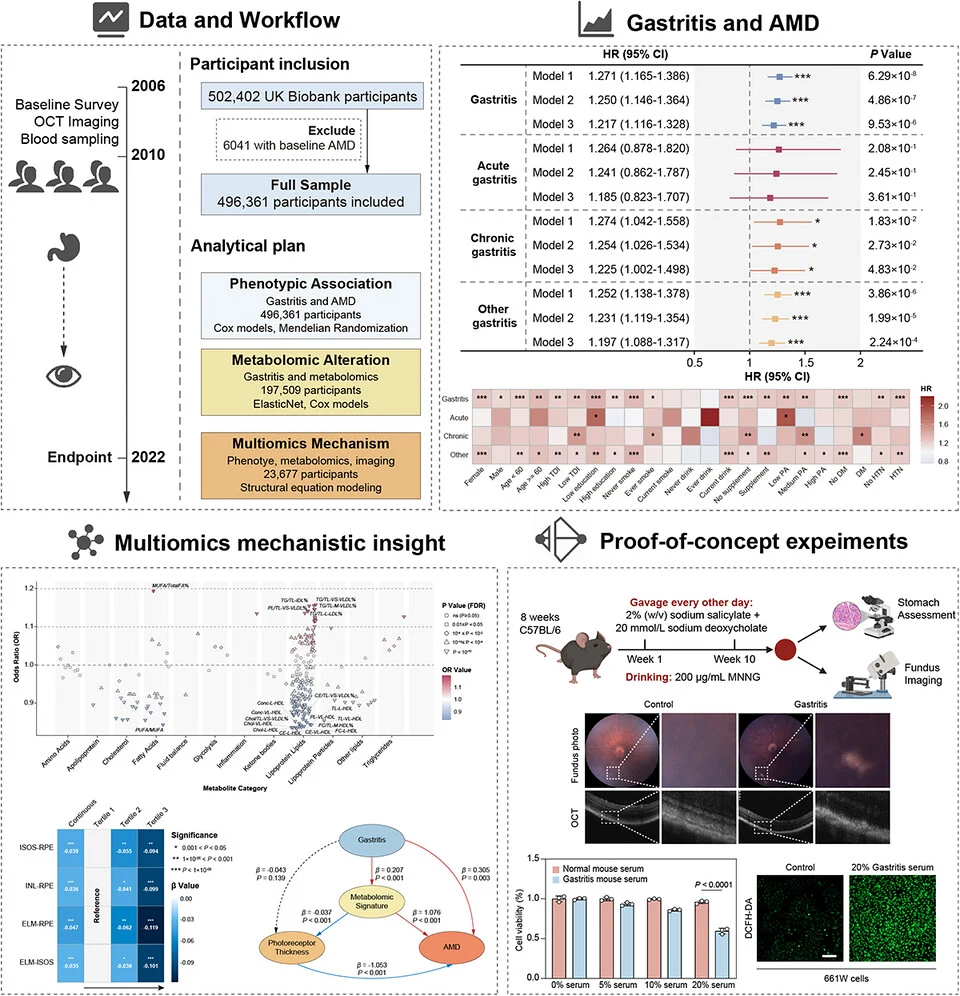
500,000 participants, 13 years
Limit: Medical records can miss early AMD cases and depend on healthcare-seeking behavior
Edited by Boris Djordjevic · AgingResearch.News
Researchers analyzed data from 500,000 UK Biobank participants over 13 years in an observational study. Gastritis, inflammation of the stomach lining, was linked to a higher risk of developing age-related macular degeneration. This disease damages the retina, the light-sensing layer at the back of the eye.
They identified a pattern of 23 blood metabolites, small molecules involved in metabolism, associated with gastritis. Statistical models suggested a potential pathway linking these molecular changes to thinning of photoreceptors, the eye’s light-sensing cells, and development of the disease. In separate experiments, mice with gastritis had reduced retinal thickness.
Why it matters
Age-related macular degeneration is a leading cause of vision impairment. The authors call for intervention studies to test whether managing gastritis could contribute to its prevention.
Caveats
The observational human findings cannot establish that gastritis caused the eye disease or that treating it would prevent it. The abstract does not report the size of the increased risk.
From the paper
- Participants
A total of 496,361 participants from the UKB were enrolled.
- Result
As shown in Figure 1B, baseline gastritis was significantly associated with higher incident AMD risk across all models (model 3: HR = 1.217, 95% CI = [1.116, 1.328], p = 9.53 × 10−).
Quoted word for word from the full text on onlinelibrary.wiley.com.
- Serum from mice with gastritis
- Oxidative stress and ROS signaling
- Age-related macular degeneration
- Gastritis
- Retinal thickness
- Mice
The paper
Second Affiliated Hospital of Zhejiang University
Open Research, Oct 28, 2026, Open access, CC BY
Comments
Be the first to comment.