HRV-anchored autonomic-morphological structured factorization for interpretable multimodal cardiovascular risk prediction
Abstract
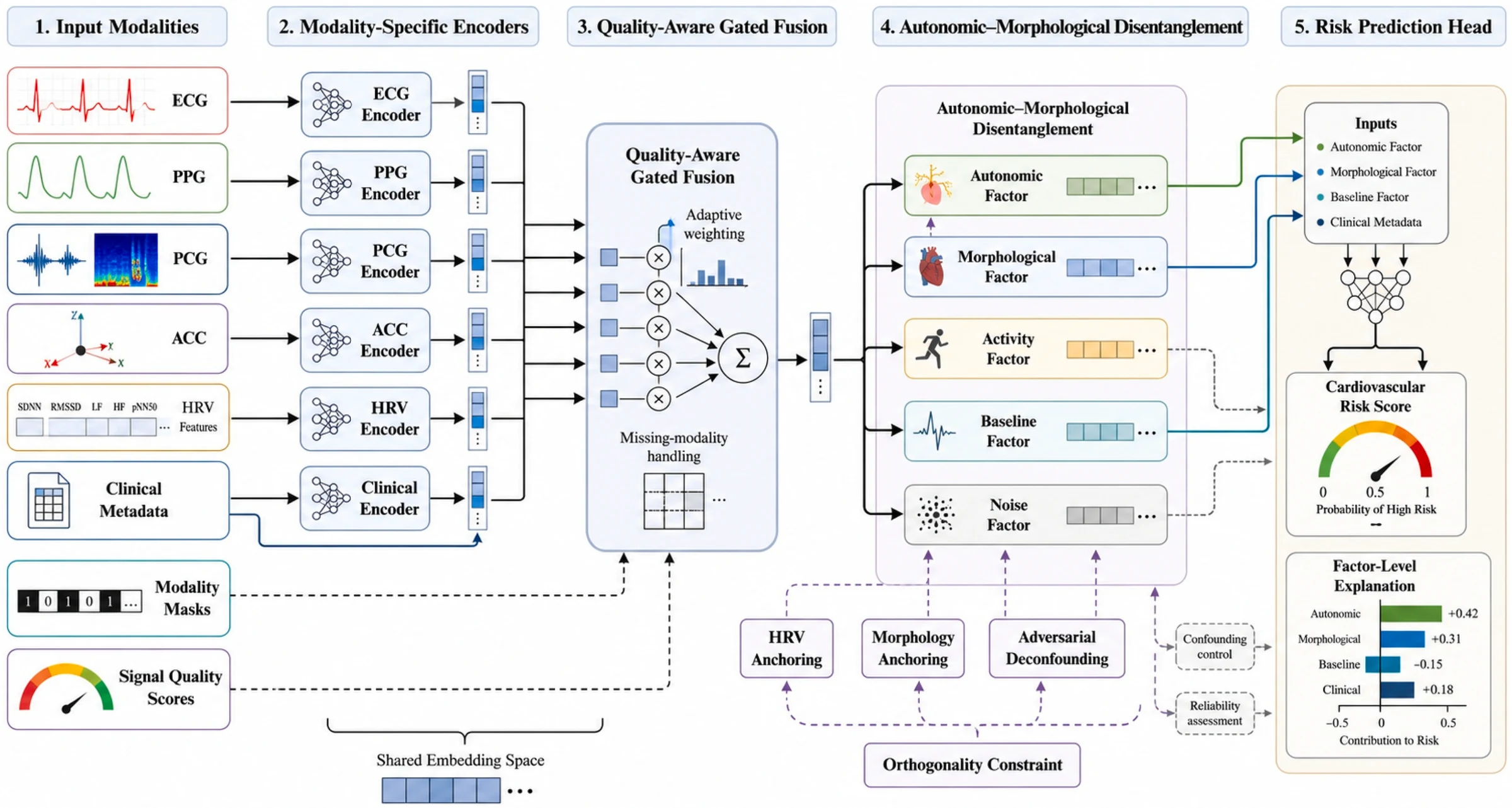
Cardiovascular risk prediction from heterogeneous physiological signals supports early warning in bedside and wearable monitoring, where ECG, PPG, HRV, signal-quality indicators, activity context, and clinical metadata jointly carry evidence of short-term deterioration. However, existing approaches face two limitations: HRV-based models are physiologically interpretable yet cannot represent waveform morphology, whereas conventional multimodal deep models entangle autonomic regulation, cardiovascular morphology, activity-related interference, patient-specific baseline, and acquisition uncertainty in one latent space. We propose AM-DiMNet, an HRV-anchored autonomic-morphological structured factorization framework predicting clinically recorded cardiovascular deterioration within 24 h. In the primary end-to-end cohort, it integrates ECG, PPG, explicit HRV features, movement- and waveform-instability proxies, clinical metadata, modality-availability masks, and signal-quality scores, then factorizes the fused representation into autonomic, morphological, activity, baseline, and noise components via HRV anchoring and quality-aware fusion. Because no public dataset jointly provides all modalities with longitudinal outcomes, PCG is treated as an architecturally compatible optional branch and is assessed only through task-specific component-level morphology experiments, not as an empirically validated contributor to the primary 24-h endpoint. AM-DiMNet attained an AUROC of 0.895, AUPRC of 0.684, Macro-F1 of 0.804, MCC of 0.641, and ECE of 0.036, raising AUROC from 0.786 and AUPRC from 0.503 over HRV-based XGBoost and surpassing attention and modality-dropout fusion in discrimination, calibration, and incomplete-input robustness. The prediction target was a retrospective composite of time-stamped physiological adverse events and care-process-mediated interventions recorded under the clinical practices represented in the source cohort, and should not be interpreted as a policy-invariant estimate of untreated biological deterioration. These results show HRV can act as an interpretable autonomic anchor for calibrated, physiologically structured risk modeling; the latent-factor analyses offer internal, mechanism-consistent evidence rather than causal or clinician-validated explanations.
The paper
University of Aizu; Southwest Forestry University
Computers in Biology and Medicine, 18 Aug 2026


