Integrating dynamic modeling of signaling pathways with subject-specific transcriptomic data to assess breast cancer risk
Abstract
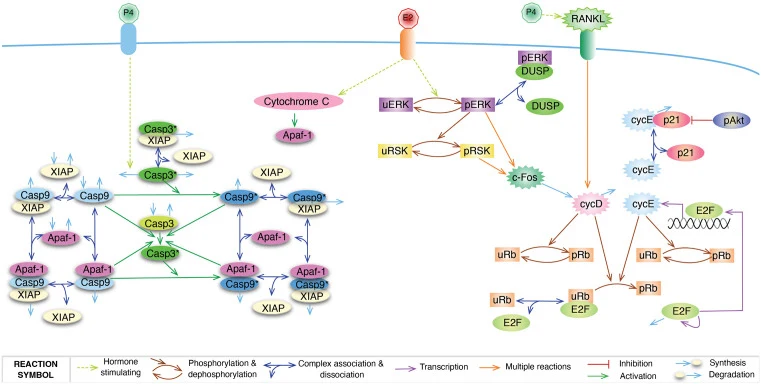
Breast cancer is the most common cancer in women and a leading cause of death. Traditional risk assessment models, such as the Gail model, lack molecular insight, limiting their usefulness for personalized prevention strategies. We developed a computational framework that integrates individual transcriptomic data with dynamic modeling of cell signaling to create personalized models for 30 subjects (including 15 who later developed breast cancer). Using features extracted from the dynamic simulation, we stratified individuals into four risk clusters with significantly different disease-free periods. The highest-risk group had a median disease-free period of 6.05 years, which is significantly shorter than that of the other clusters. This high-risk phenotype was characterized by hyperactive MAPK signaling (high phosphorylated ERK, phosphorylated RSK, and c-Fos). This approach demonstrates that interactions among pathway components provide additional information beyond static gene expression profiles in risk assessment and may serve as a promising tool for guiding personalized prevention strategies.
The paper
King Mongkut's University of Technology Thonburi; Center of Excellence in Theoretical and Computational Science
PLOS One, 13 Aug 2026