Navigation performance in virtual reality-based cognitive assessment games as a candidate digital cognitive marker of hippocampal vulnerability: a scoping review
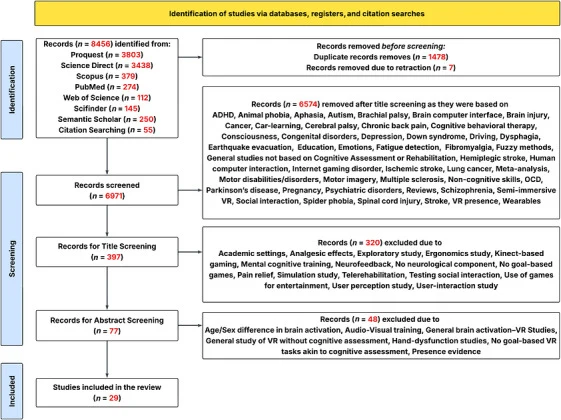
29 neuroimaging studies
Abstract
Virtual reality-based cognitive assessment games (VR-CAGs) are an emerging digital paradigm in dementia and Alzheimer's disease research. Although multiple studies report correlations between VR-CAG performance and standard neuropsychological assessments, clinical adoption remains limited, indicating that behavioral evidence alone is insufficient and that consolidated neuroimaging evidence is required. Existing neuroimaging studies link VR-CAG performance to regional brain activation, volumetric change, and brainwave dynamics, but this evidence remains scattered. We conducted a scoping review of 29 neuroimaging studies on VR-CAGs. Three functional neural systems were associated with VR-CAG performance: the spatial map system, the response system, and the executive control system. Two VR-CAG archetypes - hippocampal-based and adaptive navigation - were identified. A reporting and evaluation checklist is proposed to standardize VR-CAG research. Review findings indicate that VR-CAGs based on allocentric and egocentric tasks may be sensitive to hippocampal health, potentially acting as candidate digital markers of dementia-relevant functional cognitive decline.
- Virtual reality cognitive assessment games
- Alzheimer's disease
- Dementia
- Regional brain activation
- Volumetric change
- Humans
The paper
Birla Institute of Technology and Science, Pilani - Goa Campus
Alzheimer's & Dementia, 10 Aug 2026, Open access