Remote digital test flags cognitive impairment in older adults
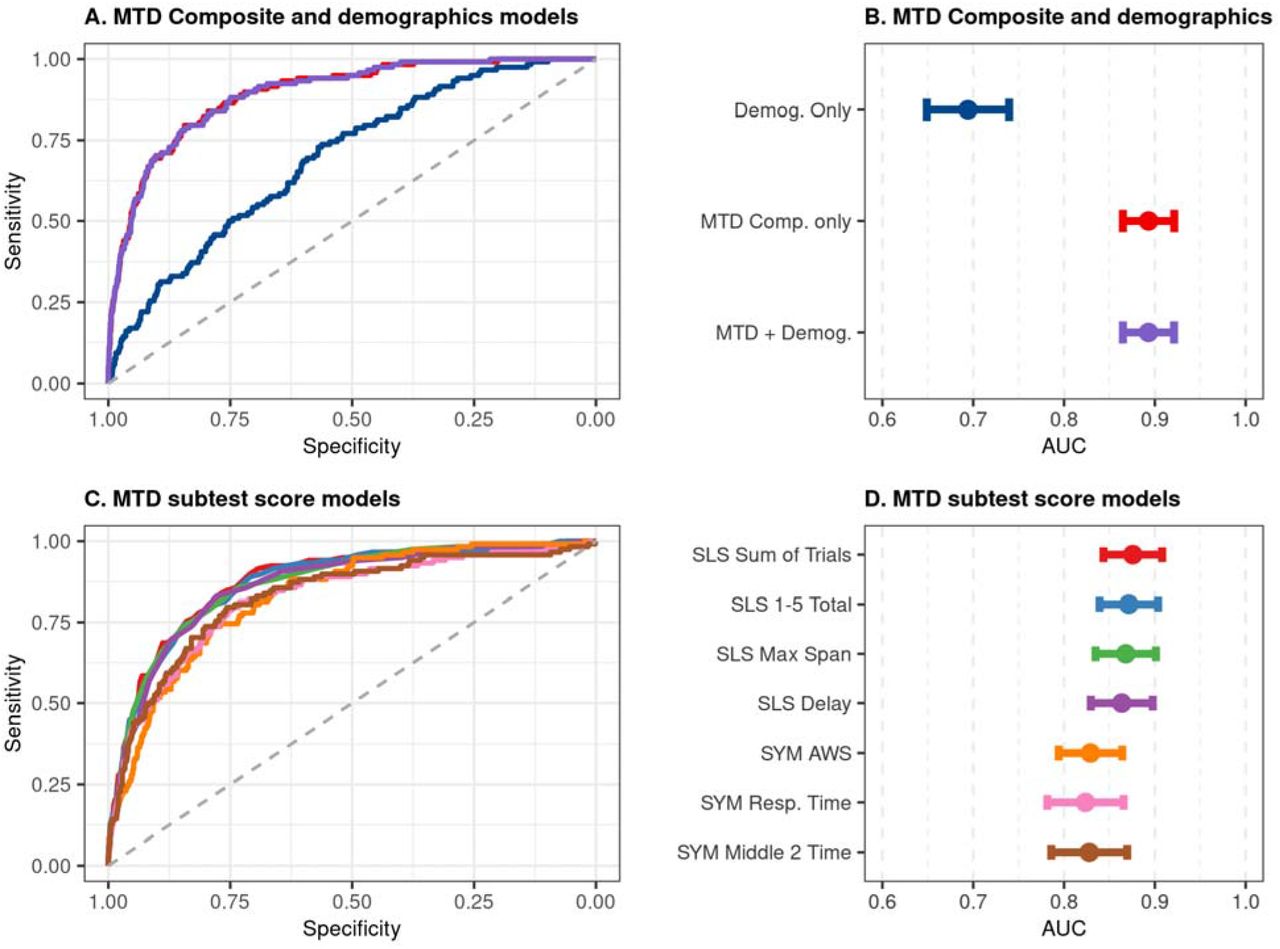
In a study of 2,249 adults, a remote test discriminated cognitive impairment with an AUC of 0.89, rising to 0.95 when confirmed by amyloid biomarkers.
medRxiv
In a preprint study of 2,249 older human adults with an average age of 70, researchers evaluated the Mayo Test Drive, a remote, self-administered digital cognitive assessment battery. The cohort included 2,131 cognitively unimpaired participants and 118 individuals with mild cognitive impairment or mild dementia who completed the assessment remotely. Amyloid- and tau-PET imaging was available for 1,224 participants. The digital tool discriminated cognitively unimpaired adults from impaired participants with an area under the curve of 0.89, and yielded an AUC of 0.88 for mild cognitive impairment alone. Discriminability reached an AUC of 0.95 when comparing amyloid-negative unimpaired individuals to amyloid-positive impaired individuals. For separating amyloid- and tau-negative adults from double-positive individuals, the test achieved an AUC of 0.76, outperforming an estimated Mini-Mental State Examination and matching the in-person Mayo-PACC composite.
Why it matters
Scalable remote screening tools may help detect cognitive impairment and biological markers of Alzheimer's disease without requiring in-person clinic visits. This could facilitate earlier clinical characterization and support recruitment for interventions targeting age-related neurodegeneration.
Caveats
The findings come from an observational cohort reported in a preprint that has not yet undergone peer review. In addition, the participants had a relatively high average educational attainment of 16 years, which may limit generalizability across broader populations.
- Mayo Test Drive
- Mild cognitive impairment
- Dementia
- Amyloid- and tau-PET
- Mini-Mental State Examination
- Humans
The paper
Show 18 more authors
Winnie Z. Fan, Ryan D. Frank, Teresa J. H. Christianson, John L. Stricker, Walter K. Kremers, Mary M Machulda, Paula A. Aduen, John Alexander Lucas, Morgan A. Hughes, Aimee James Karstens, Gregory Scott Day, Christian Lachner, Neill R Graff-Radford, Jason Hassenstab, Michelle M. Mielke, Clifford R. Jack, Bradley F. Boeve, Jonathan Graff-Radford,Mayo Clinic
medRxiv · 25 Sep 2026 · Preprint, not peer-reviewed