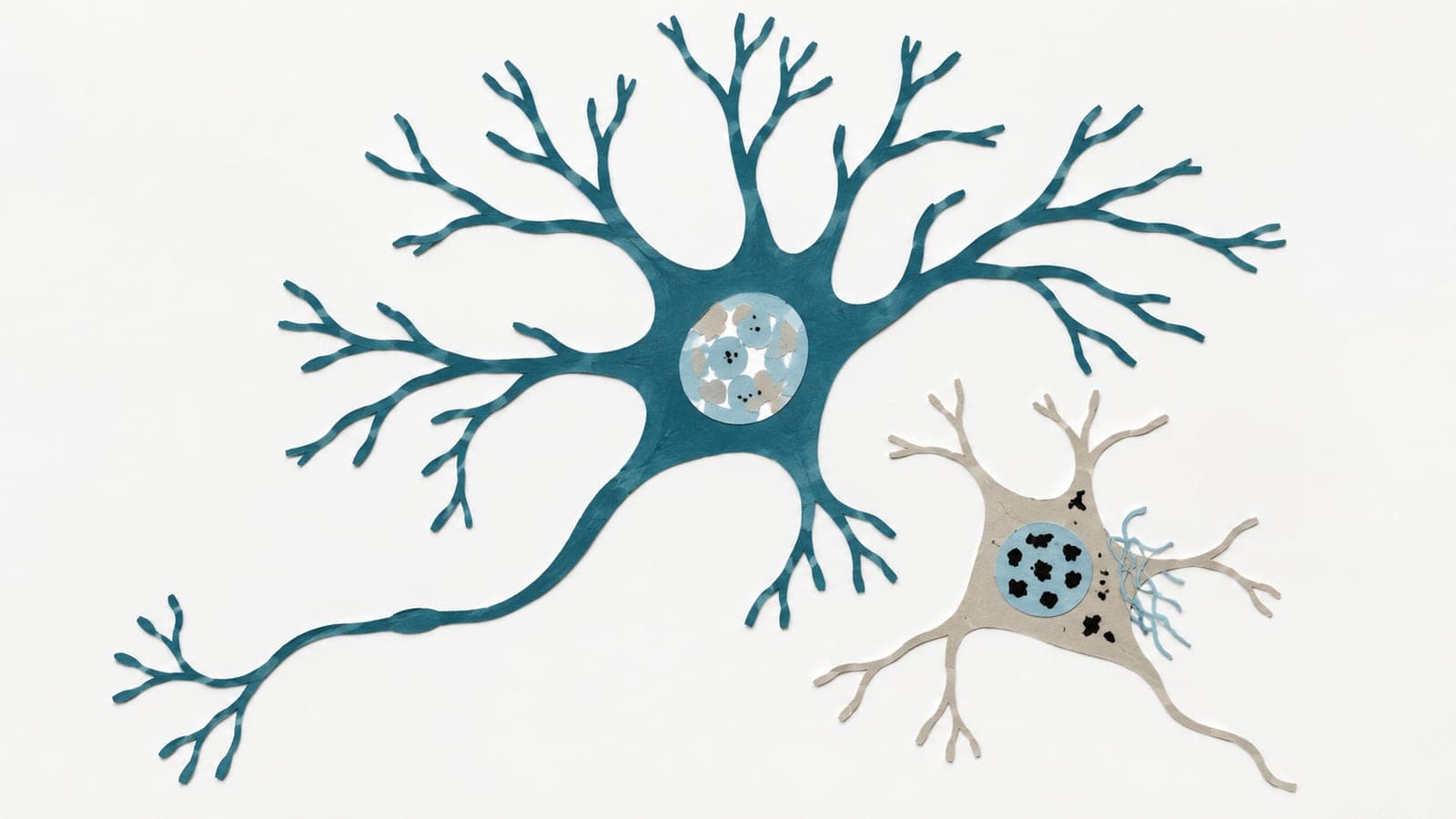
Faulty cholesterol transport linked to DNA damage in mice
Experiments in mice with an inherited cholesterol transport defect found brain inflammation and nerve-cell degeneration; fingolimod reduced both.
Limit: Aging-related gene-activity changes are surrogate markers, not measurements of cells becoming younger
Edited by Boris Djordjevic · AgingResearch.News
Mice carrying a mutation in Npc1, a gene involved in cholesterol transport, developed DNA damage, brain inflammation, nerve-cell degeneration and movement problems in laboratory experiments. The researchers also studied fibroblasts, connective-tissue cells grown from people with Niemann-Pick disease type C. These cells showed widespread DNA breaks and changes in gene activity associated with cellular aging.
Fingolimod reduced brain inflammation and nerve-cell degeneration in the mutant mice. In the patient-derived cells, it shifted disease-associated gene activity toward control patterns. The drug also prolonged lifespan in a separate experiment in aged male mice. The authors describe a pathway linking failed cholesterol transport from lysosomes—the cell’s recycling compartments—to DNA instability and persistent immune activation.
Why it matters
Lysosomal dysfunction features in both aging and neurodegeneration. This disease model helps investigate how a defined cholesterol-transport defect may lead to broader cellular decline.
Caveats
Animal and lab-grown cell experiments do not establish benefits in people, and aging-related gene-activity changes do not show that cells became younger. This preprint has not been peer-reviewed.
The paper
University of Virginia
bioRxiv, Jul 13, 2026, Open access, Preprint, not peer-reviewed