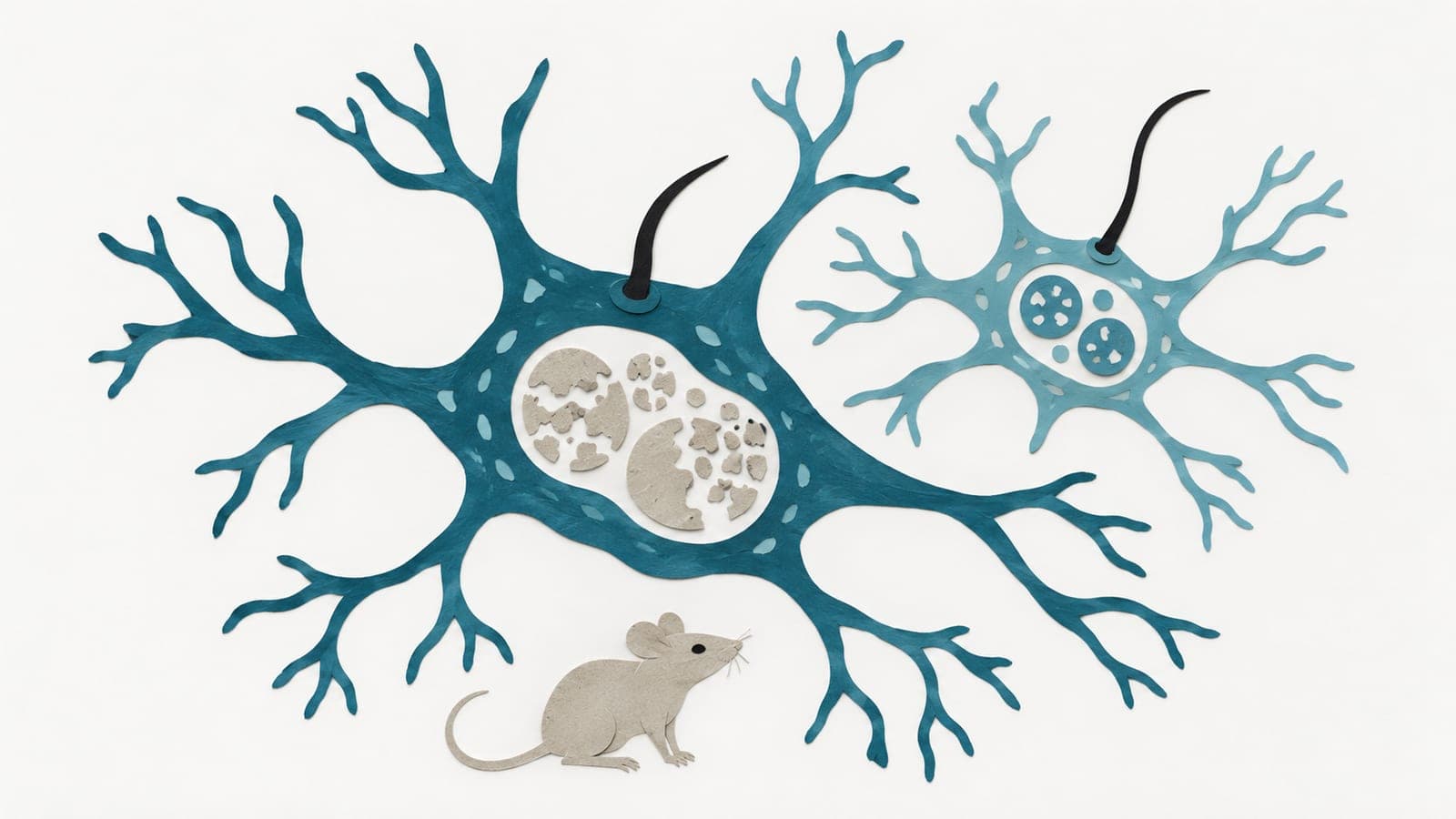
Mitochondrial recycling declined in older mouse brain cells
Old male mice had about 34% less mitochondrial recycling in nerve cells and 31% less in astrocytes, a type of brain support cell, than young mice.
Limit: Imaging measured a proxy; electron microscopy detected no significant age-related changes in mitophagy-like events
Edited by Boris Djordjevic · AgingResearch.News
In an experiment in male mice aged 2–3 months and 18–20 months, researchers imaged nerve cells and astrocytes, a type of support cell, in the somatosensory cortex, which processes touch. They used a fluorescent signal to track mitophagy—the recycling of mitochondria, the energy-producing structures inside cells—in awake, behaving animals.
The older mice had lower mitophagy in both cell types. Astrocytes had higher levels than nerve cells at both ages. Researchers then gave the older mice nicotinamide riboside, a compound used to boost nicotinamide adenine dinucleotide, a molecule that promotes mitophagy. Mice received 12 millimoles per liter in drinking water for three weeks. Imaging afterward showed mitophagy rose 56% in nerve cells and 19% in astrocytes compared with before supplementation.
Why it matters
Mitochondrial recycling helps cells maintain their energy-producing structures. The study addressed how this upkeep changes with brain aging and whether boosting it remains possible in old mice.
Caveats
The imaging signal was a proxy for mitophagy; electron microscopy detected no significant changes in mitophagy-like events with age or supplementation. The supplement comparison lacked an untreated older control group, and the experiment covered only male mice and one brain region.
The paper
University of Oslo; Norwegian University of Science and Technology
npj Aging, May 26, 2026, Open access