Grip adds little to disability forecasts in studied arthritis cohorts
In the Health and Retirement Study, scores for distinguishing future disability were 0.706 with grip strength versus 0.711 without it.
Independent replication
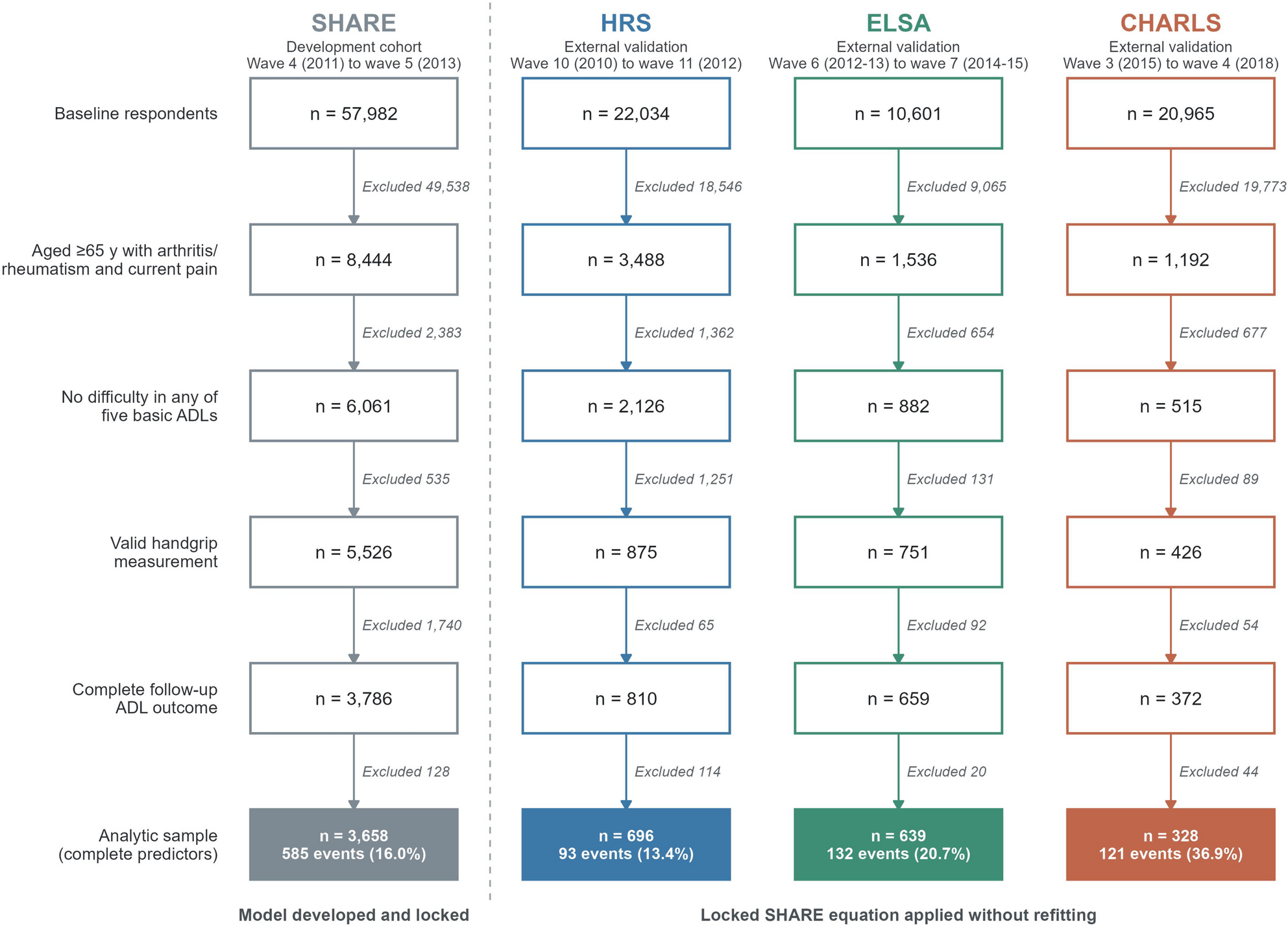
Adults aged 65 or older with self-reported physician-diagnosed arthritis or rheumatism and current pain took part in this observational study. None initially reported difficulty with five basic daily activities.
Researchers developed prediction models in 3,658 participants from the Survey of Health, Ageing and Retirement in Europe. They tested them unchanged in the Health and Retirement Study (696 participants), English Longitudinal Study of Ageing (639) and China Health and Retirement Longitudinal Study (328). Adding grip strength raised the development cohort’s prediction score from 0.681 to 0.692. This measured how well models distinguished people who later developed disability from those who did not. Grip strength was linked to disability but added little reproducible predictive value elsewhere. Other ways of expressing grip strength did not consistently improve performance. Predicted risks also differed from observed risks across cohorts. The authors called for local testing and adjustment before using predicted absolute risks elsewhere.
Why it matters
Basic daily activities underpin independence in later life. The study addresses how to estimate the risk of developing difficulties with those activities in older adults with arthritis and pain.
Caveats
Differences between predicted and observed risks partly reflected different follow-up periods. The results concern older adults with arthritis or rheumatism and pain who initially reported no difficulty with the five activities, not people already experiencing those difficulties.
From the paper
- Participants
Analytic samples comprised 3658 participants (585 events) in SHARE, 696 (93) in HRS, 639 (132) in ELSA, and 328 (121) in CHARLS.
Quoted word for word from the full text on link.springer.com.
The paper
Shanxi Medical University
BMC Geriatrics, 12 Oct 2026, Open access, CC BY-NC-ND