Human cells in long-term culture mirror features of aging
Experiments in four female fibroblast lines tracked molecular changes that resembled key features of aging in cells from the body.
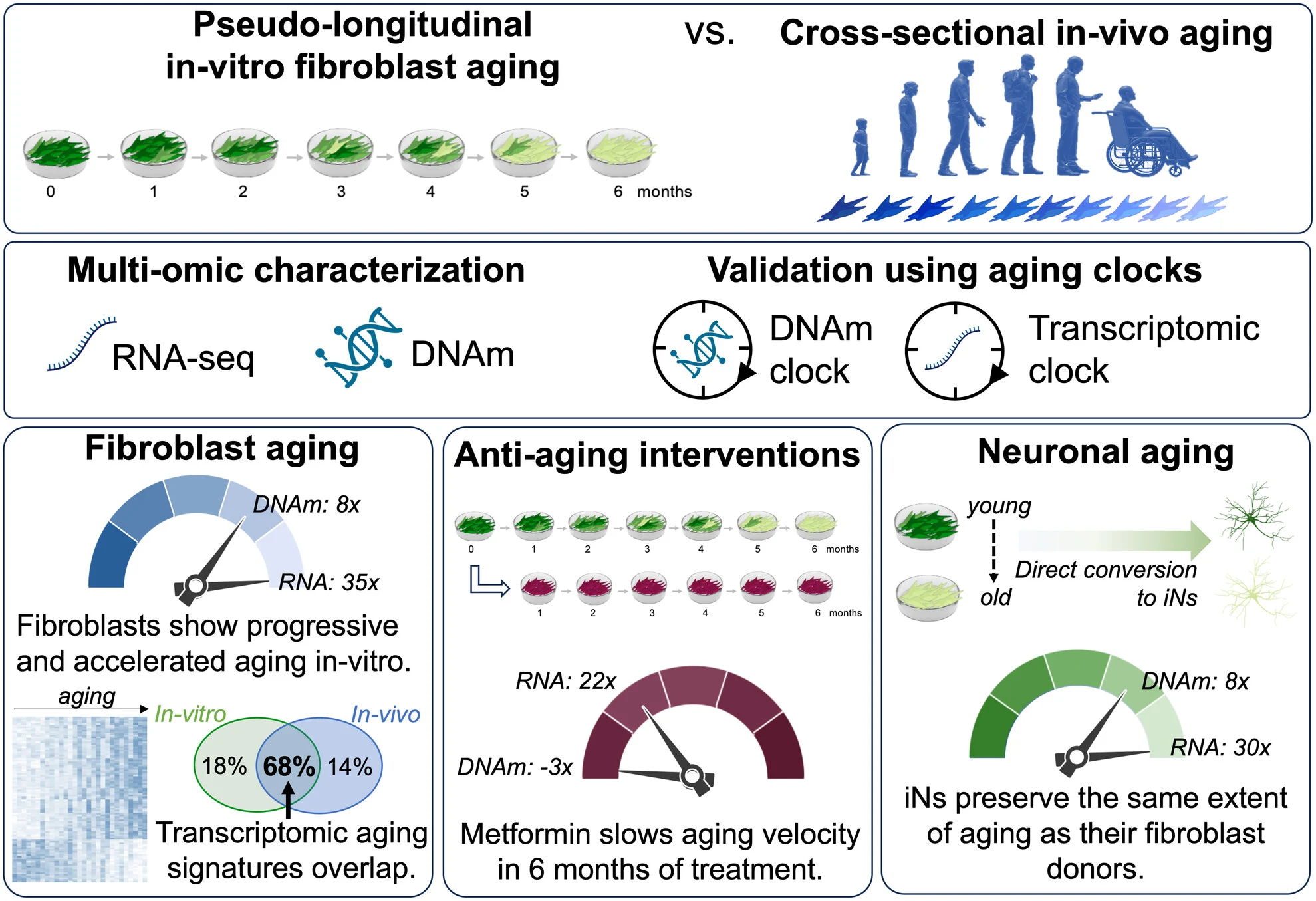
Limit: Uncorrected tests in the smaller comparison cohort could inflate apparent overlap in aging pathways
Edited by Boris Djordjevic · AgingResearch.News
Researchers studied four female human fibroblast lines—connective tissue cells grown in the lab—in an experiment that maintained the cells long-term after they stopped dividing. Repeated analyses of gene activity and epigenetic patterns—features that affect gene activity without altering the DNA sequence—revealed key signatures of fibroblast aging in the body.
Individual cells became more varied in their biological age over time. Directly converting aged fibroblasts into nerve cells preserved their biological age. When the team tested compounds in the fibroblast system, metformin broadly reduced aging-related changes in gene activity and epigenetic patterns. Rapamycin showed limited effects on these measures. The authors presented the system as a platform for evaluating potential anti-aging compounds.
Why it matters
Following human cellular aging experimentally remains challenging. The authors propose that this platform could help researchers study aging mechanisms and evaluate candidate interventions for age-related diseases.
Caveats
These were laboratory cell experiments, so changes in molecular aging measures do not establish health or lifespan benefits. The paired molecular analyses involved four female fibroblast lines.
Where the evidence stands
Metformin
- 515 independent labs in 65 countries
- 237 findings against
- 1,476 trials, 628 with no results posted
- Funders: National Institutes of Health and others
- 172 of 2,398 findings with company ties
- 195 of 1,476 trials sponsored by its developers
Rapamycin
- 298 independent labs in 47 countries
- 97 findings against
- 537 trials, 174 with no results posted
- Funders: National Institutes of Health and others
- 153 of 1,598 findings with company ties
- 53 of 537 trials sponsored by its developers
From the paper
- Result
A paired comparison of predicted age difference over 5 months in vitro revealed a significant difference in epigenetic and transcriptomic age gained, with a gain of 3.6 epigenetic years (95% CI [−1.0, 8.2]) and 21.5/10.4 transcriptomic years (95% CI [5.8, 37.2]/[4.9, 15.9]) (Figure 1h).
Results, 2.2 In Vitro Aging Accelerates DNAm and RNA Aging Clock Velocities
- Limitation
This manuscript is primarily aimed at evaluating the extent to which a long-term in vitro culture model can recapitulate key features of human aging, rather than identifying novel aging pathways.
Quoted word for word from the full text on onlinelibrary.wiley.com.
- Metformin
- Rapamycin
- Epigenetic regulation of gene expression
- Cellular age heterogeneity
- Epigenetic aging signatures
- Humans
Metformin is part of Bryan Johnson's Blueprint and David Sinclair's daily regimen in Lifespan
The paper
Department of Neurosciences University of California San Diego La Jolla California USA
Aging Cell, Nov 1, 2026, Open access, CC BY

Comments
Be the first to comment.