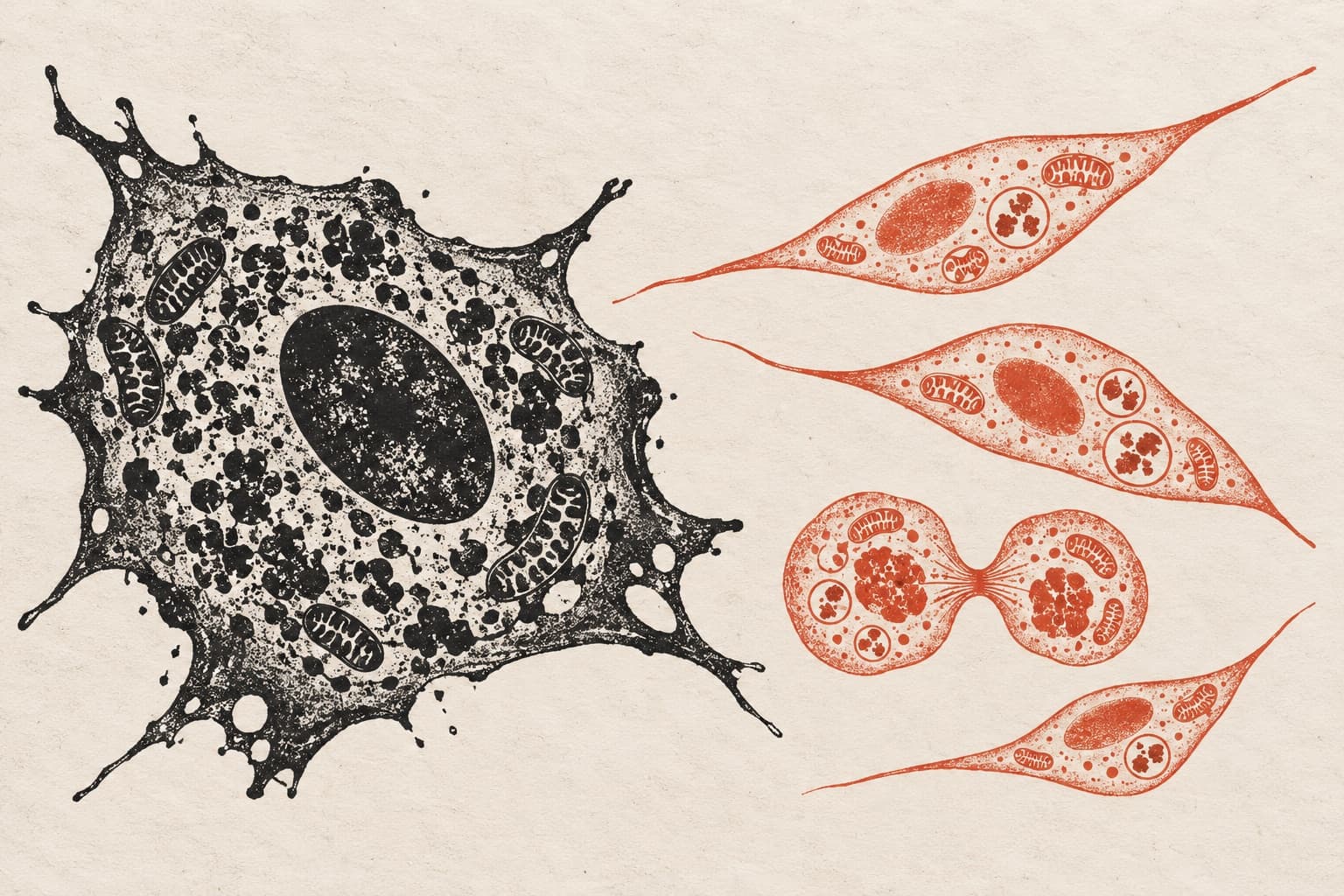
Probe enables imaging and heat-based killing of senescent cells
Laboratory tests and experiments in living organisms used an enzyme-activated probe to image senescent cells and eliminate senescent tumour cells with light-generated heat.

Limit: Harms from photothermal cell elimination are not reported
In experiments with senescent cells, which have stopped dividing, researchers tested a probe called RPM-Gal for imaging and heat-based cell elimination. The probe responds to beta-galactosidase, an enzyme produced at higher levels in these cells.
Laboratory tests found that the probe produced an imaging signal and generated heat in response to the enzyme. Its photoacoustic imaging method detects sound generated when light is absorbed. In senescent cells, the elevated enzyme levels specifically activated the imaging signal and heat-based effect when researchers applied light. The researchers also used the probe to image and eliminate senescent tumour cells within a living organism.
Why it matters
Senescent-cell accumulation contributes to chronic inflammation and age-related dysfunction. Tools for locating and targeting these cells may help researchers investigate interventions for aging-associated diseases.
Caveats
The abstract does not identify the living organism studied or report sample sizes, doses or harms. It reports no outcomes for lifespan or aging-associated disease.
- Imaging
- Rpm-gal
- Cell killing (cytotoxicity)
- Cellular senescence
- Cancer
- Senescence-associated beta-galactosidase
The paper
Hunan University of Science and Technology
Analytical Chemistry, 8 Oct 2026