Light- and enzyme-gated prodrugs target senescent cells
Pairing 390 nm irradiation with beta-galactosidase cleavage improved prodrug selectivity in senescence models and increased death in senescent lung cancer patient-derived organoids.
Our read
Interventions- Studied:
- Experiments in human cells
Editor of record: Boris Djordjevic · AgingResearch.News
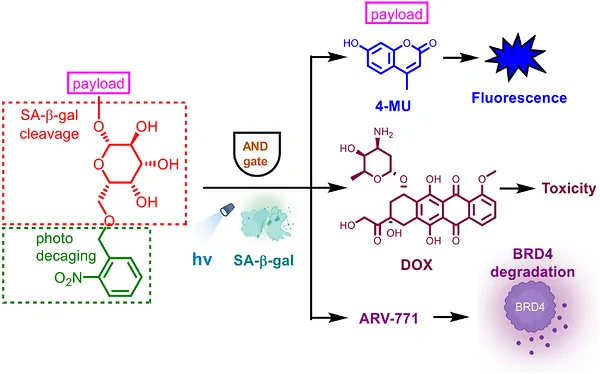
In cultured cells and patient-derived organoids, researchers evaluated a dual-trigger AND-gate system designed to improve senolytic targeting. Senescence-associated beta-galactosidase is widely used to mark senescent cells, but its activity in non-senescent tissues can limit selectivity. To control activation, the team blocked beta-galactoside cleavage with an o-nitrobenzyl photocage that releases only upon 390-nanometer light irradiation.
The researchers assessed a doxorubicin prodrug, LS-D, and a PROTAC prodrug, LS-A. Following light activation, LS-D preferentially induced apoptosis in senescent cells, while LS-A promoted BRD4 degradation. Across multiple senescence models, both prodrugs displayed higher senolytic indices than their parent compounds. In senescent lung cancer patient-derived organoids, LS-D combined with light increased organoid death, whereas either treatment alone showed minimal effects.
Why it matters
Senolytic therapies often risk damaging healthy tissue because common senescence markers also appear in normal cells. Adding a spatial trigger such as localized light may offer a way to restrict senolytic activity to intended target areas.
Caveats
The findings are based entirely on in vitro cell cultures and ex vivo patient-derived organoids, without validation in living animals. The authors describe the results as proof-of-concept evidence under specific laboratory conditions.
The paper
Orthogonal Light- and Enzyme-Triggered and-Gate Prodrugs for Senolytic Therapy
Army Medical University
Advanced Science, Oct 4, 2026, Open access

Comments
Be the first to comment.