Damaged chromosome ends limit liver cell flexibility in mice
Mouse experiments found impaired shifts toward bile duct cells during chronic injury, but no substantial impairment of liver cell survival or basic metabolic function.
Our read
Mechanisms- Studied:
- Experiments in mice with induced hepatocyte telomere damage
- What changed:
- Liver cells with telomere damage were less able to change into bile duct cells during chronic injury
- The catch:
- Regeneration after gradual telomere shortening was not measured; telomere breaks were induced
- In the record:
- One of 6 papers on telomere integrity on record: 1 with results in people, 2 in animals.
Editor of record: Boris Djordjevic · AgingResearch.News
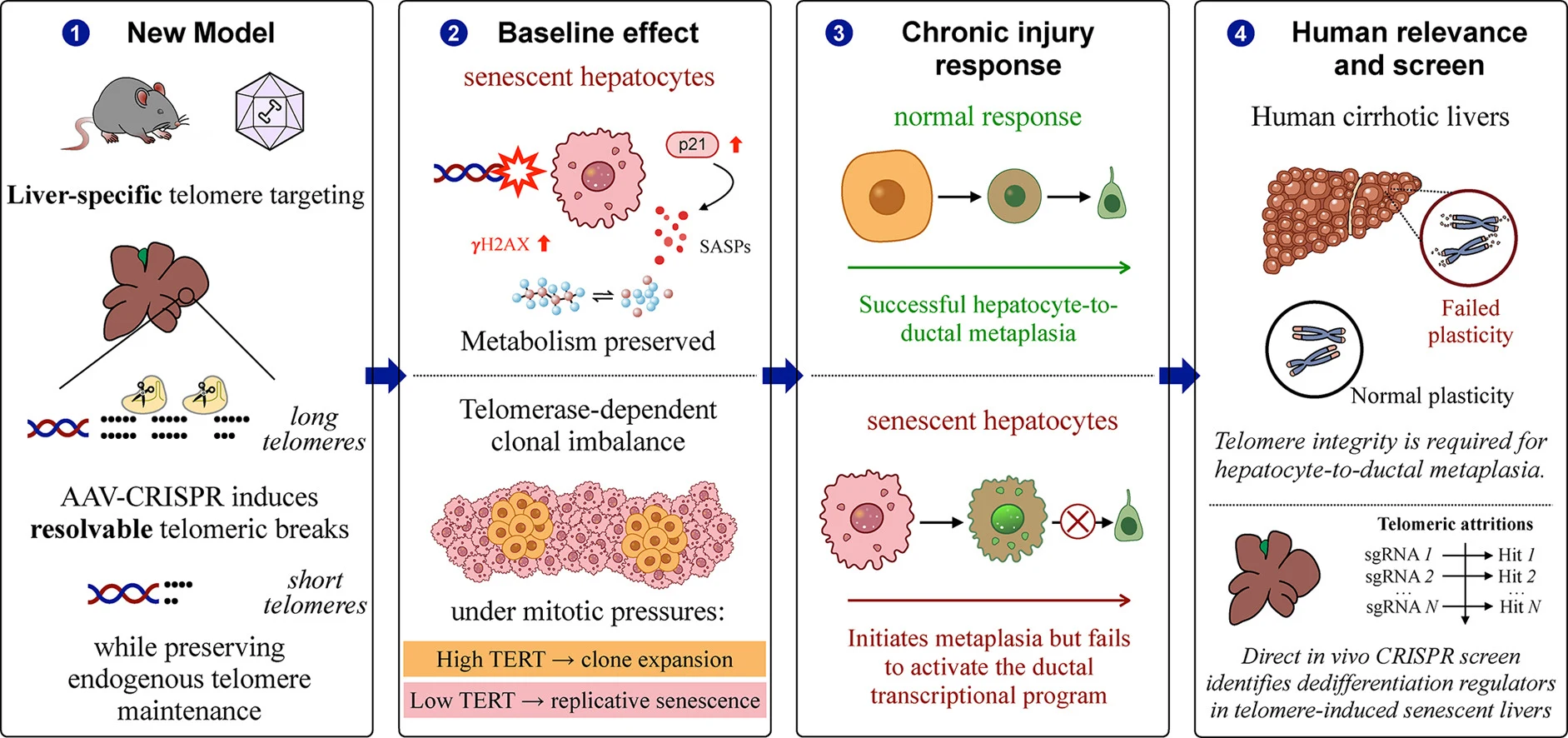
Mouse hepatocytes, the liver’s main working cells, developed senescence—a state in which cells stop dividing—in an experiment that induced telomere damage. Telomeres are protective chromosome ends. The breaks could be resolved, and the cells retained their natural telomere maintenance. Researchers tracked cell lineages and measured gene activity during chronic liver injury.
Senescence did not substantially impair liver cell survival or basic metabolic function. But affected cells were less able to enter a less specialized state and fully activate the gene program for bile duct cells. This incomplete transition altered the mix of cells and worsened the abnormal growth of duct-like structures. In a separate analysis of human livers with cirrhosis, or advanced scarring, preserved telomere integrity was associated with liver cell states capable of developing toward two cell types.
Why it matters
Telomere shortening is common in chronic liver disease. The findings suggest that preserving liver cells’ ability to change roles may be important for the liver’s capacity to regenerate.
Caveats
The mouse experiments tested induced telomere breaks, leaving open how gradual telomere shortening affects regeneration in people.
Where the evidence stands
Cellular senescence
- 862 independent labs in 75 countries
- 522 findings against
- 51 trials, 15 with no results posted
- Funders: National Natural Science Foundation of China and others
- 666 of 9,924 findings with company ties
- 49 of 51 trials sponsored by developers of drugs aimed at it
DNA damage response
- 213 independent labs in 34 countries
- 10 findings against
- Funders: National Institutes of Health and others
- 37 of 347 findings with company ties

Comments
Be the first to comment.