Mouse skeletal stem cells enter a shared, changeable state
Experiments in mice tracked how development, bone-building stimulation and injury affected a shared stem cell state.
Our read
Mechanisms- Studied:
- Preprint: experiments in mice
- Why it’s aging research:
- It studies how the body can be repaired or renewed.
Editor of record: Boris Djordjevic · AgingResearch.News
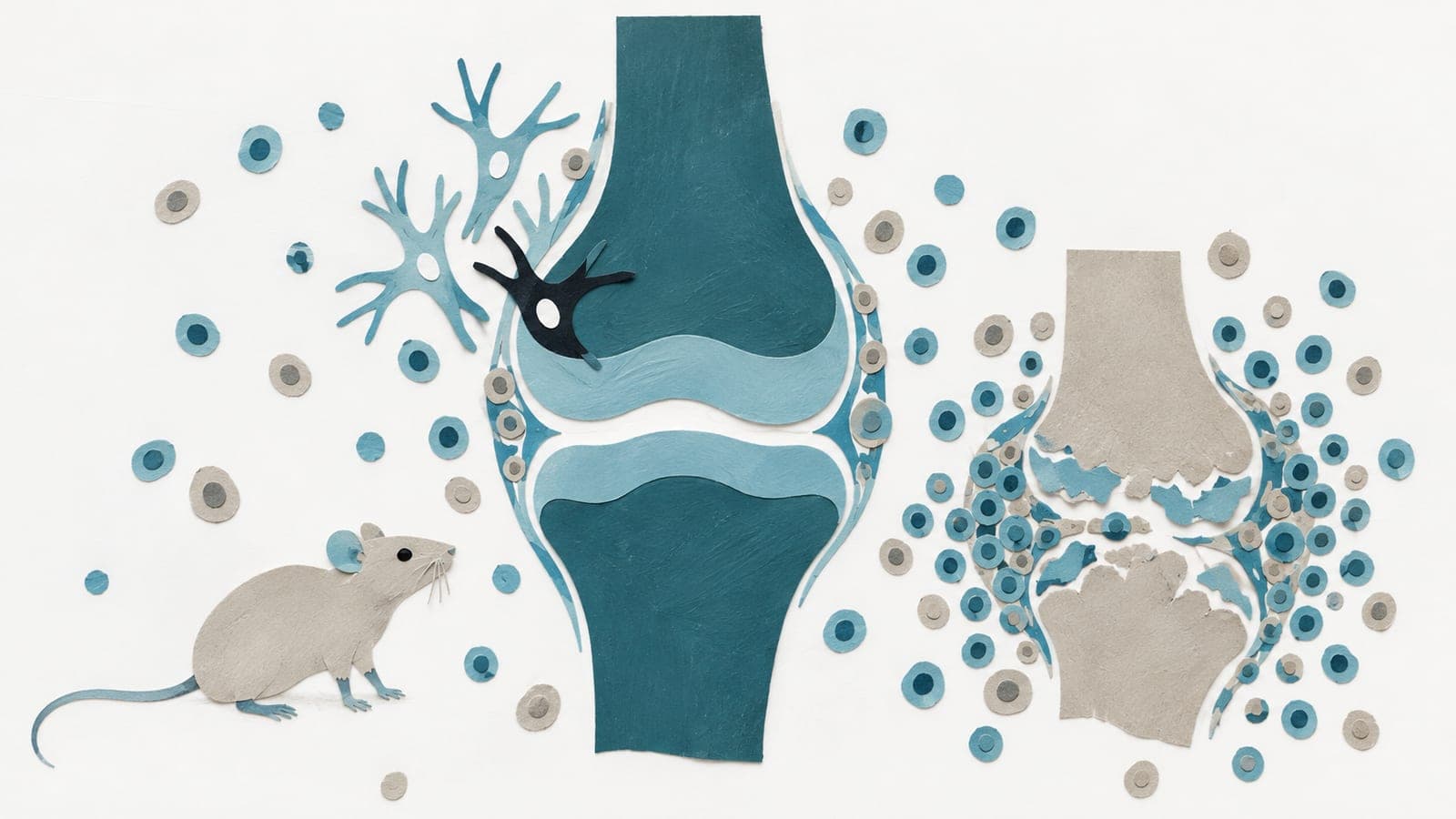
Mouse skeletal stem cells were genetically tracked over time in animal experiments that identified a shared, changeable functional state. Patterns of gene activity and cell locations helped identify Pannexin-3, a marker of this state. Marked stem cells renewed themselves and could produce multiple cell types, while their descendants persisted long term. Other skeletal stem cells could also acquire the state. Successive groups entered it during development. Bone-building stimulation expanded existing marked cell groups, while injury induced the state locally in previously unmarked precursor cells.
Signals identified in cartilage-forming environments redirected descendants of marked cells toward stable cartilage. The authors reported durable regeneration in aged mouse joints and those with osteoarthritis, a disease that damages joint cartilage. They also reported regeneration with human skeletal stem cells.
Why it matters
Skeletal regeneration in aging joints raises the question of how to steer stem cells toward cartilage. The work provides a way to track and investigate those choices.
Caveats
These were animal experiments and experiments with human skeletal stem cells, not tests of joint regeneration in people. The work is a preprint and has not been peer-reviewed.
- Osteoanabolic stimulation
- Stem cell differentiation
- Stem cell maintenance
- Osteoarthritis
- Panx3-positive skeletal stem cells
- Mice
The paper
A Dynamic Stem Cell State Links Environmental Cues to Skeletal and Regenerative Fates
UC Davis
bioRxiv, Nov 6, 2026, Open access, CC BY-NC, Preprint, not yet peer-reviewed

Comments
Be the first to comment.