Gene activity shifts nonlinearly in the aging mouse colon
In an analysis of 83 male mouse samples across five ages, researchers found a midlife shift and built an aging clock from three genes.
83 rna-seq samples, independent replication
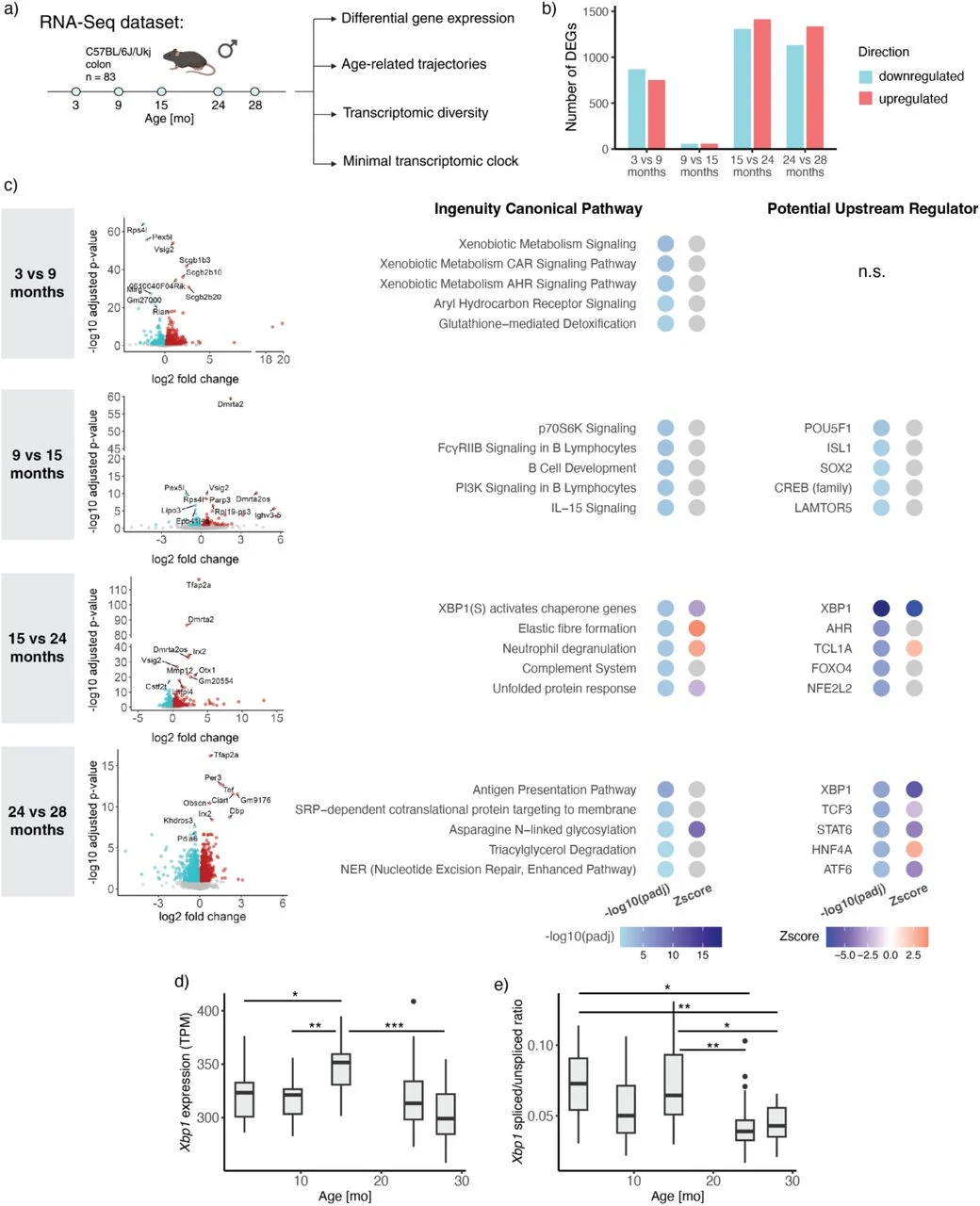
Researchers analysed 83 tissue samples across five adult ages to track gene activity in the colon of male mice. Instead of changing in a steady line, gene activity followed multiple patterns at once across life. Many genes peaked or dipped during midlife, which would be missed in comparisons limited to young and old animals. A major transition occurred between midlife and late life, marked by a collapse of the unfolded protein response, a quality-control process for handling misfolded proteins. The authors also described age-dependent patterns in RNA transcripts containing transposable elements, DNA sequences that can move within the genome. In addition, transcriptomic entropy, a measure of disorder in gene activity, changed nonlinearly across the lifespan. Finally, the team identified three genes that tracked chronological age and used them to construct a compact transcriptomic clock, which they validated with independent data.
Why it matters
Mapping how molecular activity shifts across life may help pinpoint critical midlife transition points in gut tissue and improve tools for measuring biological aging.
Caveats
This study is a preprint that has not yet been peer-reviewed. The work was carried out entirely in male mice, so whether these colon trajectories and the three-gene clock also apply to female mice or to humans remains to be tested.
- Transcriptomics
- ER unfolded protein response
- Transposable element activity
- Transcriptomic entropy
- Three-gene transcriptomic clock
- Mice
The paper
Expression trajectories in the aging male mouse colon transcriptome
Leibniz Institute on Aging - Fritz Lipmann Institute (FLI)
bioRxiv, 8 Oct 2026, Open access, CC BY, Preprint, not peer-reviewed


