Depressive symptoms linked to later chronic lung disease
Across three cohorts, adults with depressive symptoms had about 50% higher relative risk of developing chronic lung disease than those without symptoms.
Multicenter
Limit: Chronic lung disease diagnoses relied on participant reports
Edited by Boris Djordjevic · AgingResearch.News
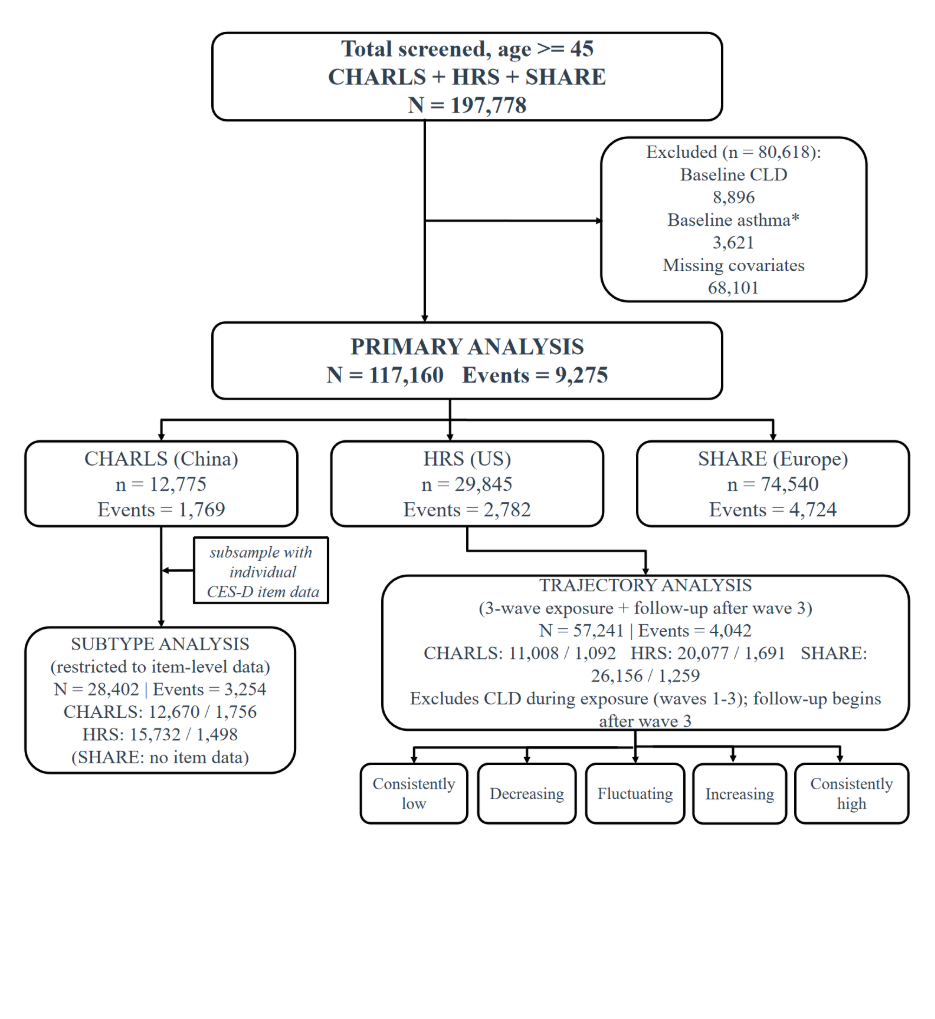
A pooled analysis of three prospective observational cohorts included 117,160 adults in China, the United States and Europe who initially had neither chronic lung disease nor asthma. Researchers recorded 9,275 new cases of chronic lung disease. The association with depressive symptoms remained after accounting for smoking, age and other measured factors.
Physical symptoms of depression and symptoms involving mood and thinking were each independently linked to later lung disease. The link was slightly stronger for physical symptoms. In a separate analysis of 57,241 participants, persistently high symptoms over the first three survey rounds were associated with the greatest risk during later follow-up. People whose symptoms decreased still had elevated risk, though the association was weaker.
Why it matters
Depression has often been viewed as a consequence of chronic lung disease. Examining whether depressive symptoms precede it may inform research on maintaining lung health with age.
Caveats
The observational design cannot establish cause and effect, and the analysis excluded people who already had chronic lung disease or asthma. This preprint has not been peer-reviewed, and depression scales and cutoffs differed across cohorts.
From the paper
- Participants
The primary analytic sample comprised 117,160 participants (CHARLS n = 12,775; HRS n = 29,845; SHARE n = 74,540).
- Result
In CHARLS (n = 12,670; 1,756 events), per one standard deviation (SD) increase, the somatic subscale was associated with an HR of 1.18 (95% CI 1.11-1.25; P < 0.001) and the cognitive-affective subscale with an HR of 1.13 (95% CI 1.07-1.20; P < 0.001).
- Limitation
Residual confounding cannot be excluded, although E-values (2.4–2.5) indicated that a relatively strong unmeasured confounder would be needed to explain away the association.
Quoted word for word from the full text on researchsquare.com.
The paper
The Fourth Affiliated Hospital of Nanjing Medical University; Nanjing Medical University
Research Square, Nov 1, 2026, Open access, Preprint, not peer-reviewed


Comments
Be the first to comment.