High or rising illness burden linked to disability in China
Compared with stable low burden, disability odds were 1.75 times as high with persistently high burden and 1.88 times as high with rapidly rising burden.
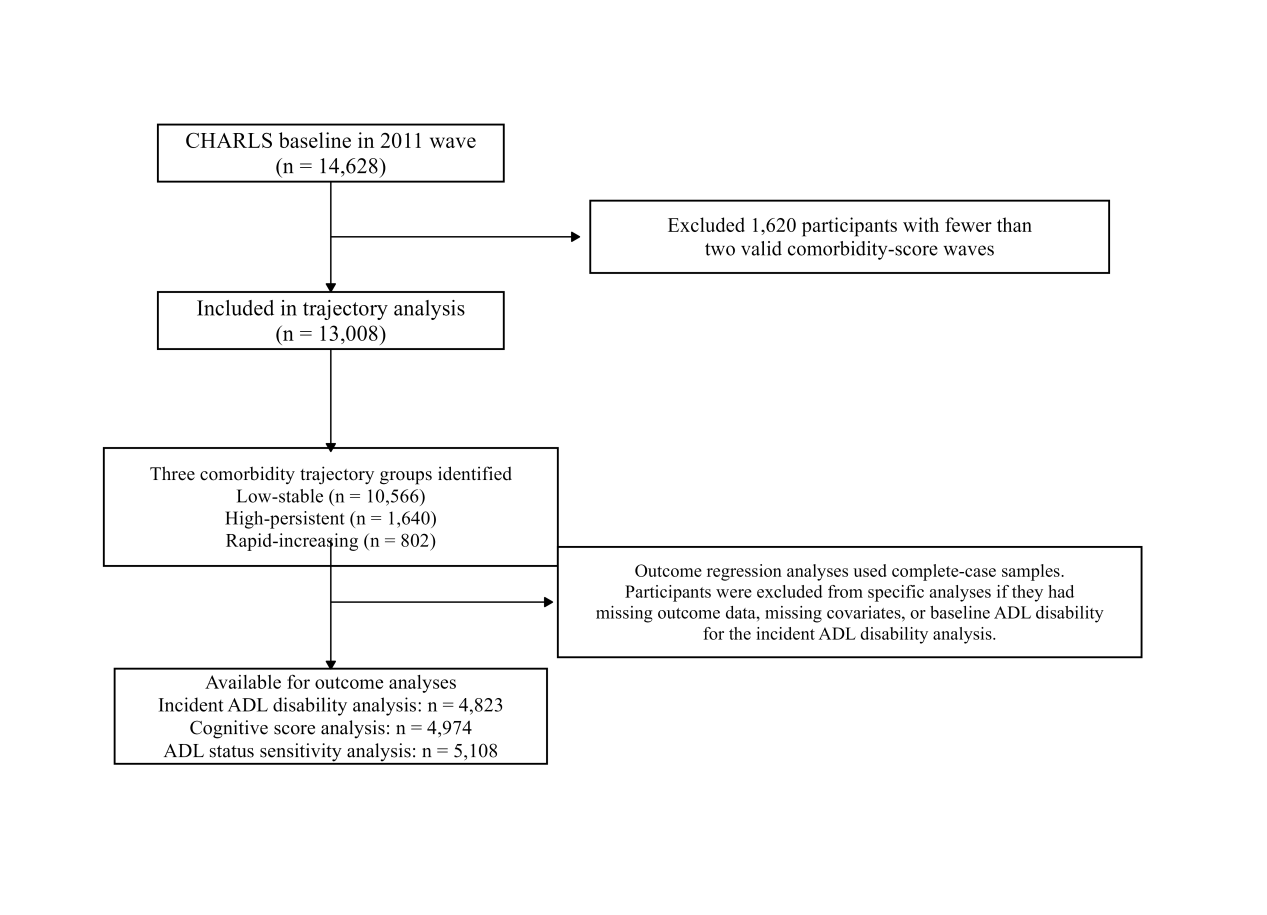
13,008 participants
Limit: Disability could worsen depressive symptoms while illness trajectories were still being measured
Edited by Boris Djordjevic · AgingResearch.News
An observational cohort study of 13,008 middle-aged and older Chinese adults used four survey waves from 2011 to 2018. The preprint scored participants from 0 to 3 based on depressive symptoms, chronic lung diseases, and heart and blood vessel diseases.
Researchers identified three patterns: stable low burden (81.2%), persistently high burden (12.6%) and rapidly increasing burden (6.2%). After accounting for other factors, both persistently high and rapidly increasing burden were associated with higher odds of new disability affecting everyday activities. Only rapidly increasing burden was associated with lower memory scores in 2018. The persistently high group had no statistically clear independent association with memory scores.
Why it matters
The study addresses whether tracking coexisting conditions over time could help identify older adults at risk of losing independence or memory. The researchers recommended monitoring changes rather than relying only on a one-time disease count.
Caveats
This observational study cannot establish that these illness patterns caused disability or lower memory scores. The findings concern middle-aged and older adults in China, and the preprint has not been peer-reviewed.
From the paper
- Participants
Data were derived from four waves of the China Health and Retirement Longitudinal Study (CHARLS) conducted between 2011 and 2018, and a total of 13,008 participants were included.
- Result
In the fully adjusted model, compared with the stable low burden group, the persistent high burden group (OR = 1.75, 95% CI: 1.38–2.22) and rapidly increasing burden group (OR = 1.88, 95% CI: 1.37–2.54) were strong predictors of incident ADL disability.
Quoted word for word from the full text on researchsquare.com.
- Depressive symptoms
- Memory score
- Cardiopulmonary disease
- Cardiovascular disease
- Chronic respiratory disease
- Humans
The paper
Baotou Central Hospital; Daqing People's Hospital
Research Square, Oct 23, 2026, Open access, Preprint, not peer-reviewed