A Scoping Review of Foundation Models in Dementia Research
Abstract
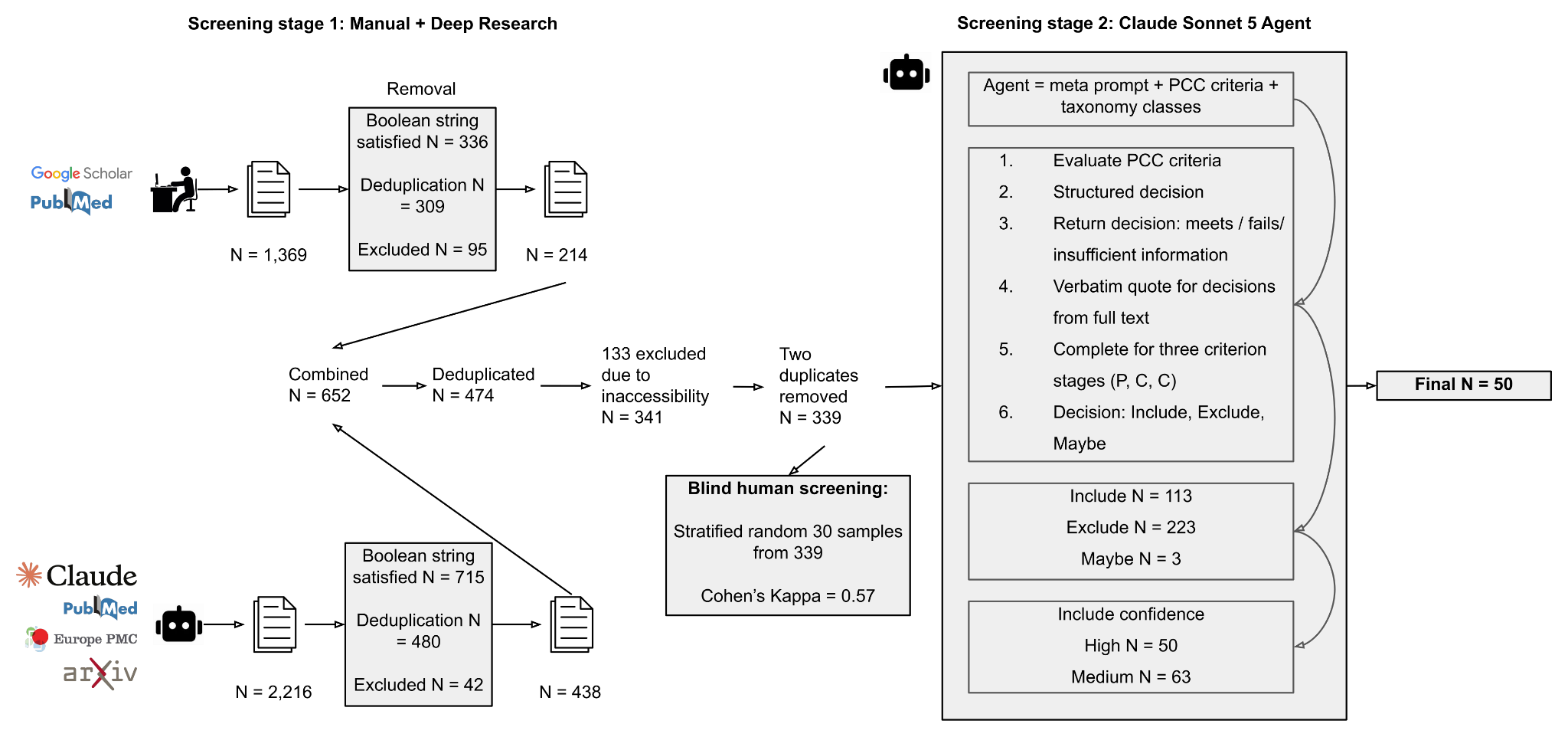
Foundation models (FMs) are increasingly applied to dementia for multiple purposes, but their main scopes and limitations remain unclear. We examined how FMs are used for dementia detection, diagnosis, prognosis and risk prediction. Eligible studies applied a pre-trained, fine-tuned or commercial LLM FM to these tasks in people with or at risk of dementia, in English, January 2022 to August 2026. Searches of PubMed, Europe PMC, arXiv and Google Scholar yielded 474 unique records, screened to 50 analysed papers, charted by taxonomy, scope, dataset, performance and validation. Of these, 8 used pre-trained FMs, 26 fine-tuned FMs and 16 commercial LLMs (detection and diagnosis predominated). Performance was not comparable across classes (tasks, datasets and metrics differed). Demographic reporting was poor: race and ethnicity in 4/50 studies, age in 24/50, studies concentrated in the USA. The literature remains at proof of concept, requiring larger, diverse datasets and rigorous validation.
From the paper
- Limitation
Sample bias and single source data, with most papers using single datasets, making results difficult to transfer to other populations.
Quoted word for word from the full text on researchsquare.com.
The paper
Queen Mary University of London
Research Square, 12 Oct 2026, Open access, Preprint, not peer-reviewed