Temporally non-local harmonisation and cardiovascular model transport between England and China: a measurement-methods study
Independent replication
Abstract
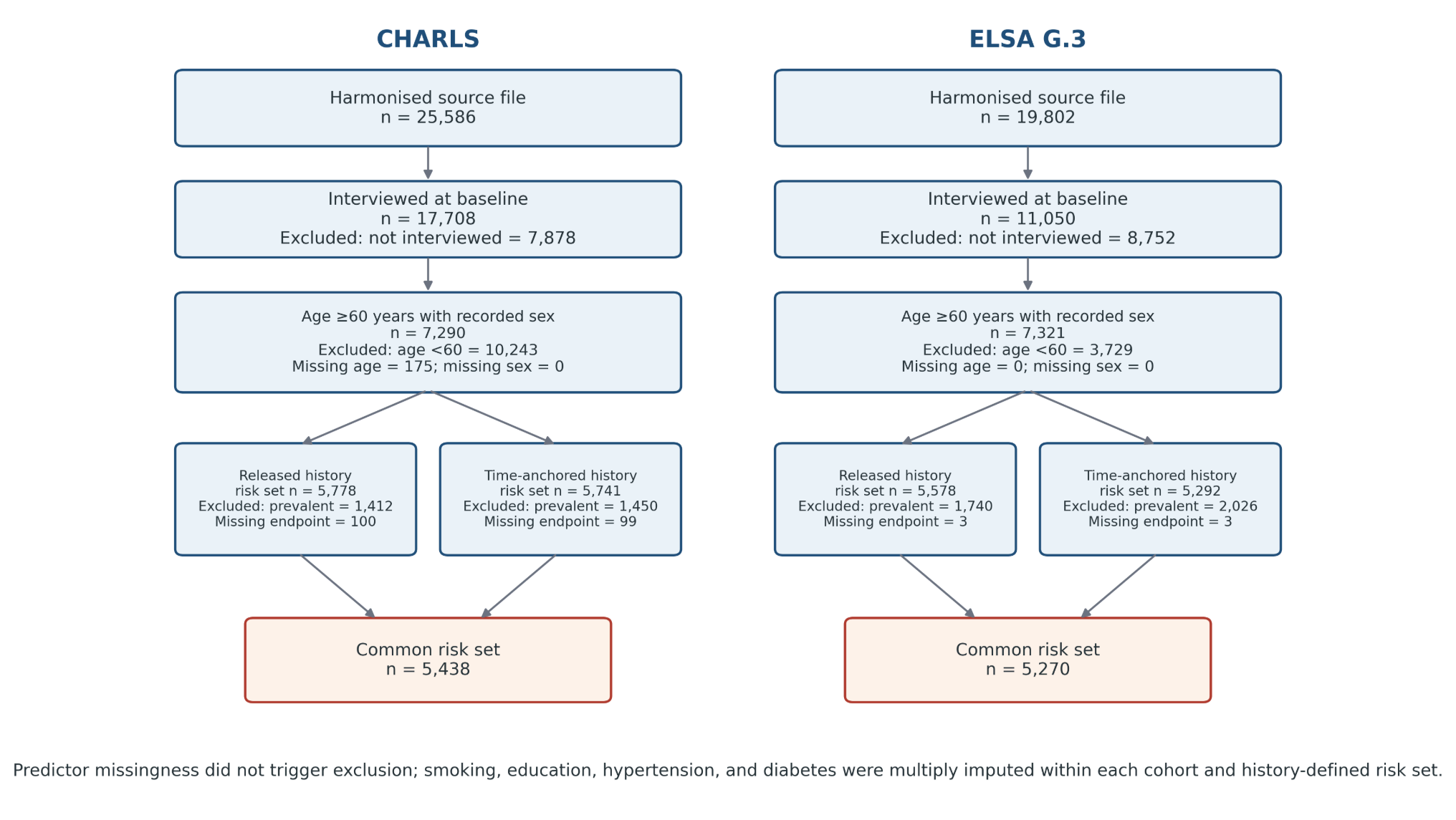
Background Harmonised disease histories can incorporate later reports, altering eligibility, outcomes, and model transport. Methods Reciprocal external validation compared released and time-anchored histories among CHARLS and ELSA participants aged 60 years or older. Analyses used full and common risk sets, prespecified sex interactions, multiple imputation, and 500 paired household bootstraps. Results Histories disagreed in 8.95% of CHARLS and 6.11% of ELSA participants; gross churn was 10.57% and 7.91%. Released and time-anchored calibration slopes were 0.173 (95% CI − 0.121 to 0.468) and 0.473 (0.189 to 0.758) for China-to-England transport, and 0.299 (0.002 to 0.596) and 0.478 (0.208 to 0.748) for England-to-China transport. AUC and Brier error both increased; IPA remained negative. Common-risk-set calibration-slope, AUC, and IPA estimates and all sex contrasts had confidence intervals spanning zero. England-to-China common-risk-set Brier error increased. Conclusions In harmonised cohorts, incorporating diagnoses reported at later waves into earlier disease histories changed cardiovascular disease-free eligibility and interval-specific outcome ascertainment among adults aged 60 years or older, and changed the calibration slope for China-to-England transport. The difference between full-pipeline and common-risk-set results indicated that this effect operated through cohort composition rather than predictor recoding and did not constitute an improvement in overall predictive performance.
The paper
University College London; First Affiliated Hospital of Heilongjiang University of Chinese Medicine
Research Square, 14 Oct 2026, Open access, Preprint, not peer-reviewed