Salivary microbiome exhibits stage-associated network topological shifts in upper gastrointestinal carcinogenesis
Dose-response
Abstract
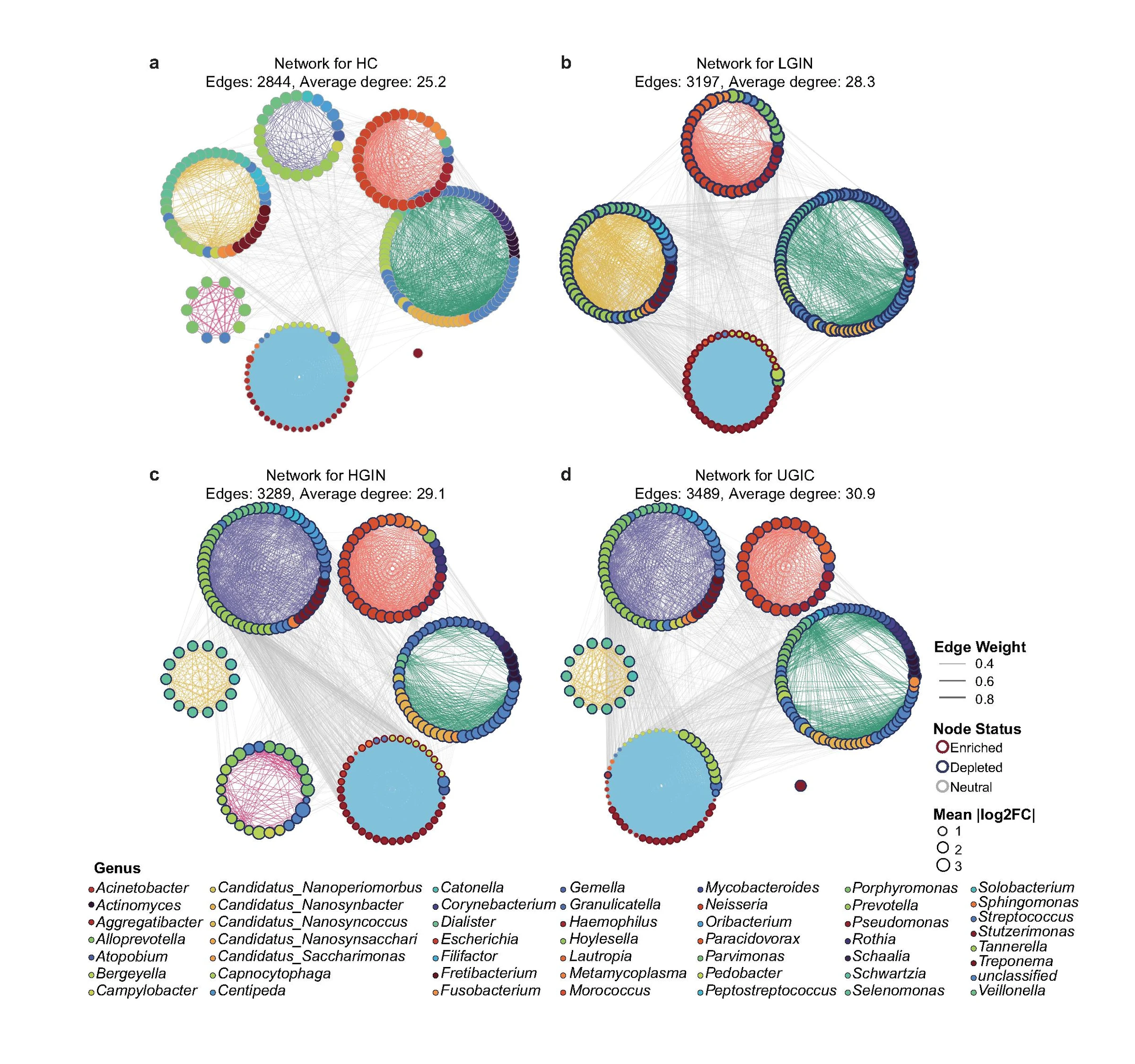
Upper gastrointestinal cancer (UGIC) presents a severe global burden due to its asymptomatic early stages and dismal clinical outcomes. Early ecological disruption of the oral-upper gastrointestinal microbial axis may precede invasive UGIC, but how salivary microbial communities are reorganized across the premalignant-to-malignant continuum remains poorly defined. We performed salivary metagenomic profiling and residual co-occurrence network analysis on a matched cohort of 416 participants spanning four stages: healthy controls (HC), low-grade intraepithelial neoplasia (LGIN) and high-grade intraepithelial neoplasia (HGIN), and UGIC. Compositionally, Pseudomonadota was significantly enriched in the LGIN and HGIN relative to HC, whereas Bacillota displayed the opposite pattern. Topologically, the salivary microbiome network revealed progressive ecological destabilization in the UGIC continuum, characterized by significantly reduced modularity and increased inter-module connectivity (FDR < 0.05), alongside a marked decline in nonlinear microbial associations ( P trend < 0.001). The initially disturbance-resistant modular network progressively transitioned into this disorganized topology. Within this structural breakdown, we uncovered highly reconnected species that were frequently overlooked by conventional abundance profiling, exposing interaction remodeling as a critical, yet hidden, dimension of UGIC progression. These highly reconnected species were further used to derive an oral microbiome risk score, which significantly improved the clinical covariate model (increasing the area under the receiver operating characteristic curve [AUC] from 0.63 to 0.69; DeLong P = 0.015) and yielded promising discrimination for LGIN (AUC = 0.72). Collectively, our study elucidates the stage-associated network rewiring and highly reconnected species of salivary microbiome, thereby providing a complementary, non-invasive tool to intercept UGIC at its precancerous stages.
From the paper
- Result
Each one-standard-deviation increase in the OMRS was associated with a 2.31-fold increase in the overall disease risk (95% CI: 1.66–3.21).
Results, Development of the OMRS and its early detection value for precancerous stages
Quoted word for word from the full text on researchsquare.com.
- Microbiome composition
- High-grade intraepithelial neoplasia
- Low-grade intraepithelial neoplasia
- Upper gastrointestinal cancer
- Oral microbiome risk score
- Humans
The paper
Shandong University
Research Square, 11 Oct 2026, Preprint, not peer-reviewed