Hypertension disease natural history and healthcare utilization when treatment guidelines do not account for race
Abstract
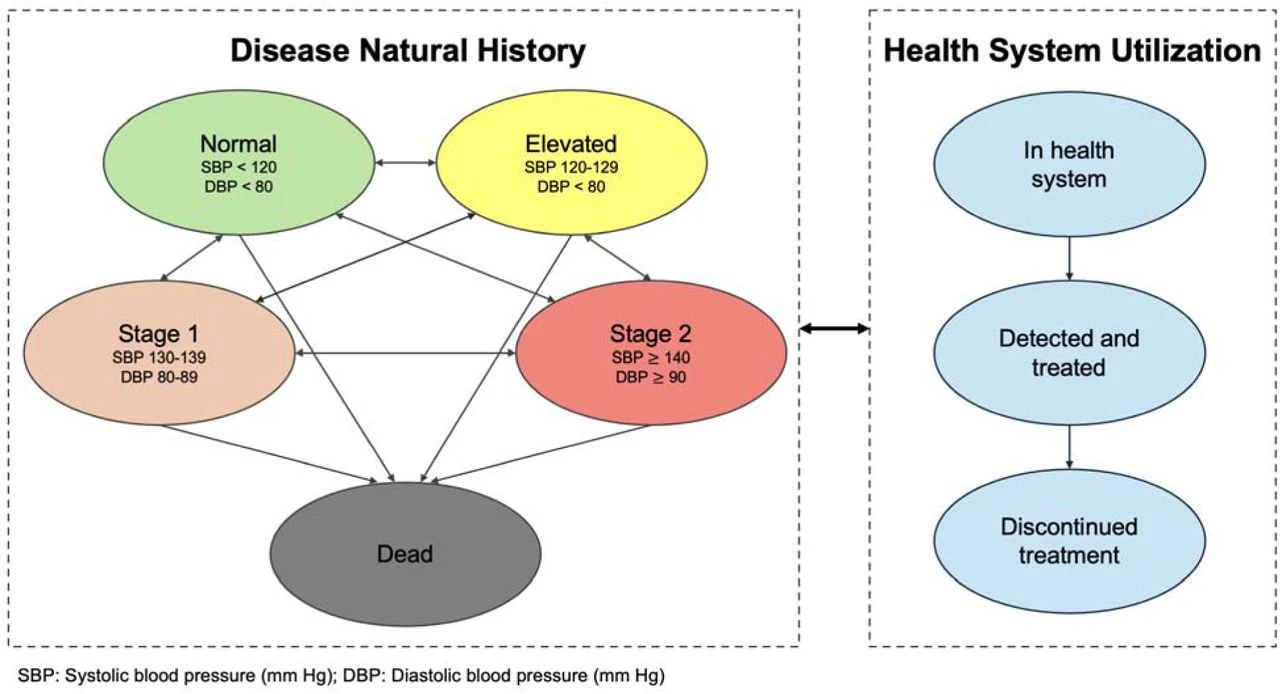
Objective: To estimate the impact of removing race-adjusted antihypertensive treatment recommendations for Black adults on health outcomes, healthcare utilization, and racial/ethnic disparities. Materials and methods: A discrete-time state-transition microsimulation model of hypertension natural history and health system utilization was developed to simulate lifetime trajectories among 100,000 non-Hispanic Black and non-Hispanic white 40-year-old adults. We evaluated the effect of removing race-adjusted antihypertensive treatment recommendations under two scenarios: one assuming racial heterogeneity in treatment effectiveness, reflecting evidence behind prior race-specific guidelines, and the other assuming no racial heterogeneity. Our main outcomes included life expectancy, cumulative incidence and duration of hypertension, and blood pressure control with antihypertensive treatment. Results: Under assumptions of heterogeneous treatment effectiveness by race, guidelines without race adjustment decreased life expectancy among non-Hispanic Black adults by 0.4 years, increasing the life expectancy gap with non-Hispanic white adults from 4.1 to 4.5 years. Hypertension control among non-Hispanic Black adults also worsened. Years with uncontrolled hypertension increased by 0.8 years, widening the disparity with non-Hispanic white adults from 1.7 to 2.5 years. Assuming no racial heterogeneity, these effects were diminished: life expectancy decreased by 0.1 years and years with uncontrolled hypertension increased by 0.2 years, less than one-half and one-quarter of the effects observed under assumptions of heterogeneous treatment effectiveness by race. Discussion: The potential effects of removing race-adjusted antihypertensive treatment guidelines depended on assumptions of racial heterogeneity in treatment effectiveness. Conclusion: Our findings highlight the importance of understanding drivers of previously observed racial differences when considering modifying antihypertensive treatment guidelines.
From the paper
- Participants
The simulation cohort included 100,000 adults aged 40 years, evenly divided between non-Hispanic Black and non-Hispanic white individuals.
- Result
Years with stage 1 or 2 hypertension increased from 15.1 years (95% CI: 15.0, 15.2) under race-adjusted guidelines to 16.4 years (95% CI: 16.2, 16.5) ( (a)).
- Limitation
First, we focused on antihypertensive monotherapy with either thiazide diuretics or ACE inhibitors.
Quoted word for word from the full text on medRxiv.
- Removal of race-adjusted antihypertensive treatment recommendations
- Modelling and theory
- Hypertension
- Blood pressure control
- Humans
The paper
Johns Hopkins University; Stanford Medicine
medRxiv, 7 Oct 2026, CC BY-NC-ND, Preprint, not peer-reviewed