Global Trends in Cardiovascular Mortality and Major Cardiometabolic Risk Factors, 2000 to 2023: A Longitudinal Ecological Analysis of 204 Countries and Territories
24 years, cohort study, multicentre
Abstract
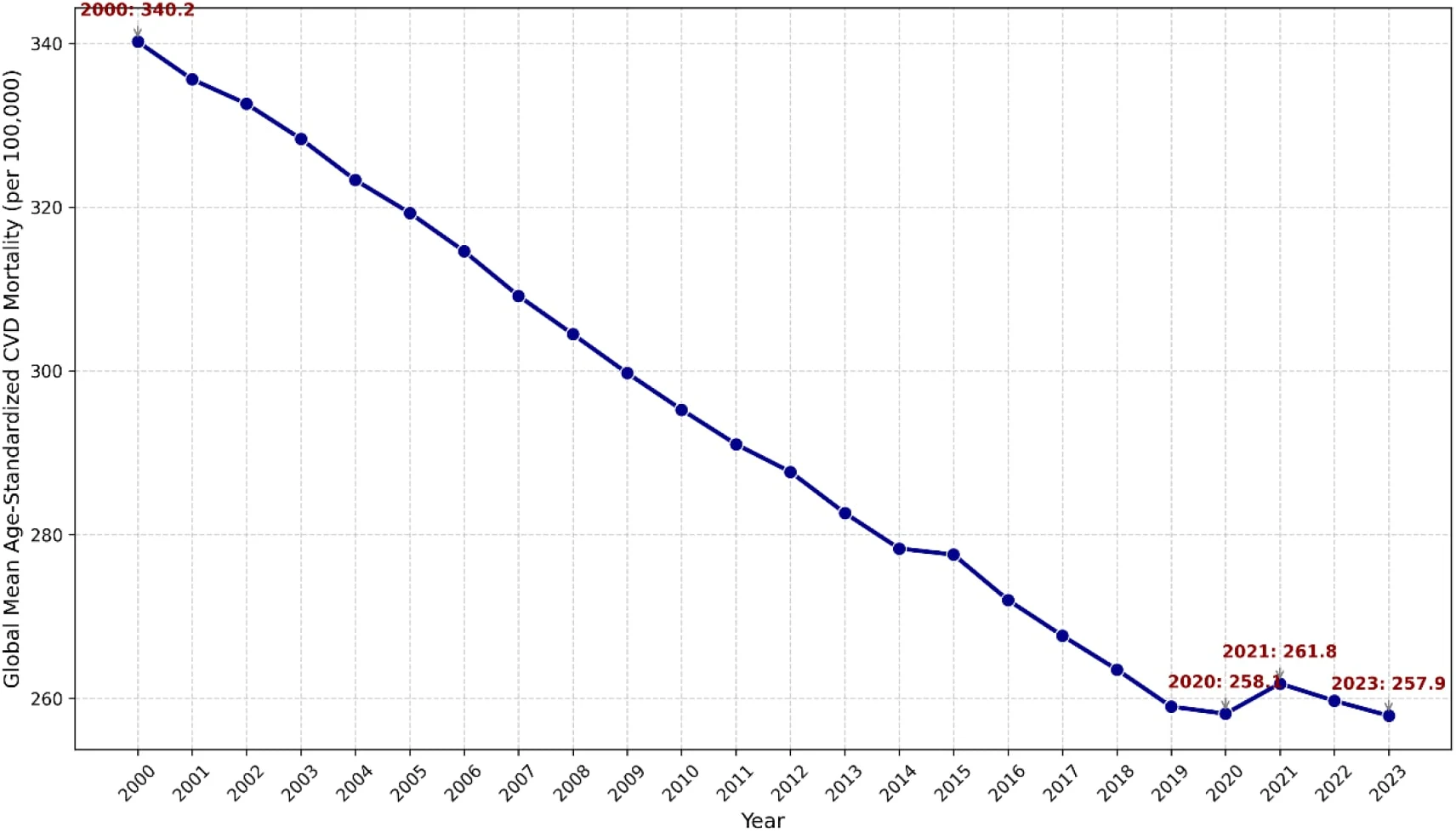
Background and AimsCardiovascular disease (CVD) remains the leading cause of global mortality. We evaluated 24-year global trends in age-standardized CVD mortality across 204 countries and territories (2000-2023) and decomposed the independent longitudinal associations of major cardiometabolic risk factor pathways. MethodsThe study analyzed a balanced panel of 4,896 country-year observations using Global Burden of Disease 2023 and World Bank data. Two-way fixed-effects panel regression models adjusting for country fixed effects, year fixed effects, GDP per capita, and urbanization were specified using Driscoll-Kraay robust standard errors. Hierarchical path mediation and extended 1- to 10-year lag models evaluated risk pathways and disease latency. ResultsGlobal age-standardized CVD mortality declined from 340.2 {+/-} 156.4 to 258.4 {+/-} 132.1 deaths per 100,000 population (2000-2023), but annual declines stagnated post-2019 (-1.31% to -0.03% per year). High SBP (adjusted beta = 1.129), high LDL cholesterol (beta = 0.622), smoking (beta = 0.452), and high fasting glucose (beta = 0.410) were independently associated with CVD mortality (P < 0.001 for all). High SBP reduction accounted for 70.91% of the global mortality decline. High BMI was not directly associated with mortality (beta = 0.049, P = 0.421); mediation analysis proved that 99.20% of its population impact is mediated through downstream metabolic intermediaries. ConclusionsElevated SBP and cumulative LDL cholesterol are the primary drivers of global cardiovascular mortality. Obesity acts as an upstream driver operating almost entirely through downstream metabolic intermediaries. Sustained progress requires prioritizing universal blood pressure control, lipid lowering, and multi-sectoral obesity prevention.
From the paper
- Result
High SBP had the strongest independent association with age-standardized CVD mortality (β = 1.129, 95% CI: 1.086–1.171, P < 0.001).
- Limitation
Analyzing point estimates without full draw-level uncertainty propagation introduces classical errors-in-variables bias that may understate parameter variance.
Quoted word for word from the full text on medRxiv.
The paper
Amran University
medRxiv, 15 Sep 2026, CC BY, Preprint, not peer-reviewed