Effects of Adolescent Parenting Styles on Adult Cardiovascular Conditions: A Population-Based Cohort Study
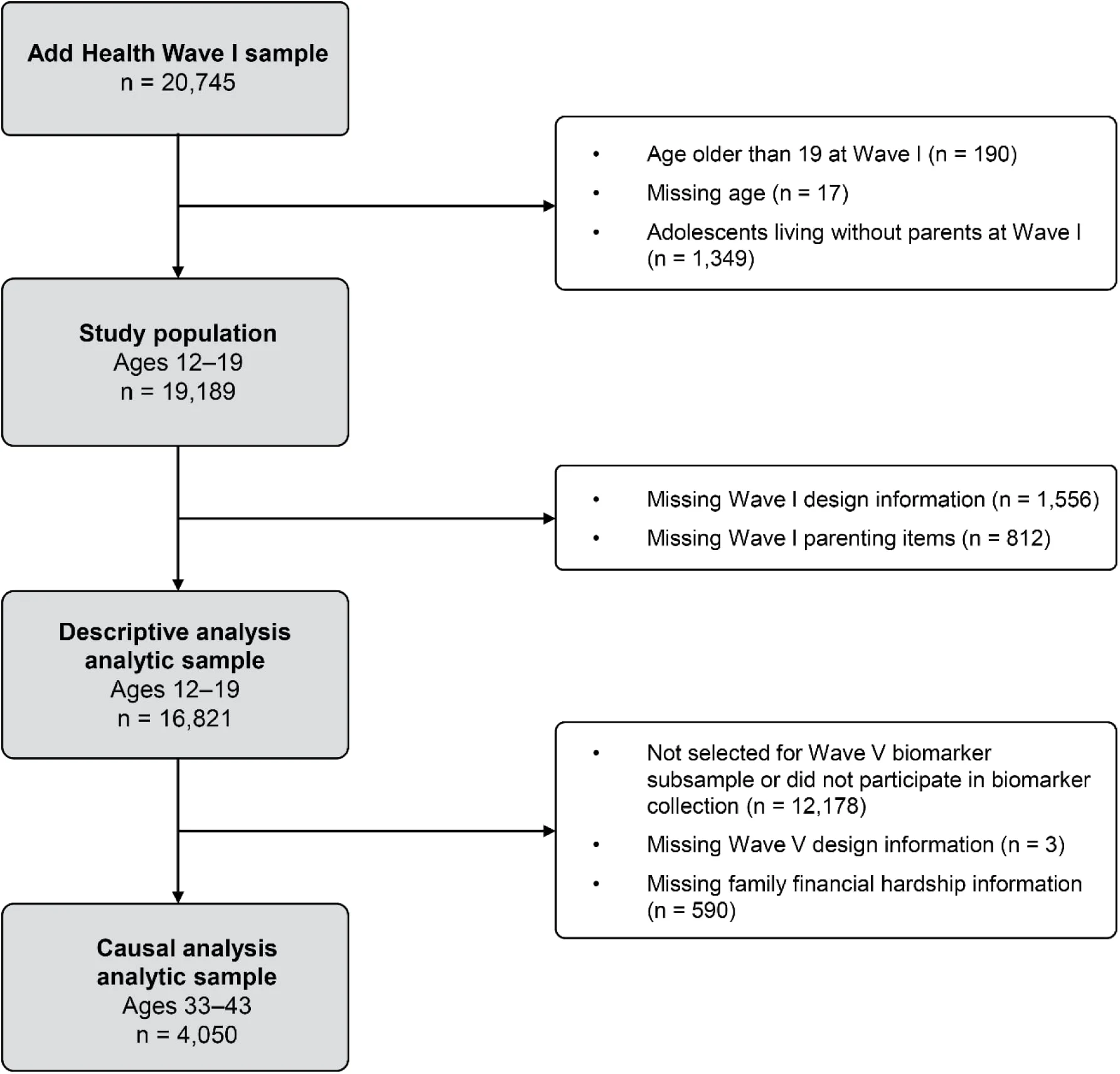
21 years
Abstract
PurposeFamily-based interventions are proposed for primordial cardiovascular disease (CVD) prevention, yet which family-environment components to target remains unclear. We quantified effects of parenting styles in adolescence on adult cardiovascular conditions, including hypertension, and whether effects differ by family financial hardship. MethodsData were from the US National Longitudinal Study of Adolescent to Adult Health (n=4,050). Parenting styles were derived via latent class analysis of adolescent-reported parental responsiveness and demandingness (ages 12-19, 1994-1995). Family financial hardship was based on parent-reported ability to pay bills. CVD and hypertension were assessed via biomarkers and self-report (ages 33-43, 2016-2018). Confounding factors were selected based on a directed acyclic graph; risk differences were estimated using doubly robust inverse-probability-weighted models. ResultsThree parenting styles emerged: authoritative (11.1%), permissive (77.9%), and indifferent (11.0%). After 21 years, 33.0% had CVD or hypertension. Whole-population risk differences for permissive and indifferent versus authoritative parenting were -1.0% (95% CI: -5.3, 3.3%) and -1.8% (95% CI: -7.8, 4.2%), respectively. Among families reporting financial hardship, permissive parenting had lower risk (-15.9%, 95%CI: -28.4%, -3.3%), though inconsistent across sensitivity analyses. ConclusionsAdolescent parenting styles had small estimated long-term cardiovascular effects, with no robust evidence of differences by financial hardship.
- Indifferent parenting
- Permissive parenting
- Cardiovascular conditions
- Cardiovascular disease
- Hypertension
- Humans
The paper
University of Fribourg
medRxiv, 25 Aug 2026, CC BY, Preprint, not peer-reviewed