Fat metabolism linked to muscle problems in aging obese mice
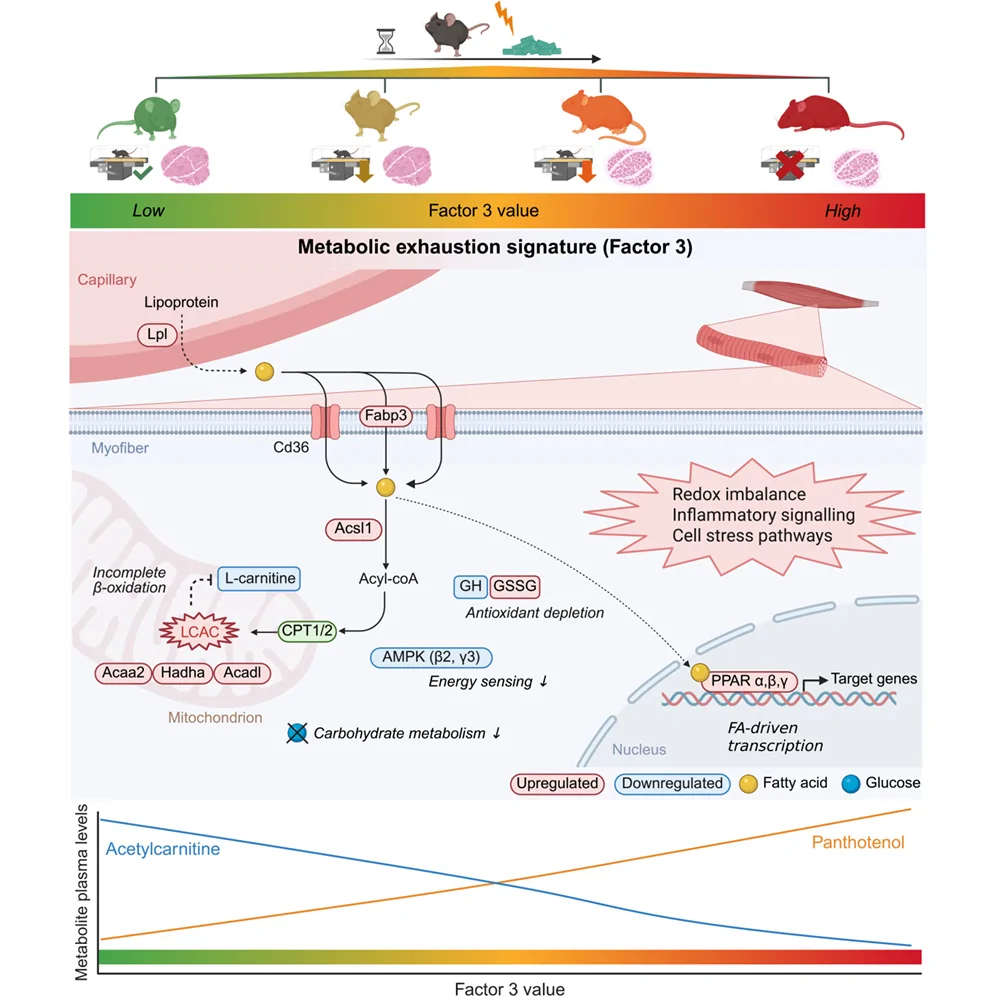
Female mice fed a high-fat diet for seven months developed obesity, but signs of metabolic exhaustion tracked differences in muscle dysfunction rather than obesity severity.
Our read
Mechanisms- Studied:
- Experiments in aging female mice, 7 months
- What changed:
- Metabolic exhaustion tracked muscle dysfunction independently of obesity severity
- The catch:
- Group sizes are missing, limiting assessment of how reliably the pattern distinguished muscle outcomes
- Why it’s aging research:
- It measures an outcome that worsens with age.
Editor of record: Boris Djordjevic · AgingResearch.News
Twelve-month-old female mice ate a high-fat or standard diet for seven months in an animal experiment. Researchers combined measurements of muscle gene activity and small molecules in a statistical analysis. All high-fat-fed mice developed obesity, but their muscle outcomes varied. One pattern in the data predicted muscle dysfunction independently of obesity severity.
That pattern pointed to what the authors called metabolic exhaustion. Activity rose in genes involved in burning fat, while molecules accumulated that indicated incomplete fat breakdown. Levels of free L-carnitine, a molecule involved in fat metabolism, fell. Pathways involved in inflammation and cellular stress responses were also activated. The authors concluded that differences in metabolic exhaustion, rather than obesity severity, reflected susceptibility to muscle decline alongside obesity.
Why it matters
Age-related muscle decline does not affect every individual with obesity equally. The findings point to fat handling in muscle as a potential focus for understanding that vulnerability.
Caveats
The susceptibility pattern came from a statistical analysis within a diet experiment in female mice, not people. The abstract does not give group sizes, limiting assessment of how reliably the pattern distinguished muscle outcomes.
Where the evidence stands
Fatty acid β-oxidation
- 148 independent labs in 28 countries
- 8 findings against
- Funders: National Institutes of Health and others
- 32 of 217 findings with company ties
Lipid and ceramide metabolism
- 226 independent labs in 36 countries
- 17 findings against
- Funders: National Institutes of Health and others
- 35 of 333 findings with company ties
The paper
Vita-Salute San Raffaele University
iScience, Oct 29, 2026, Open access
Comments
Be the first to comment.