Single vaccine dose produced lasting immune responses in mice
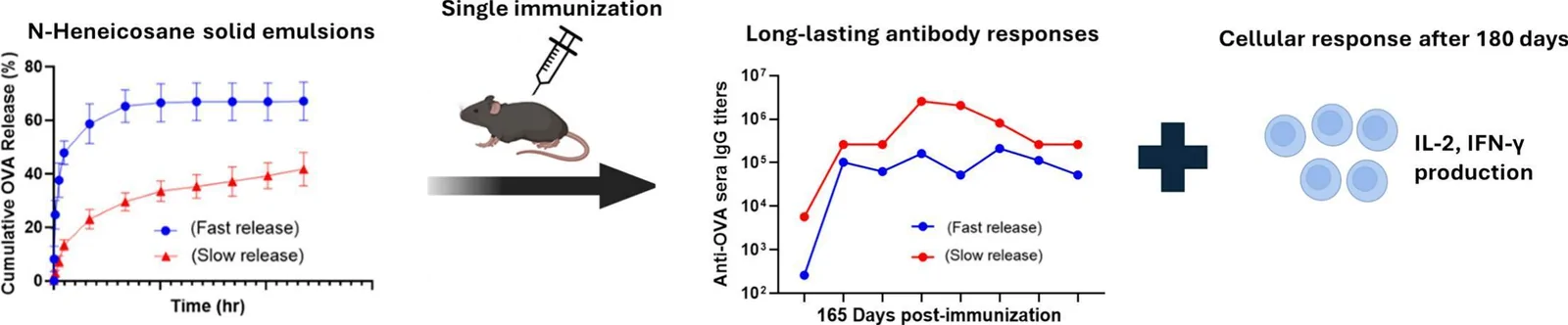
Antibody responses persisted for 165 days after one dose, while immune cells from the spleen showed responses at 180 days.
Paper by Ontiveros-Padilla L, Ehrenzeller SA, Murphy CT et al.
Limit: Immune responses were measured rather than protection against infection
In experiments in mice, researchers tested a vaccine delivery system designed to release its contents gradually. They used an emulsion made with the compound n-heneicosane to carry subunit vaccines, which use selected parts of a pathogen. The mice received a single injection under the skin.
Antibody responses persisted for 165 days after one immunization. Researchers also detected responses from immune cells taken from the spleen at 180 days. In a poxvirus vaccine model, antibody responses matched or exceeded those from an initial vaccination plus booster using Addavax, an immune-boosting vaccine ingredient. A single immunization also generated strong antibody and immune-cell responses in 18-month-old mice.
Why it matters
Age-related immune dysfunction poses a challenge for vaccination. The older-mouse results suggest that this delivery approach may help address that challenge.
Caveats
The abstract reported immune responses, not demonstrated protection against infection. These mouse findings do not establish effectiveness in people, and the reported durations were not specifically attributed to the older mice.
The paper
Ontiveros-Padilla L, Ehrenzeller SA, Murphy CT et al.
International Journal of Pharmaceutics, Oct 6, 2026