Association of Non-Cytochrome P450 3A4-Metabolized Statins Versus Atorvastatin With Major Adverse Cardiovascular Events in Patients With Cancer Receiving Tyrosine Kinase Inhibitors: A Propensity Score-Matched Target Trial Emulation
Abstract
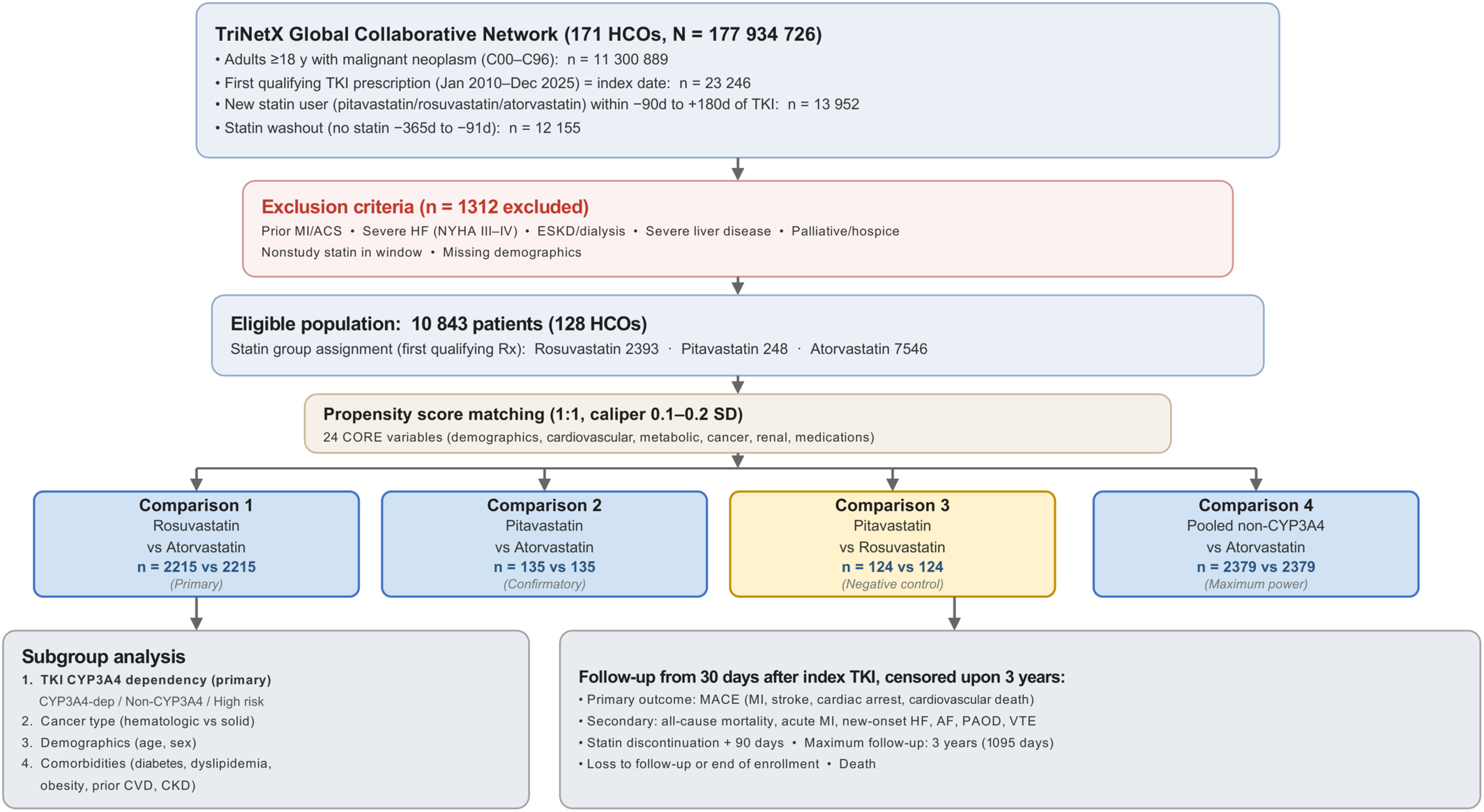
BACKGROUND: Tyrosine kinase inhibitors (TKIs) often undergo CYP3A4 (cytochrome P450 3A4) metabolism. Atorvastatin is a CYP3A4 substrate, whereas rosuvastatin and pitavastatin largely bypass this pathway. We evaluated whether statin choice was associated with major adverse cardiovascular events in TKI-treated patients with cancer. METHODS: Using TriNetX, we conducted an active-comparator, new-user target trial emulation among adults with cancer receiving their first TKI. The index date was the first statin dispensation; outcome ascertainment began on Day 30 and continued up to 3 years. Separate 1:1 propensity score-matched comparisons included rosuvastatin versus atorvastatin (primary; 2215 per group), pitavastatin comparisons, and a pooled non-CYP3A4 statin comparison. RESULTS: Among 10 843 eligible patients (mean age, 66.7 years; 60.7% male), rosuvastatin was associated with a lower major adverse cardiovascular events rate than atorvastatin (624 versus 769 events; hazard ratio [HR], 0.84 [95% CI, 0.76-0.93]). The proportional-hazards assumption was violated (P=0.042), so the HR was interpreted as a time-averaged association. The pooled comparison was concordant (HR, 0.87 [95% CI, 0.78-0.96]). The early-persistence Day-180 estimate was imprecise (HR, 0.90 [95% CI, 0.73-1.09]). CONCLUSIONS: Rosuvastatin use was associated with lower major adverse cardiovascular events than atorvastatin in TKI-treated patients with cancer. This observational finding is compatible with, but does not establish, a CYP3A4-mediated interaction. Residual confounding, nonaligned TKI and statin timing in part of the primary cohort, and lack of individual-level event-time data require prospective confirmation.
- Non-cyp3a4-metabolized statins
- Pitavastatin
- Rosuvastatin
- Major adverse cardiovascular events
- Cancer
- Humans
The paper
National Defense Medical University Taipei Taiwan
Journal of the American Heart Association, 16 Oct 2026