Routinely Derived Metabolic Indices for IDF-Defined Metabolic Syndrome in Chinese Adults: A Cross-Sectional Study
Multicentre
Abstract
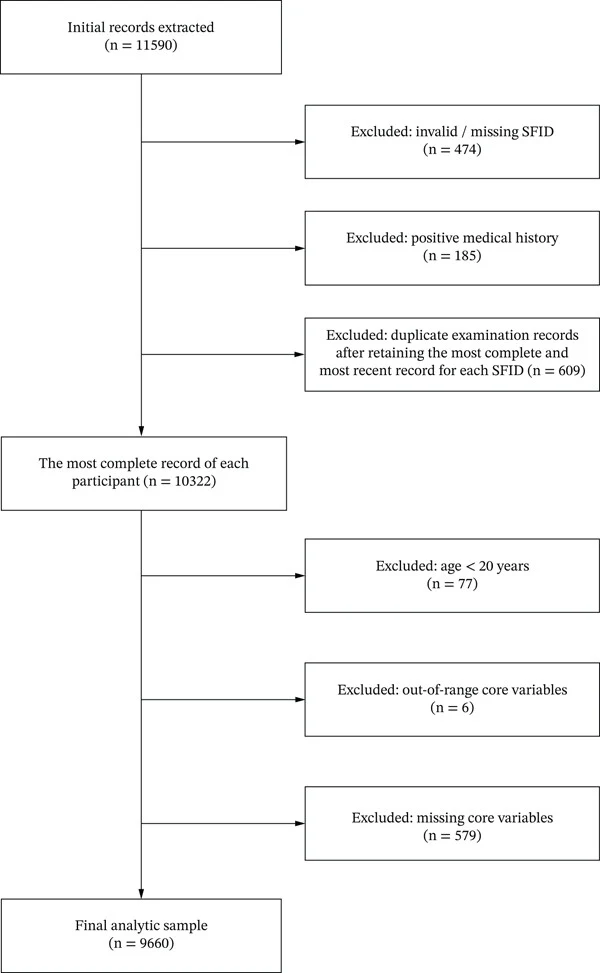
OBJECTIVE: The aim of this study is to compare the standardized associations, cross-sectional discrimination, and distributional robustness of 13 routinely derived metabolic indices for International Diabetes Federation (IDF)-defined metabolic syndrome (MetS). METHODS: We included 9660 Chinese adults who underwent routine health examinations at Peking University Shenzhen Hospital between August 2024 and March 2026. Associations were assessed using logistic regression with standardized indices and restricted cubic splines, and overall and prespecified subgroup discrimination were evaluated using receiver operating characteristic analyses. Fully adjusted analyses included age, sex, low-density lipoprotein cholesterol, total bilirubin, blood urea nitrogen, creatinine, and uric acid. Robustness was examined after 1st-99th percentile winsorization using self-standard deviation (self-SD) and fixed main-sample standard deviation (fixed main-SD) standardization. RESULTS: Among 9660 participants, 1635 had MetS (16.93%). The cardiometabolic index (CMI) showed the strongest standardized association (odds ratio (OR) per standard deviation increment, 19.437), followed by the triglyceride-glucose waist circumference index (TyG-WC; OR, 16.332). TyG-WC had the highest overall area under the receiver operating characteristic curve (AUC, 0.934; 95% confidence interval (CI), 0.929-0.939) and the highest AUC in 9 of 11 prespecified strata. After winsorization, TyG-WC retained strong standardized associations under self-SD and fixed main-SD scaling (ORs, 17.181 and 18.638, respectively) and stable discrimination (AUC, 0.935), whereas CMI, the lipid accumulation product (LAP), visceral adiposity index (VAI), and triglyceride-total cholesterol-body weight index (TCBI) showed substantial scale dependence. All indices showed nonlinear associations (p < 0.001). CONCLUSION: The 13 indices differed in association strength, discrimination, and distributional robustness. TyG-WC showed the most balanced overall profile and maintained strong discrimination across most prespecified subgroups. These findings support the further evaluation of TyG-WC in routine health examination settings. Further validation in independent multicenter populations is required.
- Metabolic syndrome
- Blood urea nitrogen
- Cardiometabolic index
- Creatinine
- Lipid Accumulation Product
- Humans
The paper
Peking University Shenzhen Hospital
Journal of Diabetes Research, 1 Jan 2026