Association of Senior Dance Participation with Mental Well-Being and Functional Performance in Older Women: A Cross-Sectional Study
Registered NCT07170241
Abstract
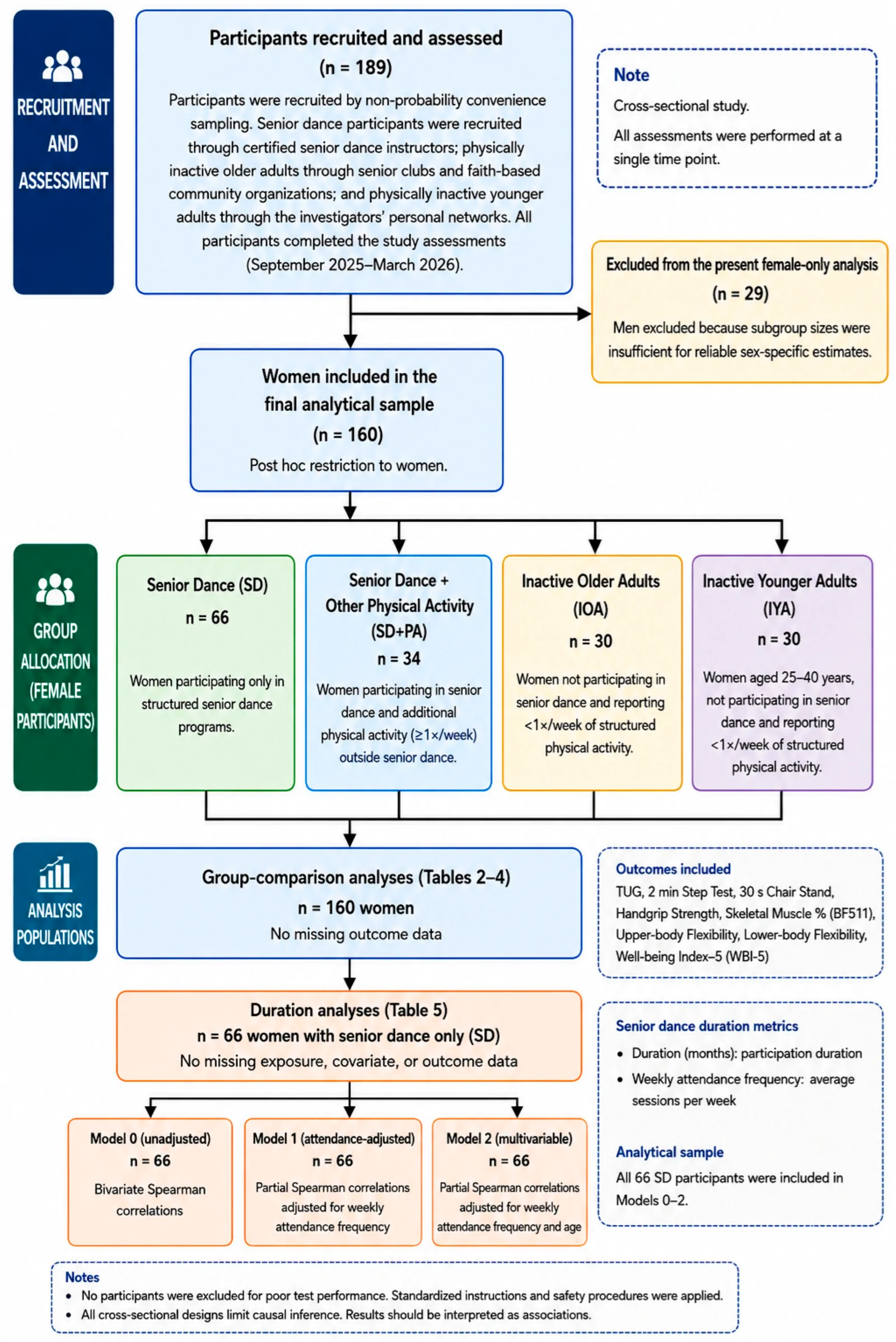
Background/Objectives: Community-based activities supporting physical function and mental well-being are increasingly relevant in later life. This cross-sectional study compared mental well-being and physical outcomes among older women participating in senior dance only, senior dance plus additional regular physical activity, and physically inactive older groups; a younger inactive group provided exploratory age-related context. A secondary aim was to examine correlations with participation duration. Methods: Participants were 160 women: 66 in senior dance only (SD), 34 in senior dance plus additional regular physical activity (SD+PA), 30 physically inactive older women, and 30 physically inactive younger women aged 25-40 years. Mental well-being was assessed with the Hungarian four-response five-item Well-Being Index (WBI-5), together with seven physical outcomes. Welch's ANOVA and prespecified Welch-Satterthwaite contrasts with Benjamini-Hochberg correction were used; duration analyses used partial Spearman correlations adjusted for weekly attendance and age. Results: Overall group differences were observed for all outcomes (all p ≤ 0.002). Seven outcomes remained significant in Contrast 1, which did not isolate a dance-specific association. No SD versus SD+PA difference remained significant after correction. Within SD, participation duration correlated with more favorable Timed Up and Go (rs = -0.428), 30-Second Chair Stand (rs = 0.425), and 2-Minute Step Test performance (rs = 0.423; all q = 0.0013). The adjusted WBI-5 correlation did not remain significant after FDR correction (rs = 0.271; q = 0.061). Conclusions: Participation duration was most consistently correlated with integrated functional performance. Prospective studies are required; causal effects cannot be inferred. ClinicalTrials.gov: NCT07170241.
The paper
Journal of Clinical Medicine, 4 Oct 2026, Open access