Social ties and well-being linked to frailty in older adults
In 751 older Japanese adults, well-being and life satisfaction accounted for 95.3% of the modelled indirect link between social ties and frailty.
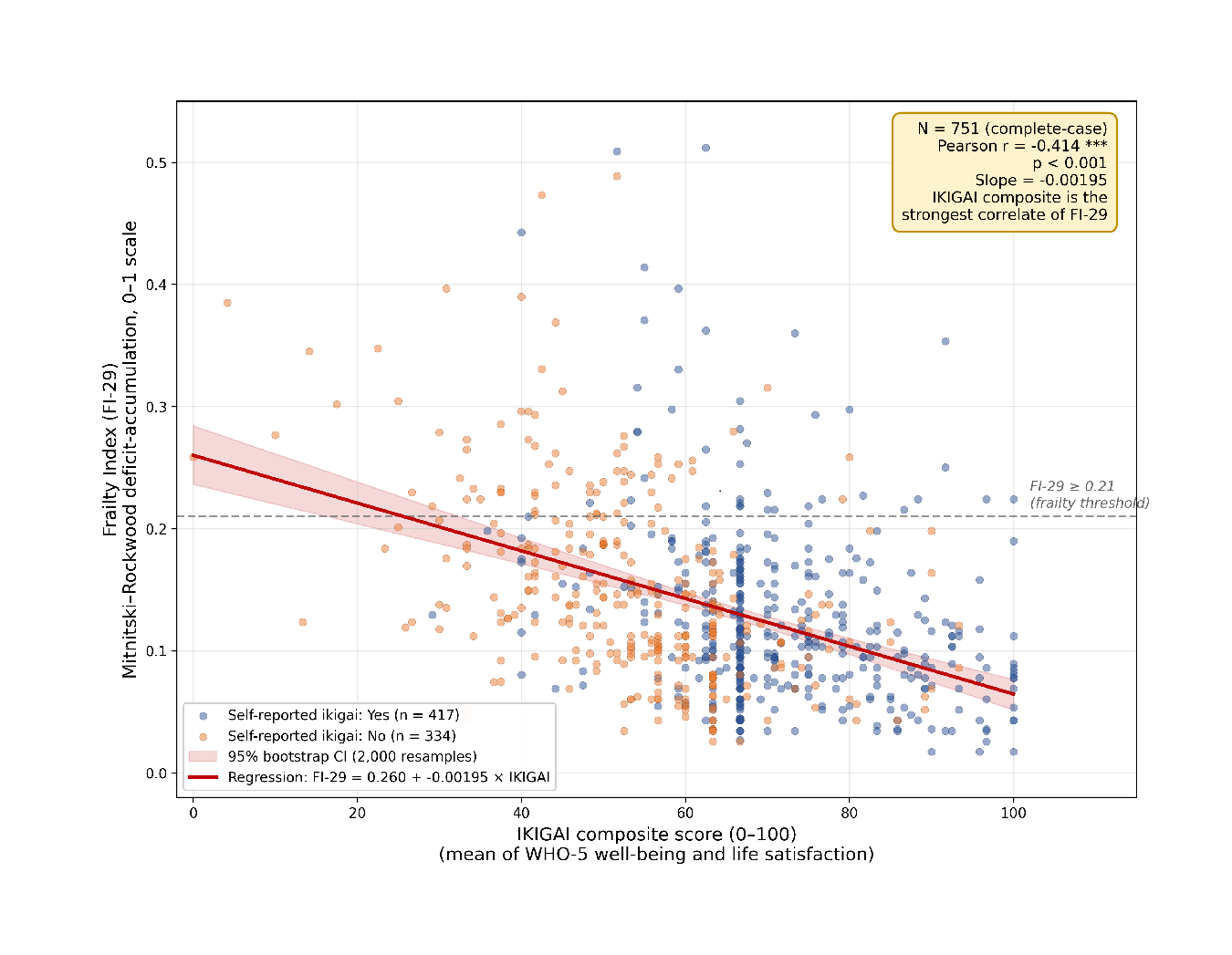
An observational, cross-sectional study examined social ties, ikigai and physical activity in 751 community-dwelling older Japanese adults, whose mean age was 72.9 years. Participants came from the Kyotango Multipurpose Cohort. Researchers measured ikigai, a Japanese concept of meaning in life, using well-being and life satisfaction scores. They assessed frailty with an index of accumulated health problems.
Their statistical model attributed 95.3% of the total indirect link between social networks and frailty to the pathway through ikigai alone. Physical activity had a separate association with frailty, with no detected link to ikigai. The results held across four versions of the frailty index and after accounting for dietary fibre intake.
Why it matters
Frailty concerns health in later life. The authors proposed ikigai as a possible target for efforts to prevent frailty.
Caveats
This cross-sectional analysis could not establish cause and effect or the order in which the associations arose. The paper is a preprint and has not been peer-reviewed.
From the paper
- Participants
The cohort comprised 786 participants who were recruited from June 2017 to March 2020; the recruitment procedures and deficit-accumulation FI have been previously described in detail7,17.
- Limitation
Second, all exposures were self-reported; nevertheless, support from public health nurses markedly mitigated typical concerns regarding recall bias in older participants.
Quoted word for word from the full text on researchsquare.com.
The paper
Kyoto Prefectural University of Medicine
Research Square, 11 Oct 2026, Preprint, not peer-reviewed