Mitochondrial-derived peptides in female reproduction: Emerging regulators of oocyte competence and novel therapeutic opportunities for infertility
Abstract
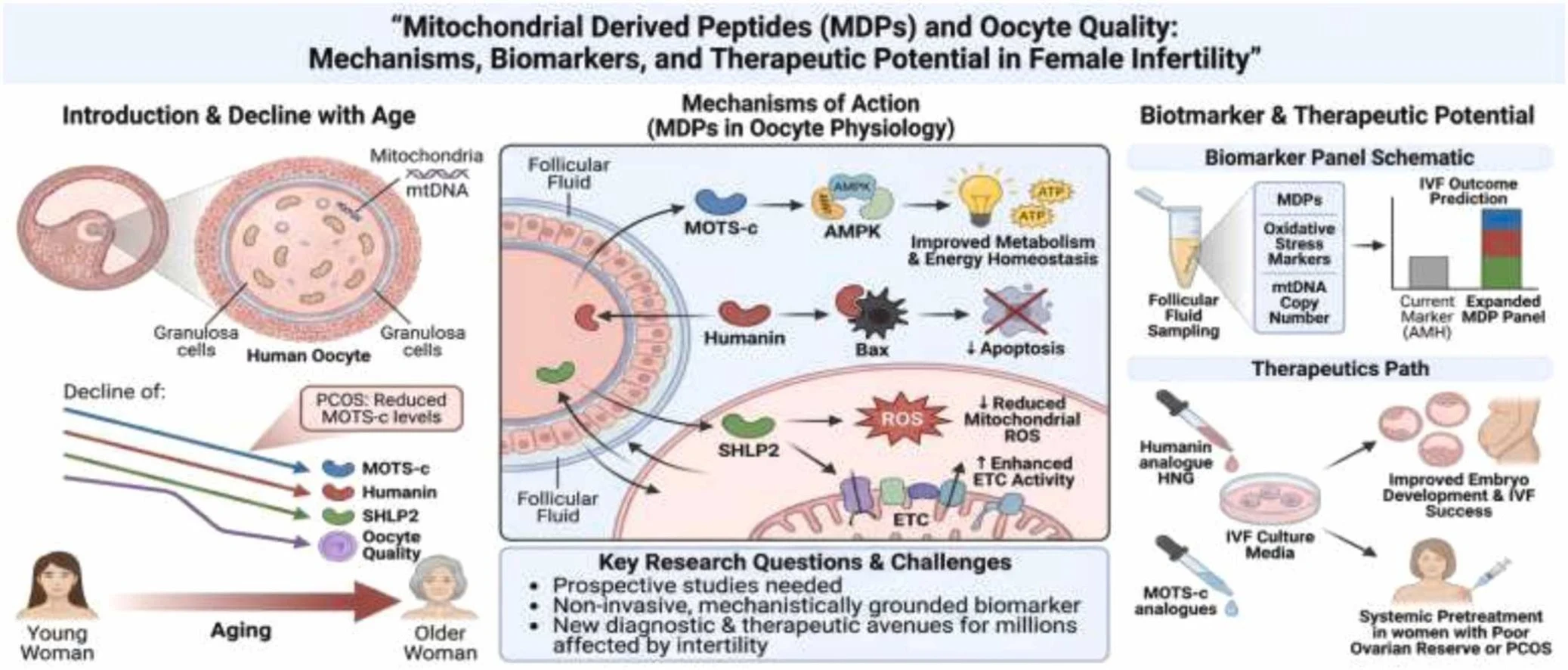
Female infertility affects approximately 17.5% of adults worldwide. Mitochondria are central to oocyte developmental competence, and a novel class of mitochondrial genome-encoded peptides, mitochondrial-derived peptides(MDPs) comprising MOTS-c, Humanin and small Humanin-like peptide2(SHLP2), regulates cellular metabolism, oxidative stress and apoptosis. This hypothesis-driven perspective aims to:(i) synthesize indirect evidence to construct a mechanistic framework for MDP involvement in oocyte physiology and female infertility;(ii) propose prioritized research questions; and(iii) delineate translational paths toward MDP-based biomarkers and therapeutics in assisted reproductive technology(ART). PubMed, Scopus and Web of Science were searched up to May 2025 using terms related to MDPs, oocytes, follicular fluid, ovarian aging and IVF. Bibliographies were hand-searched. The search yielded 312 records, of which 87 were retained. The three principal MDPs decline with age in humans, mirroring the age-related deterioration of oocyte quality. The reduced MOTS-c in polyendocrine metabolic ovarian syndrome (PMOS; formerly polycystic ovary syndrome, PCOS) (a 56% reduction in serum concentration versus controls, P < 0.001), provides preliminary evidence, albeit unreplicated and without ovarian sampling. Mechanistically, MDPs activate AMPK(MOTS-c), sequester pro-apoptotic Bax(Humanin), and reduce mitochondrial ROS while enhancing electron transport chain activity(SHLP2). Humanin is already known to be present in human follicular fluid and to associate with ovarian reserve and PMOS-related insulin resistance; we propose that this extends to MOTS-c and SHLP2, that composite MDP levels correlate with oocyte-specific quality parameters, and that a composite biomarker panel could improve IVF outcome prediction beyond AMH alone. MDPs(MOTS-c,Humanin,SHLP2) decline with age, regulate AMPK, suppress oxidative stress and inhibit apoptosis; processes that drive oocyte quality decline. Reduced MOTS-c in PMOS provides an initial, unreplicated clinical link. Convergent biology positions MDPs as promising candidates to improve IVF outcomes. Direct empirical testing, starting with quantification of MDPs in human follicular fluid and granulosa cells, is now warranted.
- BAX
- Mitochondrial-derived peptides
- Female infertility
- Humanin
- Mitochondrial reactive oxygen species
- MOTS-c
The paper
Babol University of Medical Sciences
Tissue & Cell, 11 Oct 2026