Association between android-to-gynoid lean mass ratio and advanced cardiovascular-kidney-metabolic syndrome, and the cross-sectional association decomposition of estimated glucose disposal rate
Abstract
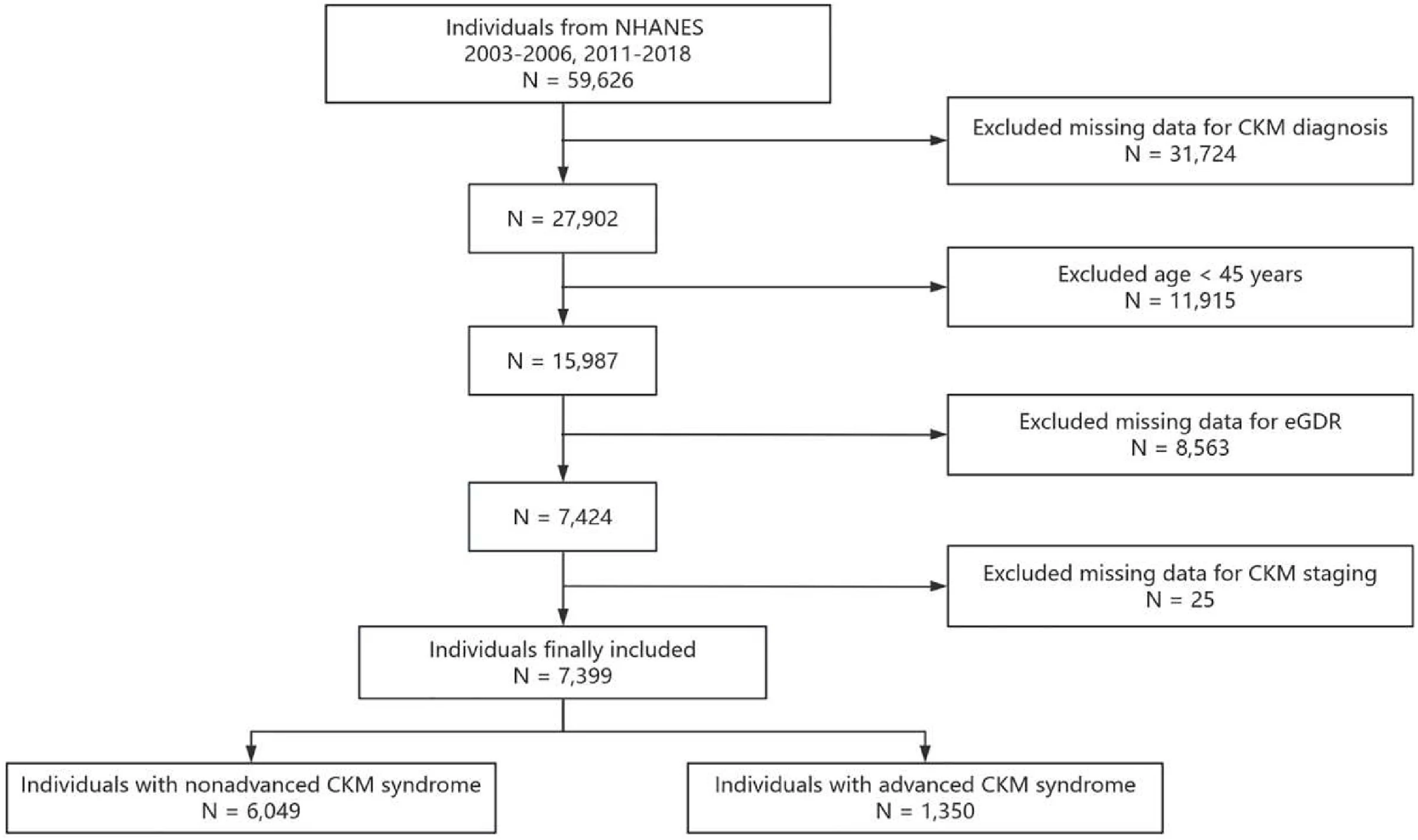
BACKGROUND: The Android-to-Gynoid Lean Mass (LM) Ratio (AGLR) reflects the distribution of body LM and may influence the risk of advanced Cardiovascular-Kidney-Metabolic (CKM) syndrome. However, the extent to which Insulin Resistance (IR), as indicated by the estimated Glucose Disposal Rate (eGDR), explains the association between AGLR and advanced CKM syndrome remains unclear. This study aims to elucidate the relationship between AGLR and advanced CKM syndrome and to determine the contribution of eGDR to this association. METHODS: 7,399 participants from the 2003‒2006 and 2011‒2018 cycles of the National Health and Nutrition Examination Survey (NHANES) were included in this cross-sectional study. The association between AGLR and advanced CKM syndrome was assessed using weighted Logistic Regression (LR) and subgroup analyses. The potential relationship was further examined using Restricted Cubic Splines (RCS). Sensitivity analyses were conducted to evaluate the robustness of the findings. Cross-sectional decomposition analysis was performed to quantify the contribution of eGDR to the observed associations. RESULTS: Higher AGLR was associated with stage 4 of CKM syndrome (OR = 1.83, 95% CI: 1.34‒2.50, p < 0.001). For stage 3, the overall trend across quartiles was not significant, indicating a less robust association. Reverse causality cannot be excluded. RCS analysis revealed a positive linear relation (p for nonlinear = 0.681). Subgroup analyses suggested that interactions were statistically insignificant across subgroups. Cross-sectional decomposition analysis showed that eGDR statistically accounted for 33.71% of the association. Notably, given shared components and the cross-sectional design, this should not be interpreted as causal mediation. CONCLUSION: LM distribution is relevant to CKM syndrome progression. IR, as reflected by eGDR, may represent a key underlying pathological mechanism.