Feasibility of High-Intensity Interval Exercise in Young Adult Survivors of Pediatric Brain Tumor and Young Adults With Isocitrate Dehydrogenase-Mutant Gliomas (HYPE): Protocol for a Randomized Controlled Trial
Abstract
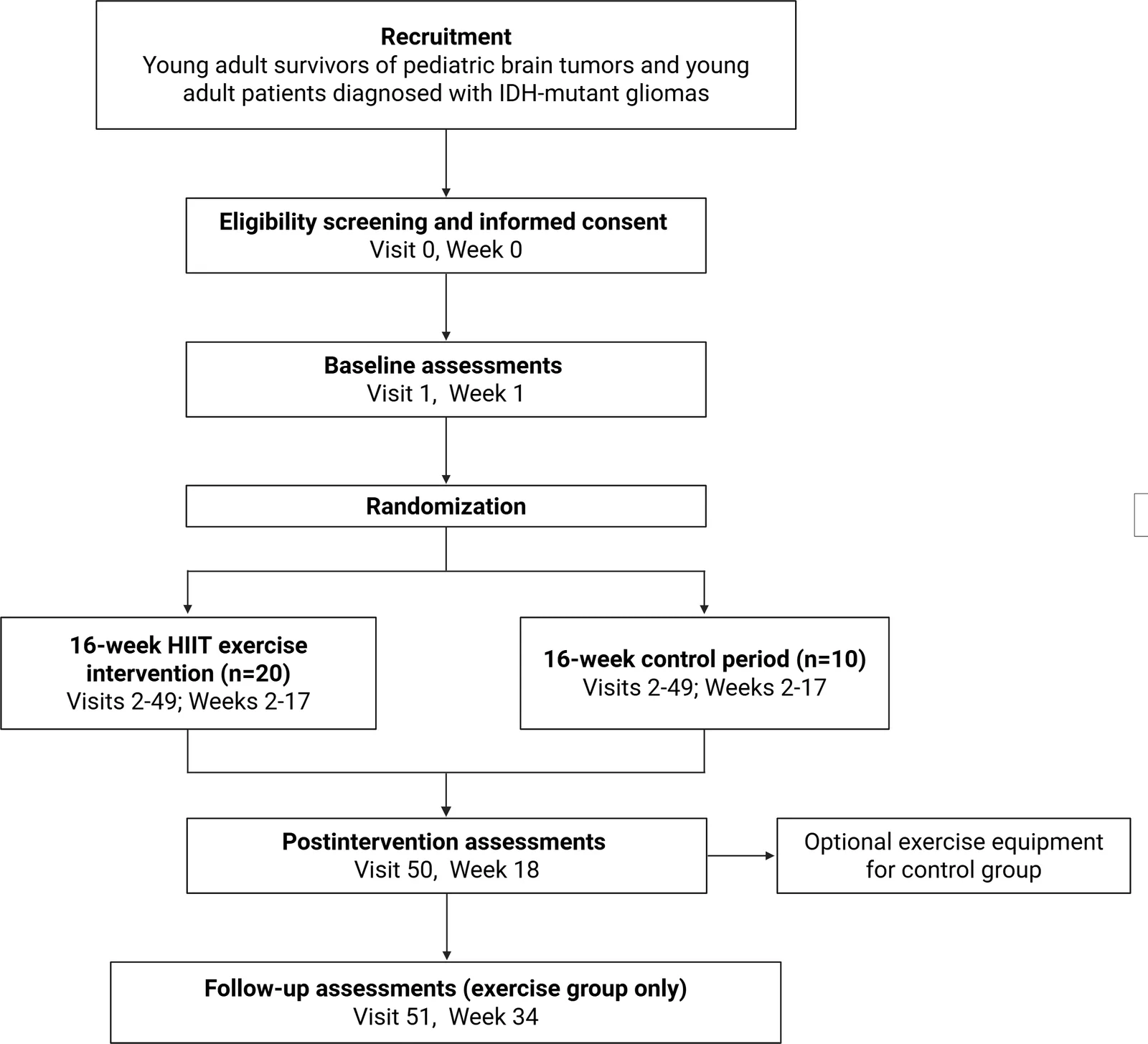
BACKGROUND: Young adult survivors of pediatric brain tumors and young adult patients with isocitrate dehydrogenase (IDH) mutant gliomas are at risk for cognitive impairment, reduced physical fitness and function, as well as poor health-related quality of life (HRQOL) and psychosocial health. Exercise improves these outcomes; however, both populations remain understudied with respect to exercise interventions. High-intensity interval training (HIIT) is a promising intervention, as it is time-efficient, safe, tolerable, enhances cognition in healthy young adults, and improves physical fitness and quality of life in adult patients and survivors with cancer. However, the feasibility of HIIT is not yet understood in survivors of pediatric brain tumors and patients with IDH-mutant glioma. OBJECTIVE: The HYPE study is a pilot randomized controlled trial that aims to (1) determine the feasibility of a HIIT exercise intervention for young adult survivors of pediatric brain tumors and patients with IDH-mutant glioma, (2) determine the preliminary efficacy of HIIT to improve physical fitness and function, cognition, HRQOL, and psychosocial health, and (3) explore exercise sustainability and the impact of social determinants of health on study outcomes. METHODS: A total of 30 young adult survivors of pediatric brain tumors and patients with IDH-mutant glioma (18-45 years of age) will be randomized to an exercise or control group. The exercise group performs virtually supervised HIIT 3 times per week for 16 weeks, followed by 16 weeks of self-directed exercise. Exercise involves indoor cycling, and sessions include 20 minutes of high- and low-intensity intervals (high intensity=60-s 60%-90% peak power output; low intensity=60-s 10% peak power output), and a 5-minute warm-up and cool-down. The control group performs a 16-week stretching program. Feasibility of the HIIT intervention is measured by the number of exercise sessions completed, including total minutes and intensity, and barriers to exercise adherence. Cognition, physical fitness and function, HRQOL, and psychosocial health are measured using standardized assessments and self-report questionnaires. Exercise sustainability is measured by change in study outcomes following the self-directed follow-up period, and social determinants of health are assessed using a self-report questionnaire. RESULTS: Baseline data collection began in February 2024, and 13 participants have been enrolled as of June 2026. The projected study end date is December 2026. Data analysis is planned to begin in January 2027, and findings will be published in the fall of 2028. CONCLUSIONS: To our knowledge, this study is the first to use a virtually supervised HIIT intervention in young adult patients and survivors of brain tumor. The findings will elucidate the feasibility of HIIT to design and power a randomized controlled trial to address cancer- and treatment-related sequelae. They will also provide insights into the sustainability of HIIT and the impact of social determinants of health.


