Laser Therapy for Sexual Health in Breast Cancer Survivors Receiving Aromatase Inhibitors: A Secondary Analysis of a Randomized Clinical Trial
12 months, double-blind, sham-controlled, registered NCT04619485
Abstract
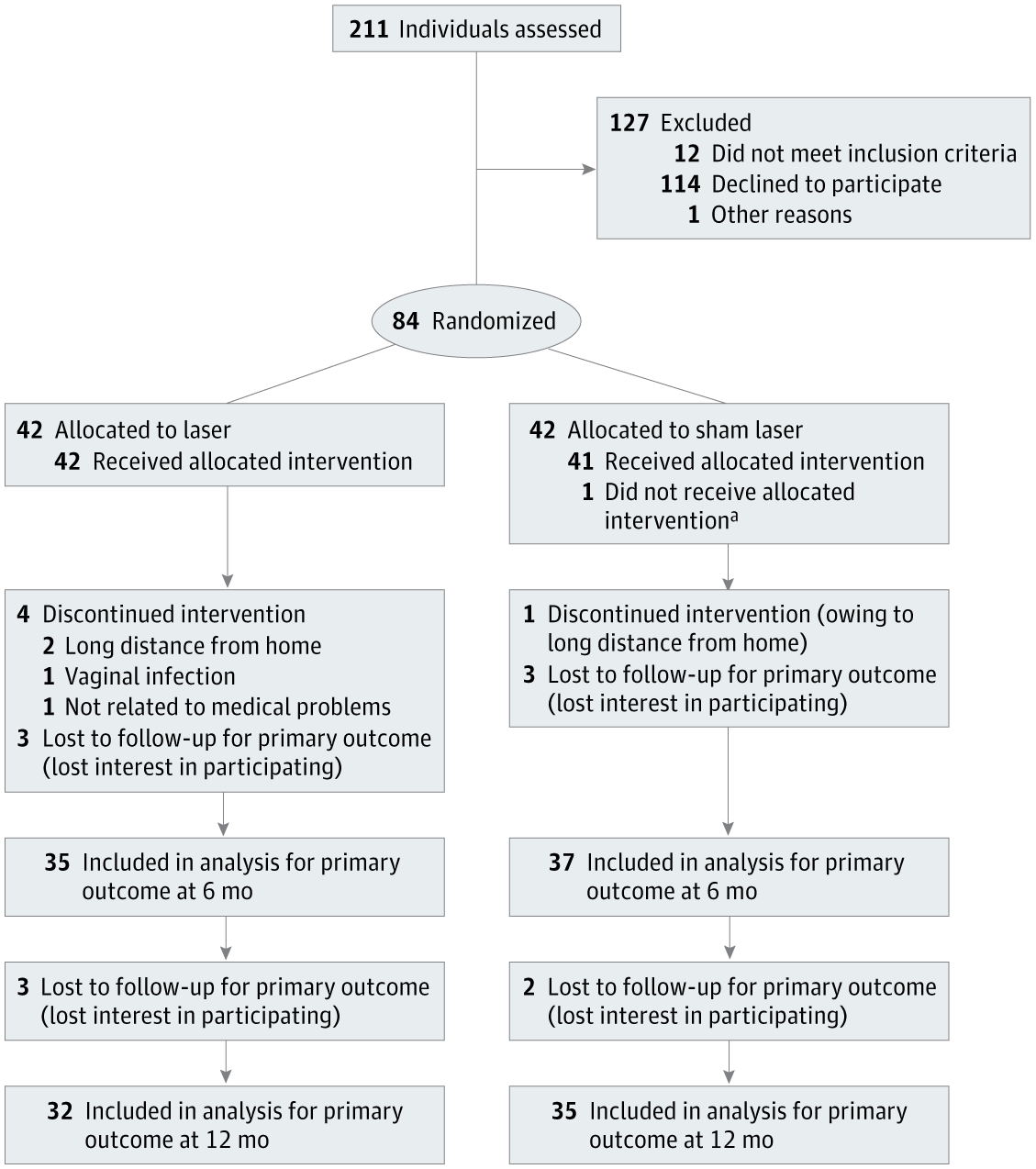
IMPORTANCE: Laser therapy is increasingly used to treat genitourinary syndrome of menopause (GSM) in breast cancer survivors, but sham-controlled evidence of benefit remains limited. OBJECTIVE: To evaluate 12-month efficacy and safety of fractional carbon dioxide (CO2) laser therapy (CLT) vs sham laser therapy (SLT) for GSM in breast cancer survivors receiving aromatase inhibitors. DESIGN, SETTING, AND PARTICIPANTS: This is a secondary analysis of a single-center, double-blind, sham-controlled randomized clinical trial conducted at a tertiary academic hospital in Spain. Participants included breast cancer survivors with GSM and dyspareunia receiving aromatase inhibitors, recruited from October 30, 2020, to September 1, 2021. Participants were followed up for 12 months. Data were analyzed from December 1, 2024, to June 30, 2025. INTERVENTION: Five monthly sessions of CLT or SLT plus first-line nonhormonal therapy (FLT), including vaginal moisturizers and vibrators. MAIN OUTCOMES AND MEASURES: The primary outcome was the between-group difference in change in Female Sexual Function Index (FSFI) score. Secondary outcomes included rate of sexual activity, dyspareunia, Spanish Body Image Scale, quality of life (12-Item Short Form Health Survey), Vaginal Health Index, objective parameters (pH, vaginal maturation index, epithelial measures), serum estradiol level, FLT adherence, and adverse events. RESULTS: Of the 84 randomized participants (mean [SD] age, 53.8 [8.8] years), 67 completed the 12-month follow-up (CLT, 32; SLT, 35). The CLT group did not differ from the SLT group in FSFI score change from baseline to 12 months (difference, CLT vs SLT, -0.69 [95% CI, -3.58 to 2.20]; P = .64), nor in any secondary outcome. Across the full sample, significant improvements from baseline to 12 months were observed in FSFI score (18.9 to 23.0; mean difference, 4.5 [95% CI, 3.1-5.9]; P < .001), dyspareunia (mean difference, -3.7 [95% CI, -4.4 to -3.0]; P < .001), Spanish Body Image Scale (mean difference, -3.9 [95% CI, -5.1 to -2.8]; P < .001), and Vaginal Health Index (mean difference, 4.2 [95% CI, 3.1-5.2]; P < .001). Sexual activity increased among 57 of 67 participants (85.1%; odds ratio, 2.35 [95% CI, 1.23-4.50]; P = .009). Improvements were found in pH (mean difference, -0.5 [95% CI, -0.8 to -0.2]; P < .001) and vaginal maturation index (mean difference, 19.0% [95% CI, 13.4%-24.5%]; P < .001). FLT adherence was similar between groups. No severe adverse effects occurred. CONCLUSIONS AND RELEVANCE: In this randomized clinical trial of breast cancer survivors receiving aromatase inhibitors, vulvovaginal CLT provided no additional benefit for sexual or vaginal health at 12 months. Improvements in both groups likely reflected FLT adherence, trial participation, or contextual factors rather than laser efficacy. High-quality sham-controlled trials remain essential before routine implementation. TRIAL REGISTRATION: ClinicalTrials.gov Identifier: NCT04619485.
The paper
University of Barcelona
JAMA Network Open, 1 Oct 2026


