Longitudinal Modeling of Cardiometabolic Dysfunction in Patients With Type 2 Diabetes Using Item Response Theory
Abstract
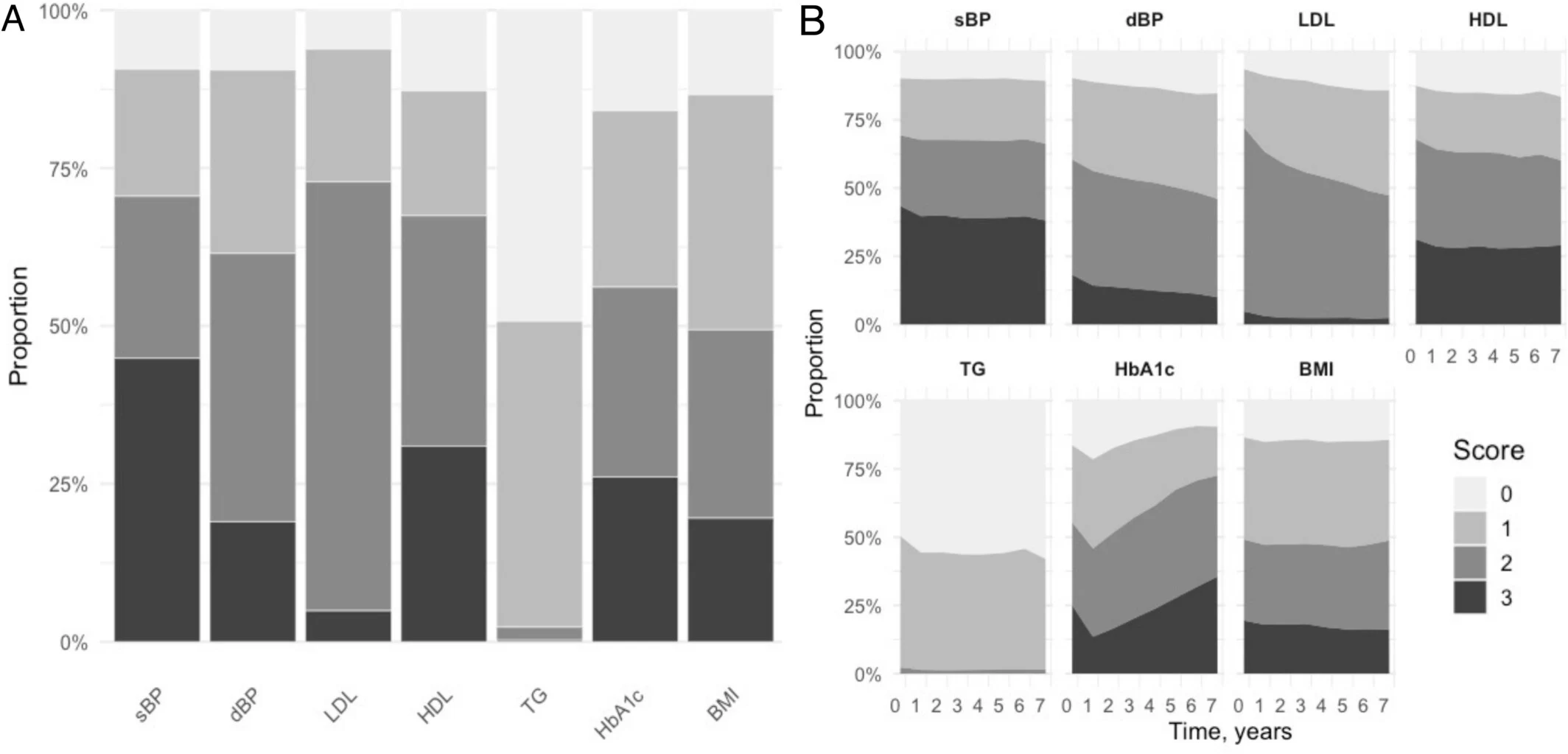
Cardiometabolic dysfunction in patients with type 2 diabetes (T2D) is reflected by multiple risk factors and cannot be fully characterized by any single biomarker. Item response theory (IRT) provides a framework for integrating observed risk factors into latent measures of underlying cardiometabolic dysfunction. Routinely collected measurements of systolic and diastolic blood pressure (sBP and dBP), high- and low-density lipoproteins (HDL and LDL), triglycerides (TG), HbA1c, and BMI from 33,396 adults newly diagnosed with T2D were analyzed, with biomarkers categorized into four ordered levels. A two-dimensional model described the data better than a unidimensional, identifying a blood pressure-related latent variable ( ψ ₁) primarily informed by sBP and dBP, and a metabolic latent variable ( ψ ₂) primarily informed by HDL, HbA1c, TG, and BMI, while LDL showed low discrimination on both dimensions. At baseline, age at T2D diagnosis was associated with both latent variables, with opposing effects of 0.02 for ψ ₁ and -0.07 for ψ ₂. Sex was associated with ψ ₂, with women scoring 0.43 units lower than men on the latent variable scale. Longitudinally, ψ ₁ and ψ ₂ showed post-baseline offsets of -0.10 and -0.22, respectively, followed by separately estimated annual slopes of approximately -0.03 year⁻¹. HbA1c exhibited a distinct trajectory with an initial post-baseline improvement followed by deterioration, requiring an item-specific slope of 0.45 year⁻¹. The ψ ₂ contributed modest additional information for all-cause mortality beyond age and sex. This framework integrated routinely collected biomarkers into continuous latent measures of multidimensional cardiometabolic dysfunction while accounting for differences in their contributions to the latent dimensions.
From the paper
- Limitation
Although the MIRT model was developed using registry data with a large sample size and broad coverage of clinical biomarkers, reliance on routinely collected observational data introduces challenges with data quality and consistency …
Quoted word for word from the full text on ascpt.onlinelibrary.wiley.com.