Modeling human neurodegeneration with iPSCs: opportunities, limitations, and the challenge of aging
Abstract
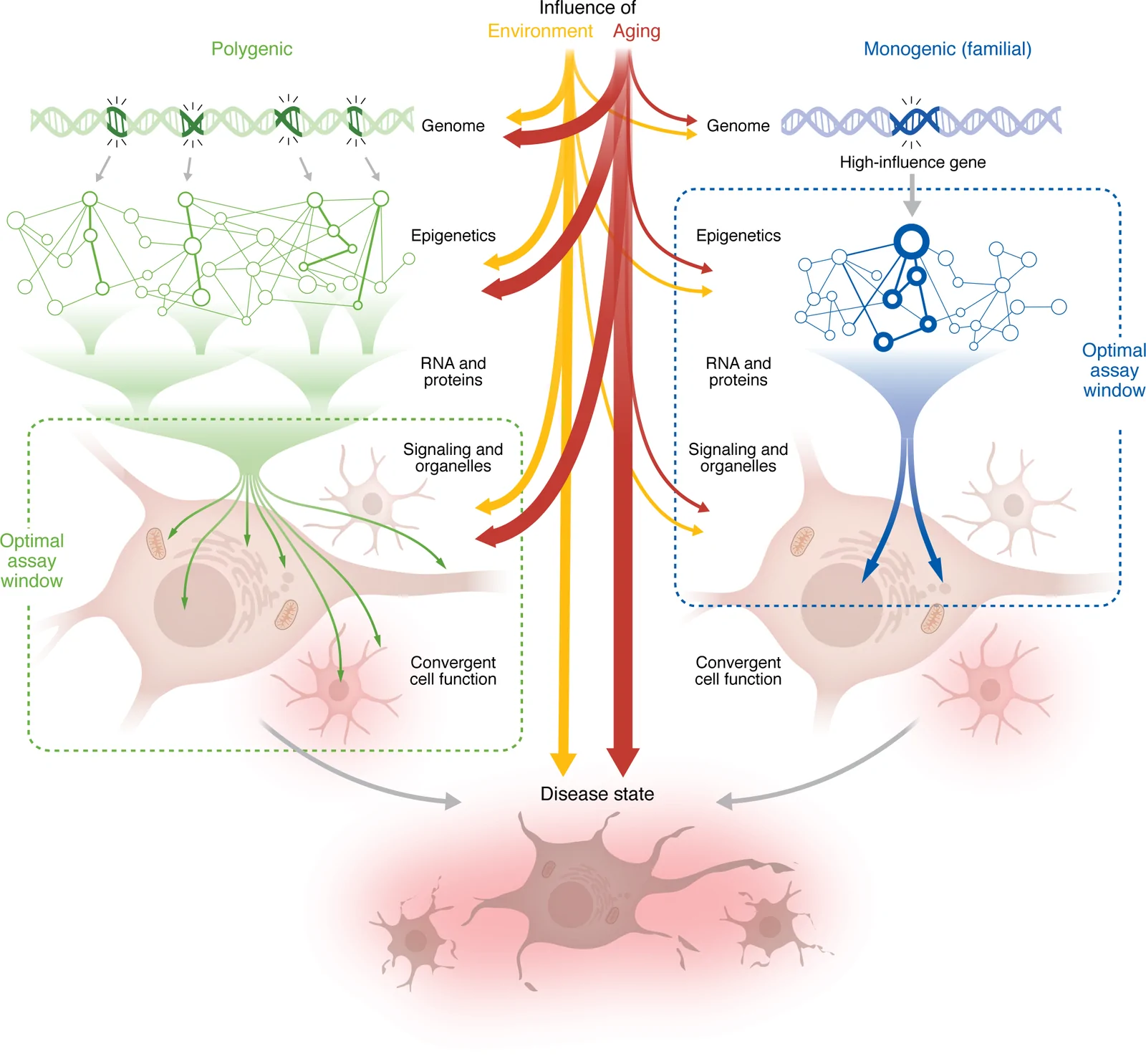
Most neurodegenerative diseases reflect patient-specific combinations of polygenic risk variants interacting with aging and environmental factors, rather than a single causative mutation. Phase III clinical trial failure rates for neurodegenerative indications exceed 95%, reflecting in part the limitations of existing preclinical systems to fully model the human genetic context of disease. Patient-derived induced pluripotent stem cells (iPSCs) have the potential to address this shortcoming by faithfully recapitulating human cell biology and preserving each patient's complete genetic architecture. This Review examines iPSC-based models of neurodegeneration across three themes. First, we discuss mechanisms revealed by these models, from convergent pathways uncovered by familial mutations to early evidence that sporadic disease biology is accessible at sufficient cohort scale. Second, we evaluate culture systems from 2-dimensional monocultures to organoids, examining how increasing complexity expands addressable biological questions while introducing trade-offs. Third, we address the aging problem: reprogramming erases epigenetic signatures of donor aging, removing the cellular context in which late-onset sporadic neurodegeneration emerges. We discuss strategies approximating aging in iPSC-derived neurons and highlight direct conversion strategies that preserve native epigenetic age, enabling access to age-dependent phenotypes. We propose a framework matching model systems to biological questions, improving mechanistic understanding and therapeutic development.
- Direct conversion
- Reprogramming
- Epigenetic regulation of gene expression
- Neurodegenerative disease
- Epigenetic age
- Humans
The paper
Gladstone Institutes
The Journal of Clinical Investigation, 15 Oct 2026, Open access