Prenatal Remote Blood Pressure Monitoring and Detection of Chronic Hypertension
Abstract
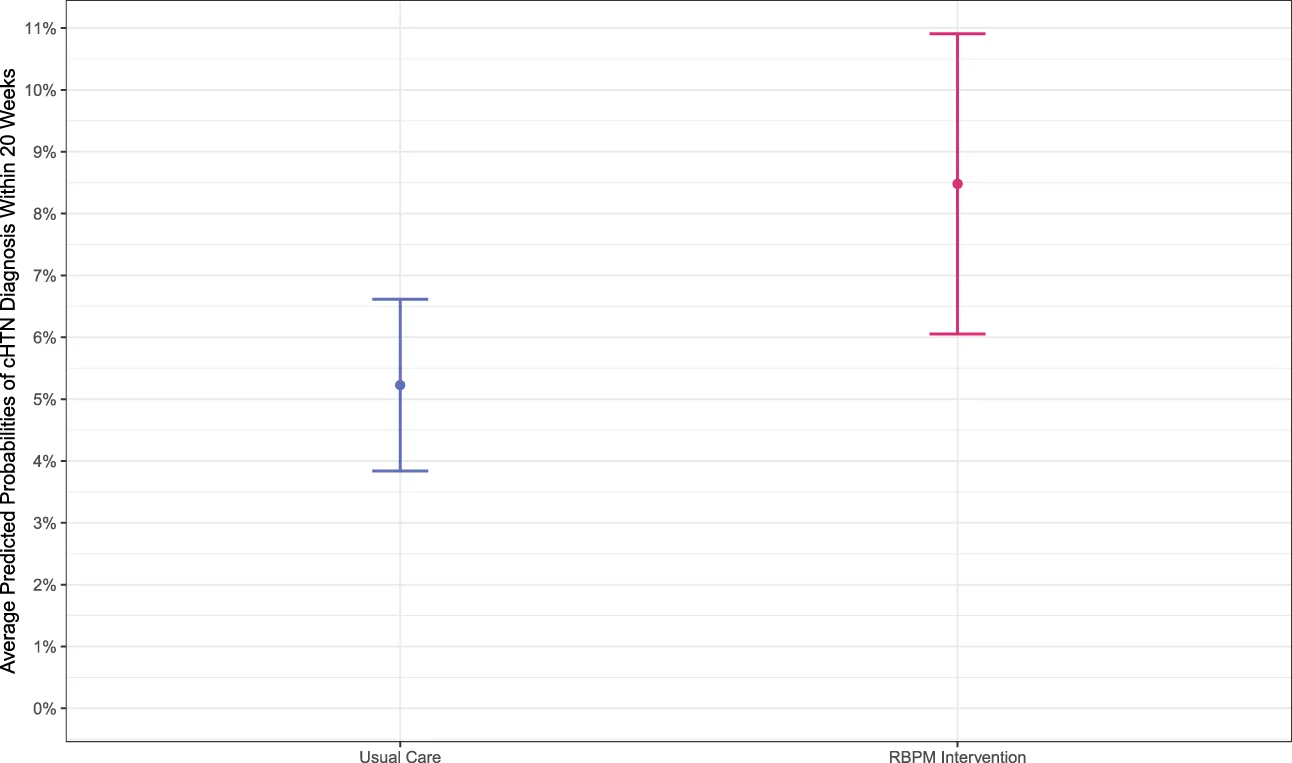
OBJECTIVE: To evaluate whether universal enrollment in a prenatal remote blood pressure (BP) monitoring program initiated at the first prenatal visit is associated with higher rates of new chronic hypertension diagnosis before 20 weeks of gestation compared with usual care. METHODS: This was a retrospective cohort study comparing patients enrolled and those not enrolled in the remote BP monitoring intervention between September 2021 and May 2023. Two:one optimal pair propensity score matching balanced nine demographic and clinical covariates between groups. A logistic regression model with remote BP monitoring enrollment as the sole independent variable estimated the odds of chronic hypertension diagnosis within 20 weeks; cluster-robust SEs accounted for within-pair dependence. Odds ratios (ORs) with 95% CIs and average predicted probabilities were reported. RESULTS: Of 3,294 patients initially included (508 remote BP monitoring, 2,786 usual care), 1,521 remained after 2:1 matching (507 remote BP monitoring, 1,014 usual care). Remote BP monitoring patients had 68.0% higher odds of chronic hypertension diagnosis (OR 1.68, 95% CI, 1.10-2.57, P=.017). Predicted probability of chronic hypertension diagnosis was 8.5% (95% CI, 6.1-10.9%) in the remote BP monitoring group versus 5.2% (95% CI, 3.8-6.6%) in usual care. CONCLUSION: Universal prenatal remote BP monitoring is associated with significantly higher odds of chronic hypertension diagnosis before 20 weeks compared with propensity score-matched controls, enabling timely chronic hypertension-specific management.
The paper
MedStar Washington Hospital Center
O&G Open, 13 Oct 2026

